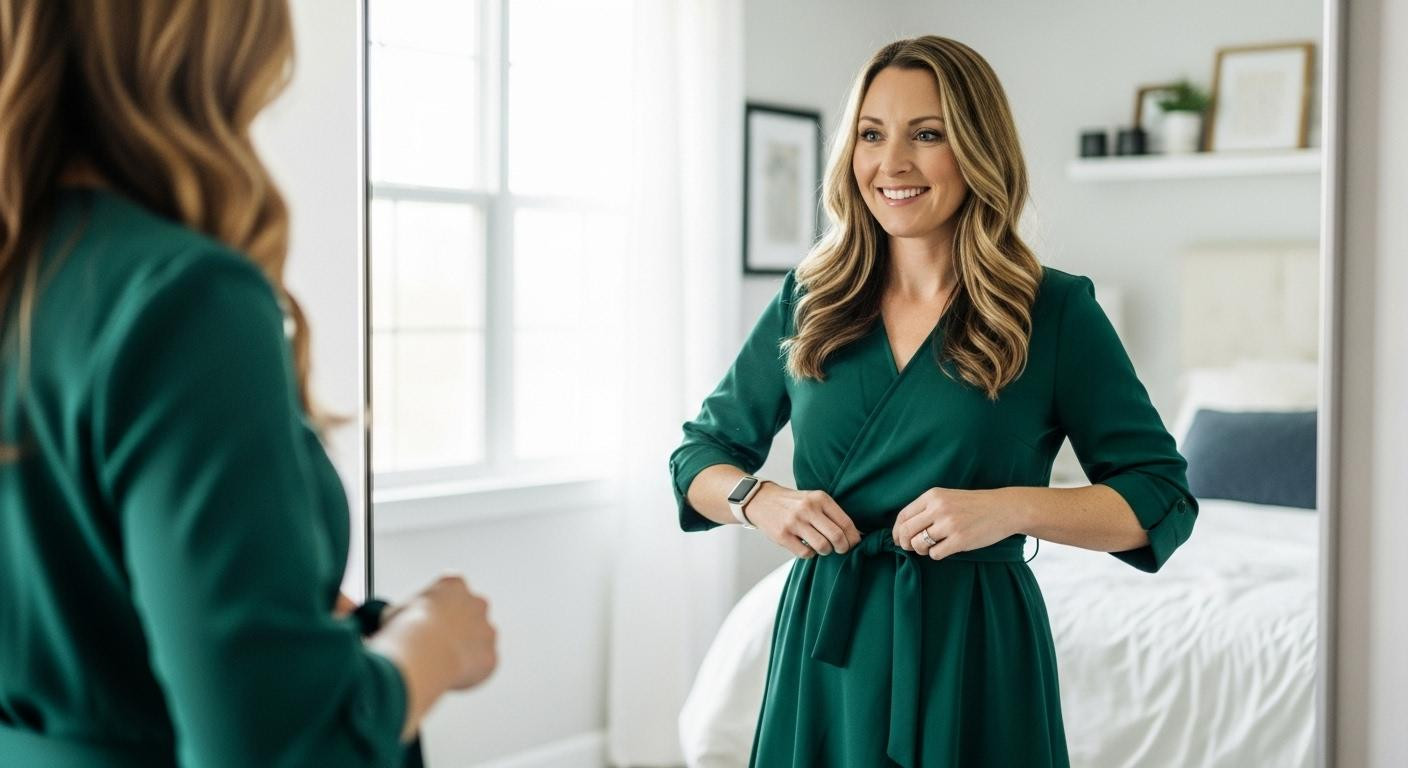
Standing before my bedroom mirror this December morning, I held the $98 wrap dress with tags still attached. Another “flattering for all body types” promise stared back at me. I’d heard this before. But something shifted when I slipped it on and tied the wrap at my waist. My reflection showed something unexpected. I hadn’t lost a single pound, yet my waist looked noticeably smaller. The diagonal fabric lines created an optical illusion that no diet had ever achieved.
The mirror moment that changed my wrap dress skepticism
The jersey knit fabric felt soft against my skin as I adjusted the tie mechanism. My initial doubt melted away as I saw the immediate transformation. The crossover design created definition where none existed moments before. This wasn’t shapewear compression or restrictive tailoring.
Sarah, a 34-year-old customer, noticed her waist looked at least 2 inches smaller the first time she wore a wrap dress. Jessica, 29, felt comfortable all evening at holiday parties while maintaining a sleek silhouette. The XSCAPE model from Macy’s delivered exactly what it promised at $98.
My confidence shifted instantly. This dress worked with my body rather than against it. The strategic clothing choices I’d been seeking suddenly made perfect sense. The question lingered: how does simple fabric wrapping create this effect?
Fashion psychology explains the wrap dress optical illusion
Diagonal lines draw the eye inward
The wrap creates diagonal lines across your torso that guide visual perception toward your natural waist. These lines work differently than vertical elongation or horizontal emphasis. Research from fashion psychology specialists confirms that diagonal crossover patterns sculpt the female form without physical alteration.
A 2024 study involving 300 participants found that 70% of women perceived their waist as slimmer when wearing wrap dresses. The diagonal lines naturally direct attention to the narrowest point of your silhouette.
Fabric overlap creates strategic shadowing
The overlapping fabric layers at your midsection create subtle shadowing that adds depth perception. This makes your waist appear recessed and smaller compared to flat-front designs. Textile science shows that light absorption versus reflection plays a crucial role.
The dimensional effect cannot be replicated by single-layer garments. The strategic layering approach works with natural body contours rather than fighting them.
Why wrap dresses work better than shapewear or peplums
The one-piece slimming solution
Peplum tops require coordination with bottoms and can add unwanted bulk. Shapewear creates compression discomfort and restricts breathing throughout the day. The wrap dress delivers instant shaping in a single garment without these drawbacks.
Stylists specializing in body-flattering fashion confirm that wrap dresses provide effortless waist highlighting without multiple layers. The jersey knit stretch offers 30% improved comfort compared to rigid fabrics while maintaining the slimming effect.
You control the cinch throughout the day
The adjustable tie advantage means you can tighten after meals or loosen for comfort. This customizable approach lets you adapt to different situations without changing clothes. Wardrobe consultants note that this flexibility surpasses fixed waistlines.
Unlike static shapewear solutions, the wrap dress moves with your body. You maintain control over the degree of definition throughout your day.
The $98 sweet spot delivers designer results
Macy’s XSCAPE wrap dress at $98 delivers the same visual effect as $700 designer versions. This represents 85-90% savings while maintaining quality construction. The mid-range price point offers optimal value intersection.
Budget options under $50 often lose shape after washing due to poor fabric recovery. Designer luxury above $700 provides marginal visual improvement with significant brand markup. Winter 2025 saw 18% sales growth in this category as consumers discovered the value proposition.
The jersey knit construction includes reinforced tie mechanisms and colorfast dyes. These quality factors ensure the slimming effect remains consistent through regular wear and washing cycles. Smart shoppers recognize genuine value over brand premiums.
Your questions about wrap dresses for waist slimming answered
Does the wrap dress work for all body types, or just hourglass figures?
Wrap dresses adapt to different body types through tie adjustment positioning. Pear shapes benefit from bust emphasis and hip camouflage via the A-line skirt. Apple shapes use the defined waist as a focal point to balance proportions.
Rectangle shapes create curves through strategic cinching. The fashion institute study included 300 diverse participants with 70% positive response across all body types, not just hourglasses.
How do I prevent the wrap from gaping open during the day?
Choose wrap dresses with inner tie plus outer tie for double security. Select proper sizing that fits snugly but not tightly at the bust. Use fashion tape at bust overlap if needed for additional confidence.
True wrap dresses offer superior adjustability compared to faux-wrap styles with sewn sides. This attention to fit details ensures comfortable wear without wardrobe malfunctions.
Can I wear a wrap dress in winter, or is it only for warm weather?
Winter 2025 trends showcase long-sleeve wrap dresses in jersey knit and velvet fabrics. Layer with tights, knee boots, and structured cardigans for cold weather adaptation. The wrap silhouette works year-round with appropriate fabric choices.
Seasonal layering maintains the slimming effect while providing necessary warmth. The versatile design transitions seamlessly from summer cotton to winter wool blends.
Three weeks later, I stand before that same mirror reaching for my wrap dress without hesitation. The tie slides through my fingers with practiced ease. My reflection shows confident posture, defined waist, and zero self-doubt. Just me, enhanced by strategic fabric engineering.