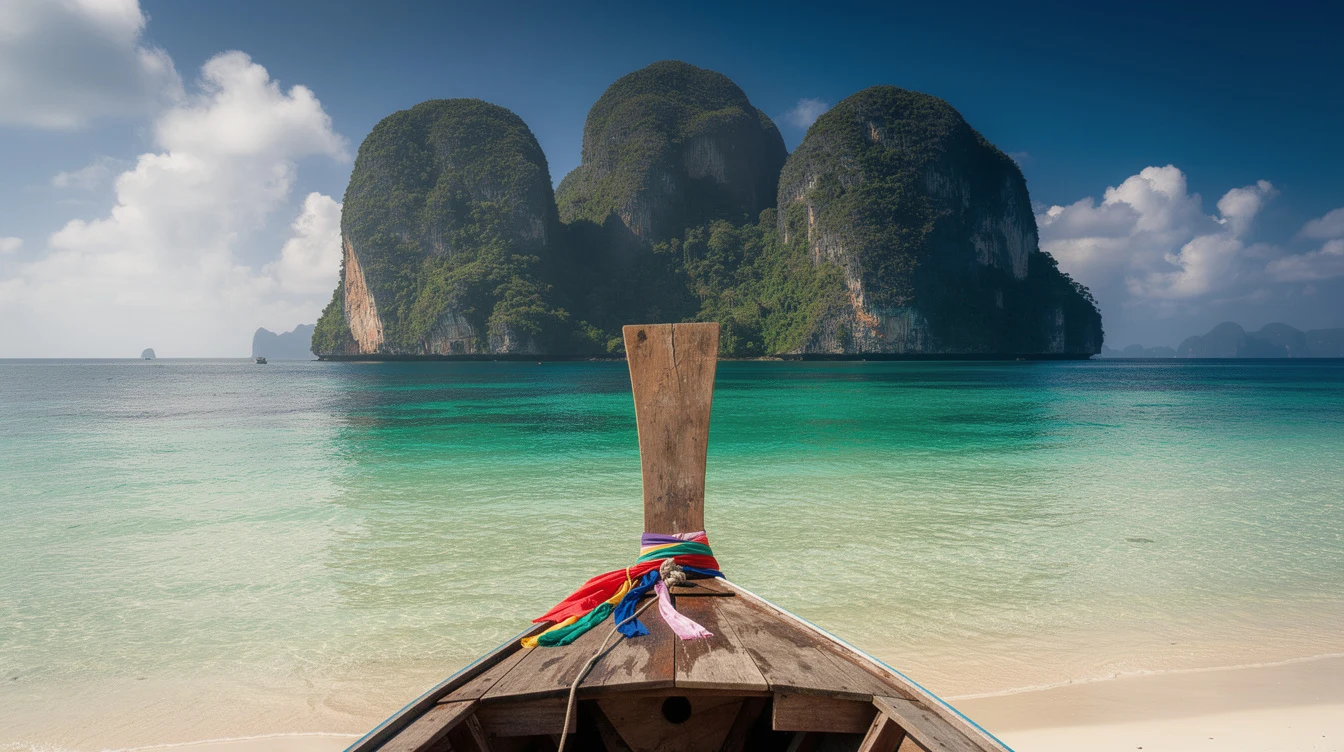
Ko Yao Noi sits 50 minutes by boat from Phuket, but it might as well be a different country. The island has 5,096 residents, 90% of them Muslim, and almost none of the nightlife that draws crowds to Thailand’s mainland beaches. That is the whole point.
The ferry drops you into a quieter rhythm
The longtail boat from Bang Rong Pier costs about 300 THB and takes roughly 50 minutes. You’ll pass the karst towers of Phang Nga Bay, and then the engine cuts. The pier at Ko Yao Noi has no taxi swarm, no bucket-drink vendors, no one pressing a flyer into your hand. A couple of songthaew drivers wait by their trucks. The water laps the stilts. That’s the arrival.
And the quiet is not an accident. The island’s Muslim identity shapes daily life here. Alcohol is scarce. The call to prayer carries across the rice paddies. There are no beach clubs, no fire shows, no Full Moon derivatives. If you want Patong, stay on Phuket.
How do you get around an island with barely any paved roads?
Most visitors rent a scooter or a bicycle. A bike runs about 150 THB per day. The island is only 47 km², with a spine of low hills and simple roads running the perimeter. Some northern tracks stay dirt, so after rain you’ll want to walk or wait. The distances are short enough that slowness becomes the point.
From there, the east coast delivers what you came for. Tha Khao Beach and Pasai Beach face the bay’s limestone sentinels, the same formations that crowd Instagram from Krabi but seen from a near-empty shore. At low tide, a sandbar connects to a small islet off Tha Khao. The light is best at sunrise, and most mornings you’ll share it with two or three people.
North beaches and cave paintings
The northern beaches are wilder and emptier. Little Long Beach often has clear water and no one in it. The trade-off is fewer services, and sometimes no shade. Bring water, because there is no convenience store on every corner here.
Back inland, cave paintings on the island hint at early habitation. The early residents were Moken sea nomads, later joined by groups from the Malay Peninsula. The layered history is present but not packaged. Just the fact that people have been coming here, and choosing to stay, for a very long time.
Can you island-hop without the party boats?
Yes, and it is calmer than the Phuket standard. A private half-day to four islands in Than Bok Khorani National Park runs about 2,500 THB, plus 300 THB entry fee for Hong Island. The stops include Monkey Island, Pakbia, Lao Lading, and the lagoon at Hong. The boats are longtails, not speedboats with 40 seats and a DJ. The pace is snorkel, drift, eat something simple on the boat, repeat.
Other days, you kayak the mangroves, take a Muay Thai class at a small gym, or follow the rubber plantations and rice paddies on a scooter loop. Yoga retreats exist, but they are small-scale, not the industrial wellness of Koh Samui. The Wi-Fi is variable, which is either a warning or a selling point depending on why you came.
Where to stay when “authentic” is the brief
Accommodation splits in two. Simple guesthouses and beach bungalows cluster on the east coast, family-run and basic. Or you can go upscale at places like Koyao Island Resort, where private villas with pools face the same karst view. The price jump is steep, but the setting is shared. Both ends of the spectrum sit on the same quiet shoreline.
For food, small local restaurants dominate. A few spots like Sea Gypsy, Bay View, and Takao Beach add some polish and a view. The cooking is Thai-Muslim style, which means less pork, more seafood, no beer on the table. The flavors are sharp and unfussy. Dinner ends early because nothing opens late, and that is when the island feels most like itself.
Who is this island actually for?
Ko Yao Noi works best for 3-5 days between bigger stops, Bangkok to Phuket to Krabi and back. It is not cheaper than the mainland, and it is not more convenient. The ferry runs twice daily, not on demand. The one restaurant you wanted might close Tuesdays.
But the payoff is real. The beaches empty by late afternoon. The absence of nightlife is not a lack, it is a design. And by the time the last ferry pulls out toward Phuket, the harbor goes quiet, the call to prayer starts again, and the island returns to its 5,096 residents. That is exactly when you understand why they never built the bars.