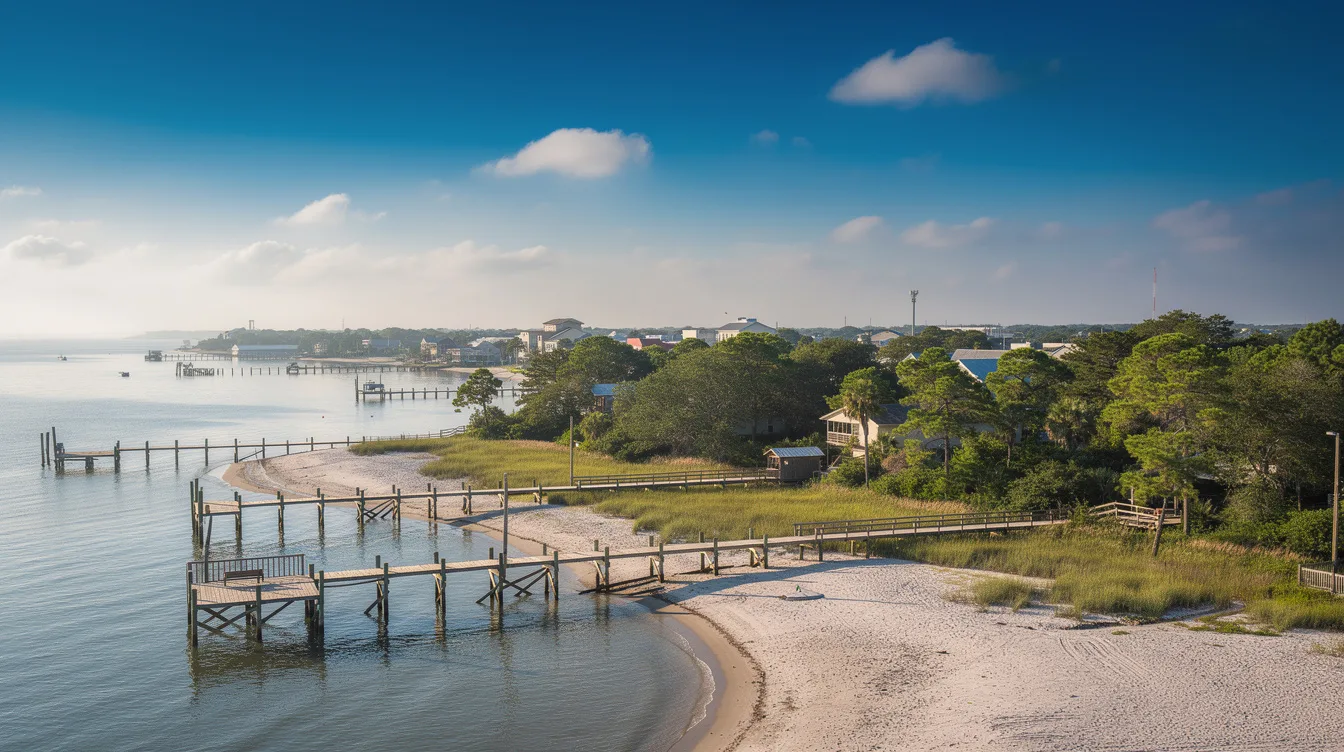
Ocean Springs sits on the Mississippi coast where Fort Maurepas was established in 1699, the first permanent French outpost in French Louisiana. That long view matters here, because this small city has also had to reckon with the force of one terrible modern day.
It is about 2 miles east of Biloxi, across Biloxi Bay in Jackson County. You can arrive for galleries and restaurants, but the stronger reason to stop is the way history keeps surfacing beside the water.
1699 began the French story on Biloxi Bay
Fort Maurepas, also called Old Biloxi, began in April 1699 at present-day Ocean Springs. It was established under French authority as a foothold against Spanish claims, which gives this bay a geopolitical past far larger than its easygoing shoreline suggests.
And that past is not tucked away in a distant museum district. The fort site belongs to the present-day city, so a visit puts colonial French Louisiana and a Gulf Coast town in the same frame.
The settlement remained in place well into the early 18th century. But Ocean Springs did not freeze itself at that moment, which is a relief for travelers who prefer a town with history over a historical set.
Its name came later. The place was briefly called Lynchburg Springs after a post office opened in 1853, then became Ocean Springs in 1854 because local spring waters were believed to have healing qualities.
Downtown rewards a slower afternoon
Today, the city of 18,429 residents has a reputation as an arts community. Its downtown streets are lined with live oaks, galleries, shops, restaurants, and bars, so you can wander without needing to build an itinerary around one headline attraction.
But it is popular, especially as a coastal stop, and that is part of the trade-off. The appeal is concentrated downtown, where the shade of the oaks and the low-key rhythm make an unhurried afternoon feel like the right plan.
There are more than 100 restaurants in Ocean Springs, according to the supplied city description. That is an unusually deep bench for a place of this size, though you should still choose by mood rather than treating dinner as a checklist.
And seafood has been central here from colonial times onward. Shrimp, fish, crabs, and oysters remain available locally, a direct line between the waters around the old fort area and the meals travelers can find today.
Can you pair town time with the national seashore?
Yes. Ocean Springs is the headquarters of Gulf Islands National Seashore, and Davis Bayou forms part of it. The city also includes Weeks, Halstead, Heron, and Davis bayous, which means the watery edge is more than scenery at the end of downtown.
The bayous give the city a quieter counterweight to its restaurant and gallery scene. You may come for the streets and storefronts, then find yourself watching the still water instead, with the air carrying that thick coastal dampness.
28 feet changed the connection to Biloxi
On August 29, 2005, Hurricane Katrina struck the Mississippi Gulf Coast and severely damaged Ocean Springs. Its 28-foot storm surge destroyed the Biloxi Bay Bridge, the crossing that connected Ocean Springs and Biloxi.
That bridge loss made the storm’s scale plain. The surge also destroyed shoreline buildings, including the Ocean Springs Yacht Club and a wooden replica of Fort Maurepas, so the French story itself was caught in Katrina’s damage.
But the city’s history did not end as an artifact of the storm. Reenactments still depict the 1699 landing near a replica of Fort Maurepas, connecting the original settlement story to a coast that has repeatedly had to rebuild.
The new bridge had six lanes, though recovery arrived in stages. Two lanes opened on November 1, 2007, restoring part of the link across Biloxi Bay before construction was fully completed in April 2008.
Go in spring or fall, and let the weather set the pace
Spring and fall are the sensible choices. Ocean Springs has a subtropical climate, and summers are consistently hot and humid, with afternoon and evening thunderstorms that can bring torrential downpours.
And those storms usually do not last long, though they can be strong. You will enjoy a walkable day more in the cool-to-warm conditions typical of spring or autumn, when the coast feels less like a test of endurance.
Winter can be warm, but cool spells bring unexpectedly chilly northerly dry winds. The weather shifts, which is why Ocean Springs is better approached as a place to linger and adjust than one to rush through on a rigid schedule.
By the bay, the town’s French beginning and Katrina’s 28 feet are never far apart. The bridge carries people across the water again, while the live oaks keep their shade over downtown.