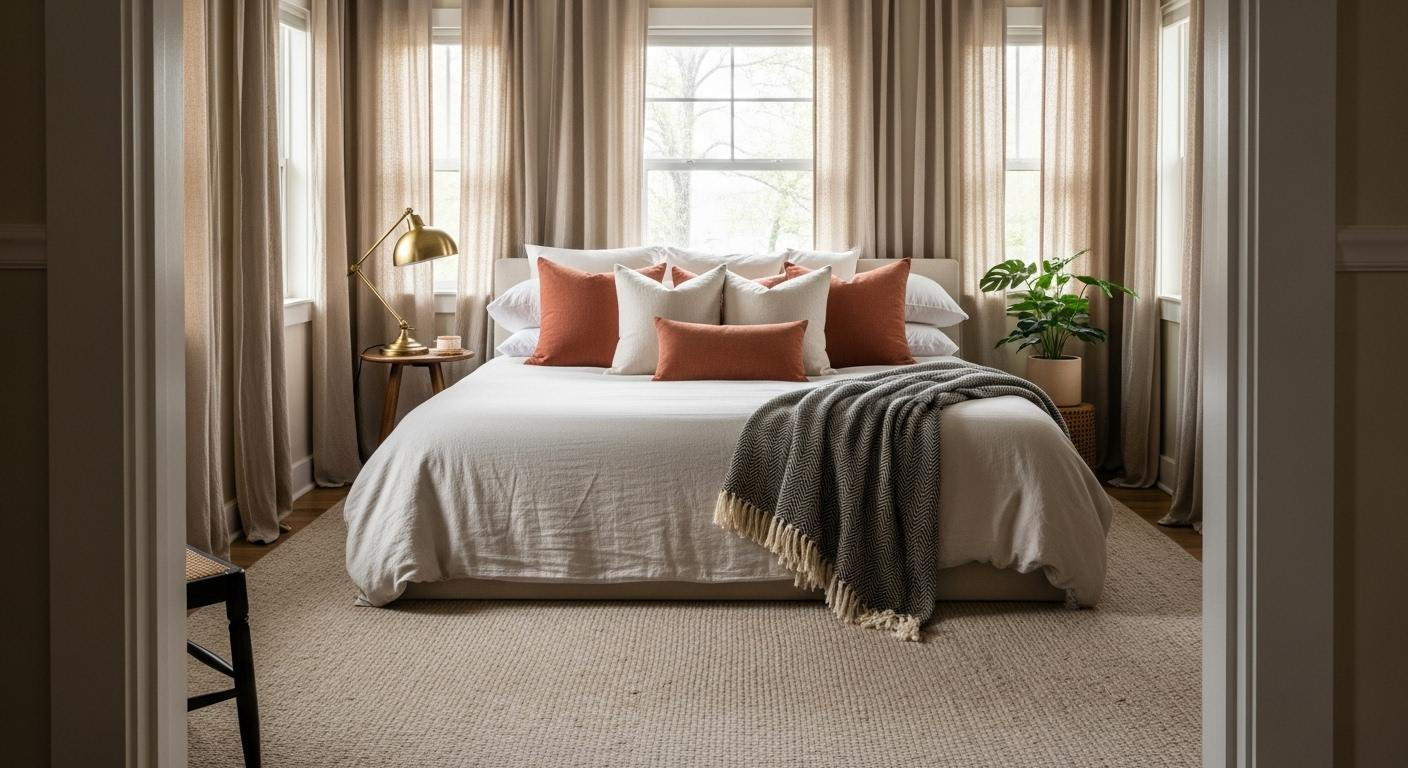
You’ve stripped your 90 square foot bedroom down three times this winter. The throw pillows disappeared into storage. That textured rug sits rolled in the closet. The room feels emptier, colder, somehow smaller than before. Interior designers creating 2026’s most-saved cozy tiny rooms use the opposite approach. Strategic layering tricks the eye into seeing more space while creating tactile warmth. Four specific texture layers transform cramped boxes into enveloping retreats for $200 to $500, with Pinterest’s 4.7 million cozy nook saves proving the formula works.
Why the empty equals bigger rule fails in tiny rooms
The minimalist dogma collapses in spaces under 100 square feet. According to design professionals featured in home publications, the shift to textured designs with warmer colors overtakes bland, cold spaces for good reason. White walls plus empty floors create harsh light bounce and acoustic echo in confined areas. Hard surfaces amplify stress indicators in psychological studies. The sterile box reads as unfinished, not spacious.
Soft textiles diffuse light completely differently. Design experts specializing in small spaces note that mid-tones and texture soften acoustics naturally. Fabrics absorb sound waves that tile and glass reflect endlessly. The eye scans slowly across layered surfaces instead of racing across blank walls. Perceived spaciousness comes from visual interest, not vacancy. A tiny room needs texture to feel intentional rather than empty.
The four texture layers that create cozy without shrinking space
Professional organizers with small-space portfolios confirm one principle guides every transformation. Maximizing every inch without feeling boxed in requires specific layering, not random accumulation. These four elements work together systematically.
Layer one: vertical softness through canopy or tall drapes
Floor-to-ceiling fabric panels draw eyes upward in 8 to 9 foot ceiling heights. Interior designers featured in shelter publications note that lush drapery creates a cocoon-like environment immediately. The vertical lines elongate perceived room height through basic visual psychology. Soft fabric breaks harsh overhead light into gentle diffusion.
Budget options deliver impact without investment pain. IKEA sheer panels cost $20 to $40 and mount via tension rods for renters. West Elm linen drapes run $80 to $120 for mid-range quality. Restoration Hardware Belgian linen reaches $150 to $300 for luxury feel. The transformation happens regardless of price point when fabric pools slightly at floor level.
Layer two: grounding texture through oversized rugs
The small rug myth dies here. Design professionals confirm that rugs covering 80 to 90 percent of floor space unify tiny rooms instead of fragmenting them. A 6×9 foot or 8×10 foot rug anchors a 90 to 120 square foot room completely. Visual clutter disappears when floor and furniture contrast reduces.
Material selection determines warmth perception directly. Wool ranks highest for cozy factor, followed by faux sheepskin, then jute, with synthetic trailing. Texture type impacts thermal sensation through tactile association alone. Target faux sheepskin costs $30 to $50 for budget builds. Nordic Knots wool Berber runs $300 to $500 but lasts decades. The investment pays through daily foot contact.
Layers three and four: pillow scale play and warm light zones
Layer three: varied pillow geometry not quantity
More pillows create clutter traps in confined spaces. The technique requires three pillows in graduated sizes instead. Professional stylists recommend 22-inch Euro shams, 18-inch standard squares, and 14-inch lumbar pillows for depth perspective. Size variation creates visual complexity without pile-up chaos.
Micro-prints add detail without pattern overwhelm in tight quarters. Design experts note that warm clays and muted greens keep layers cohesive across multiple textures. Target pillow covers cost $10 to $20 for budget rooms. Pottery Barn micro-prints run $40 to $60 for mid-range. Limit color families to two or three maximum for tonal harmony that prevents visual fragmentation.
Layer four: layered lighting goodbye overhead glare
Single ceiling fixtures shrink rooms through harsh shadow creation. Lighting designers with residential portfolios recommend 2,200K to 2,700K bulb temperatures for warmth perception. Multiple sources at 50 to 100 lumens per square foot eliminate the shadows that make walls feel closer.
Two to three lamps suggest distinct zones in one room. Strategic light placement expands perceived square footage through visual separation. Target antique-style lamps cost $40 to $60 for instant vintage warmth. West Elm brass floor lamps run $150 to $200 for modern elegance. The glow pockets create intimacy without claustrophobia when placed at varying heights.
The spatial paradox: how full reads as bigger
Design psychology reveals counter-intuitive truth about tiny spaces. Curated abundance signals intentional design that reads as high-status curation. Emptiness registers as unfinished or lacking resources in our subconscious pattern recognition. Gallery consultants note that creativity around layered elements re-energizes spaces through visual storytelling.
Compare the scenarios directly. A bare 100 square foot bedroom gets visually scanned in two seconds flat. The eye finds nothing to pause upon, making the space feel small through instant comprehension. A layered bedroom creates textural stops that slow the visual journey across the same square footage. Longer scanning time translates to perceived spaciousness through engagement duration. Your tiny room isn’t too small for coziness. It’s been starving for the right layers all along.
Your questions about how to make a tiny room incredibly cozy answered
Will adding texture layers make my small room feel cluttered?
Clutter comes from visual chaos through mismatched items competing for attention. These layers use tonal cohesion with warm neutrals limited to two or three color families maximum. The result delivers richness without mess through intentional scale variation. Professional organizers confirm that discipline prevents actual clutter when you edit down to exactly four layers. The key lies in strategic selection rather than random accumulation of soft goods.
What if my rental doesn’t allow drapes or wall changes?
Freestanding solutions bypass landlord restrictions completely. Tension rods install without holes for sheer panels. Removable wallpaper panels create texture for $30 to $50 per panel without damage. Oversized floor plants substitute vertical softness through natural height. Budget transformations run $150 to $250 using portable elements. Plug-in sconces and floor lamps avoid electrical work entirely. Your deposit stays protected while achieving the same layered warmth through strategic product selection.
Can I do this on a 200 dollar budget without looking cheap?
The expensive look comes from layering technique rather than price tags. IKEA sheers cost $40, Amazon faux sheepskin rugs run $100, Target lamps sell for $50, and thrifted pillow covers cost $10 for a total $200 transformation. Mix one higher-end piece with budget finds intentionally. One West Elm pillow plus two Target versions reads as curated curation instead of uniform cheapness. The visual impact derives from texture variety and tonal harmony, not individual item costs.
Your fingertips graze the linen drape pooling at your bedroom corner now. You sink barefoot into the faux sheepskin rug as warm lamp glow catches textured pillows at perfect angles. The same 85 square feet surrounds you. Different physics entirely. The room doesn’t feel bigger through measurement. It feels like it’s holding you.