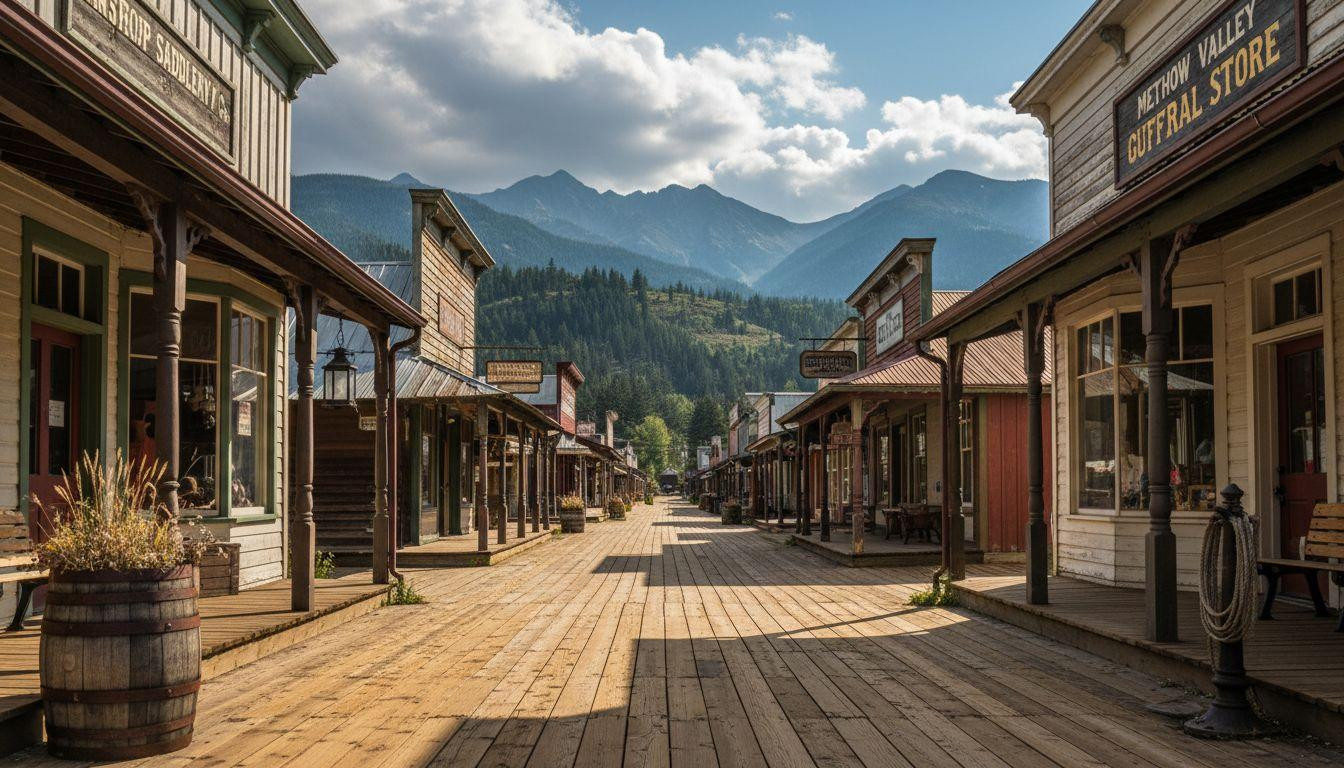
This Washington town echoes with frontier boardwalks where 500 residents keep 1890s mining heritage alive on authentic wooden planks. Four hours northeast of Seattle, Winthrop preserves genuine Western character without theme park artifice. The Methow River runs crystal clear through town while cross-country ski trails stretch 120 miles into winter silence.
Wooden boardwalks line the main street with weathered timber that creaks underfoot. These aren’t replicas. Built in 1971-1972 using rough-sawn Douglas fir, they replaced concrete sidewalks while maintaining human-scale frontier proportions.
Local businesses operate from structures designed to evoke 1850s storefronts. The Winthrop Emporium rebuilt after a 1993 fire maintains period authenticity through strict preservation ordinances.
Where wooden boardwalks tell frontier stories
Morning light illuminates golden timber planks that stretch two blocks through downtown. Footsteps resonate authentically on full-dimensional hemlock lumber treated for weather resistance. The acoustic quality differs from concrete – each step announces your presence with frontier authority.
Canopies and porches connect buildings in continuous Western architecture. Design review boards enforce 1850-1900 aesthetics, banning glossy paint and modern nails. The gold rush authenticity extends beyond surface decoration into functional commercial space.
Unlike theme parks, these boardwalks serve genuine business purposes. Purple Sage Gallery showcases regional artisan work. Glassblowers and ironworkers operate studios along the wooden walkways.
The mining heritage that never left
From gold rush settlement to cross-country ski capital
Gold rush activity began in 1883 when settlers established trading posts at the Methow-Chewuch confluence. The townsite was platted in 1897 and approved in 1901. Mining, orchards, and sawmills drove the early economy through river and road access.
Twenty-two buildings received Western facades during the 1972 Westernization project. Many combine period fronts with modern interiors. The transformation avoided theme park development while preserving frontier character through careful architectural controls.
Shafer historical museum’s living archive
The Shafer Historical Museum occupies the 1891 “Waring Castle” home of original settler families. Period machinery includes ore stamps and shaker tables from local mining operations. Museum exhibits demonstrate Methow Valley history through authentic artifacts rather than recreations.
Tours operate seasonally on Saturday mornings during summer months. Admission operates on donation basis. The museum preserves mining equipment from exploratory and production shafts that shaped the town’s founding era.
Four seasons in frontier quiet
Winter’s 120-mile ski network
The Methow Trail System features the largest network of cross-country ski trails in the Western Hemisphere. January 2026 conditions provide optimal groomed trails with clear Eastern Washington skies. Current temperatures range 20-35°F with heavy snow coverage ideal for Nordic skiing.
Cross-country culture shapes community identity rather than serving casual tourism. Trail passes are required for winter access. Winter recreation infrastructure supports serious outdoor enthusiasts seeking uncrowded mountain access.
Summer’s golden larch and river culture
Fall transforms surrounding Okanogan National Forest into golden larch displays. The Methow River maintains unusual clarity for alpine systems, supporting robust fishing and floating culture. Pearrygin Lake State Park sits 4 miles from town with swimming and boating access.
Summer events include the Winthrop Rhythm & Blues Festival in July and Methow Valley Rodeo on Memorial and Labor Day weekends. The town’s elevation at 1,800 feet creates warm days with cool evenings throughout summer months.
Authentic mountain town experience
Population under 500 creates genuine quietness rather than manufactured solitude. Hiking boots and technical wear serve as standard attire year-round. Local customs embrace Western heritage identity without theatrical performance.
The town consciously avoided commercialized resort development while maintaining historic character. Authentic mountain communities like Winthrop offer alternatives to celebrity-focused destinations like Aspen or luxury-oriented Lake Tahoe developments.
Casual outdoor culture dominates social interaction. Residents embrace frontier aesthetics as living heritage rather than tourism marketing. The atmosphere feels unhurried and timeless according to visitor feedback.
Your questions about Winthrop answered
How do I get there from Seattle?
Drive 225 miles northeast via I-90 east to Highway 97 north, then Highway 20 east into the Methow Valley. The route takes 4-4.5 hours by car. Note that North Cascades Highway 20 closes seasonally from late November to early May, requiring alternate routing through Highway 97.
What’s the best time to visit?
December-February offers peak cross-country skiing with optimal groomed trail conditions. Late June-September provides all-season outdoor access when Highway 20 opens fully. March features the Winthrop Balloon Roundup, a three-day hot-air balloon festival coinciding with winter recreation opportunities.
How does it compare to Colorado ski towns?
Winthrop offers dramatically fewer crowds than Aspen or Telluride with lodging costs ranging $80-200/night versus $300+ in Colorado resort areas. The town emphasizes cross-country skiing over alpine resorts, creating more authentic outdoor culture. Pacific Northwest mountain access provides closer proximity to Seattle than Colorado destinations.
January afternoon light touches weathered boardwalk timber while the Methow River flows clear beneath winter silence. Steam rises from coffee cups in frontier storefronts where 1890s authenticity meets modern mountain culture.