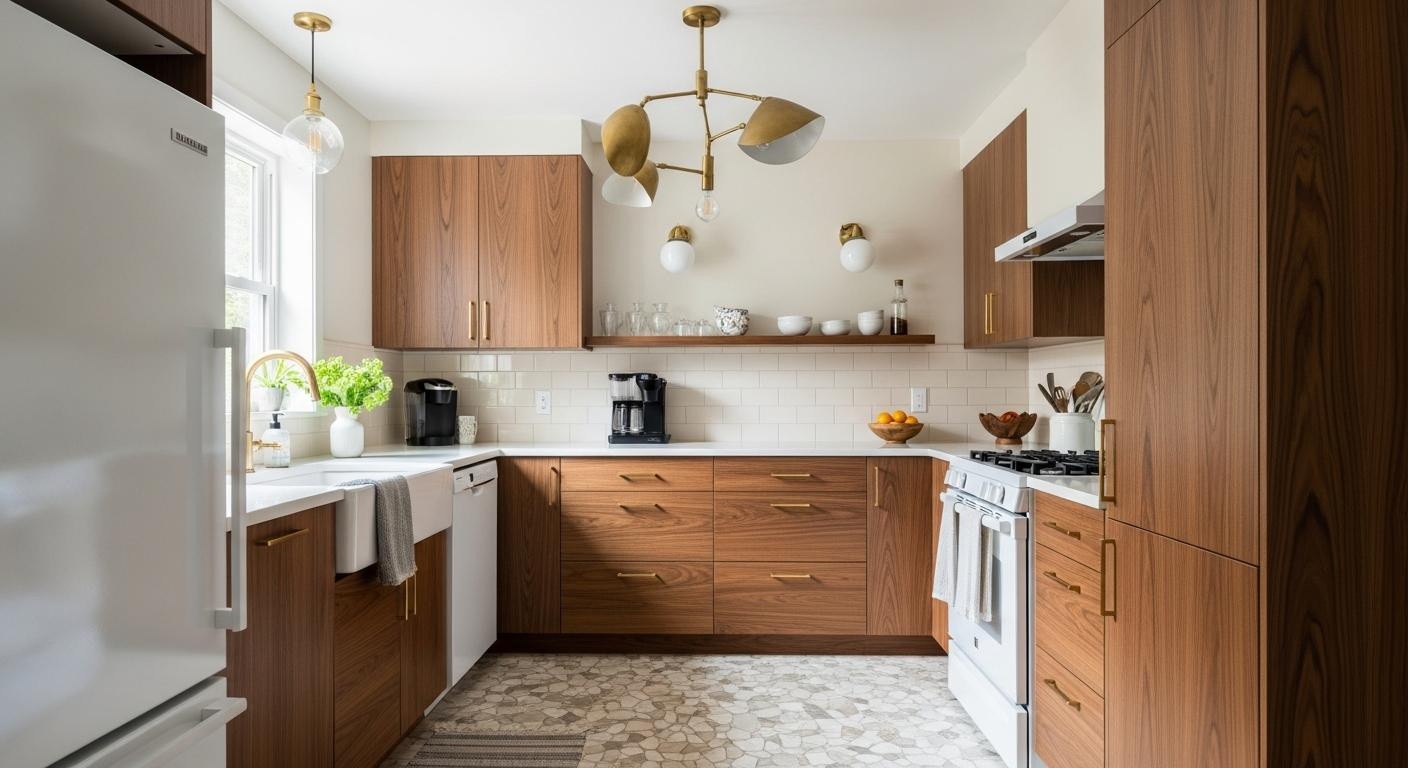
The kitchen measured 62 square feet with one north-facing window. Oak cabinets from 1987 turned amber under fluorescent strips humming at 8:15am on a Tuesday. Laminate counters peeled at the seams where water pooled near the sink.
For eleven months, mornings started in a space that felt more like a closet than a room you’d want to linger in. Then a $2,847 budget and two weekends changed how light moved through the room. Rift-cut walnut veneer replaced the oak. Tumbled limestone went underfoot.
A single sculptural pendant replaced the fluorescent box. The walls stayed beige but the room stopped feeling temporary.
The three materials that absorbed light instead of reflecting it back cold
Walnut veneer cabinets cost $890 at IKEA and made mornings feel 12 degrees warmer, at least perceptually. The SEKTION handleless fronts in walnut finish replaced eight feet of upper cabinets and six feet of lower storage over one Saturday. Running a palm across the matte surface, you could feel the difference from oak’s reflective polyurethane coating.
The walnut grain breaks up light patterns, creating shadows that read as depth instead of flatness. That’s the shift that makes warm wood tones like smoke-toned walnut work in tiny kitchens where every surface counts. And it’s not just visual. The texture absorbs morning light through the wood grain instead of bouncing it back harsh and cold.
Tumbled limestone floor at $620 added texture the fluorescent light couldn’t flatten. The 12×12 mosaic sheets from Floor & Decor went down over one Sunday, each stone sitting slightly uneven to create micro-shadows. Barefoot at 7:00am, the surface felt cool but intentional, nothing like the vinyl’s flat glare.
Those micro-shadows give the floor dimension under the new pendant’s directional light. But installing it yourself means thin-set under your nails and grout haze for two days. Patterned tile floors with tumbled limestone mosaics solve the visual flatness problem 80s kitchens can’t shake, especially when paired with warm wood overhead.
The lighting swap that cost $340 but changed how the whole room felt
Replacing the fluorescent box with a sculptural brass pendant shifted everything. The $340 fixture from Schoolhouse Electric hangs 18 inches across with hammered brass that catches afternoon light differently than the 4-foot fluorescent strip ever did. Installation took two hours on a Saturday morning, rewiring the junction box to handle the 100-watt equivalent LED.
Overhead fluorescents cast shadowless light that flattens surfaces. The pendant creates gradients, darker corners, visual breathing room. According to lighting designers with residential portfolios, directional light pooled on textured surfaces like limestone makes small kitchens feel taller by drawing the eye to vertical planes instead of spreading attention evenly across flat expanses.
Admittedly, task lighting suffered near the stove until adding a $47 under-cabinet LED strip. The Philips strip mounted with adhesive under the upper cabinets, set to warm white at 2700K. Chopping vegetables at 6:30pm no longer meant working in your own hand shadow. Layered lighting that makes small spaces feel taller relies on this kind of task-plus-ambient combination, nothing complicated.
The $240 hardware and backsplash details that made builder-grade bones disappear
Brass cabinet pulls at $112 caught light like jewelry. The Rejuvenation knobs cost $14 each for eight pieces in antique brass finish, replacing chrome from 1987. Holding one in your hand, the weight feels deliberate, and after two months a patina started developing near the stove where oils from cooking landed on the metal.
Brass reflects warm yellow tones that amplify the walnut. Chrome bounced blue-white that made everything feel institutional, even on sunny mornings. That’s the kind of detail that quietly changes the whole mood without announcing itself.
Peel-and-stick subway tile at $128 warmed the backsplash in three hours. The Smart Tiles sheets covered 10 square feet of original white ceramic in cream with beveled edges. Installation over a Saturday afternoon meant cutting around outlets with a box cutter and pressing tiles firm enough to stick but not so hard the adhesive squished out the sides.
The cream tiles bridge walnut and limestone, eliminating the stark white contrast that made the walls feel clinical. But they won’t withstand heat directly behind the stove, which means keeping a 6-inch buffer near burners.
What the $2,847 total bought and what it couldn’t fix
The budget broke down to walnut cabinets at $890, limestone floor at $620, pendant at $340, under-cabinet LED at $47, brass pulls at $112, peel-and-stick tile at $128, paint in Sheraton Beige at $68, and caulk, grout, and supplies at $142. Total came to $2,347, leaving a $653 buffer for mistakes that turned into one cracked tile sheet and extra grout.
The appliances stayed white because replacing them would’ve consumed the entire budget. The layout didn’t change, still a galley with 24 inches between counters. The window remained north-facing, limiting natural light to mornings only.
But the room stopped feeling like a cave. Morning coffee at 7:30am now happens in warm light on textured stone, surrounded by wood that ages instead of yellowing. According to design experts featured in residential case studies, 1980s kitchens feel cold primarily because honey-tone oak reflects harsh light, white grout shows every stain, and vinyl flooring creates visual flatness that reads as cheap even when clean.
Your questions about tiny dark 80s kitchen makeovers answered
Can you do this in a rental without losing your deposit?
Some elements reverse cleanly. Peel-and-stick tile comes off with heat from a hair dryer. The pendant requires landlord permission if you’re altering the junction box. Brass pulls leave small holes that spackle covers in ten minutes.
Floor tile and cabinet replacement need approval. The compromise: paint cabinets instead of replacing them for $200 versus $890, or use removable wallpaper for the backsplash at $80 per roll.
Does walnut veneer hold up to kitchen moisture after six months?
After two months, the IKEA melamine core prevents swelling and edge banding protects the veneer at seams. Near the sink, one edge showed slight discoloration where water pooled overnight. Caulking the seam fixed it, and wiping spills within an hour keeps the finish clean.
What if my 80s kitchen is even smaller than 62 square feet?
Under 50 square feet, skip floor tile because the pattern reads too busy in tight quarters. Focus budget on cabinets and lighting instead. Under 40 square feet, consider handleless cabinets only and skip decorative hardware to reduce visual clutter. Sculptural islands that blend into living spaces won’t fit, but a wall-mounted fold-down table at $90 adds prep surface without permanent footprint.
By 8:00am Wednesday, three weeks post-makeover, sun angles through the window differently. Light catches the brass pulls, slides across the limestone’s uneven surface, absorbs into walnut grain. The coffee maker sits on cream tile that doesn’t glare. Bare feet meet cool stone that reads intentional, not cheap.