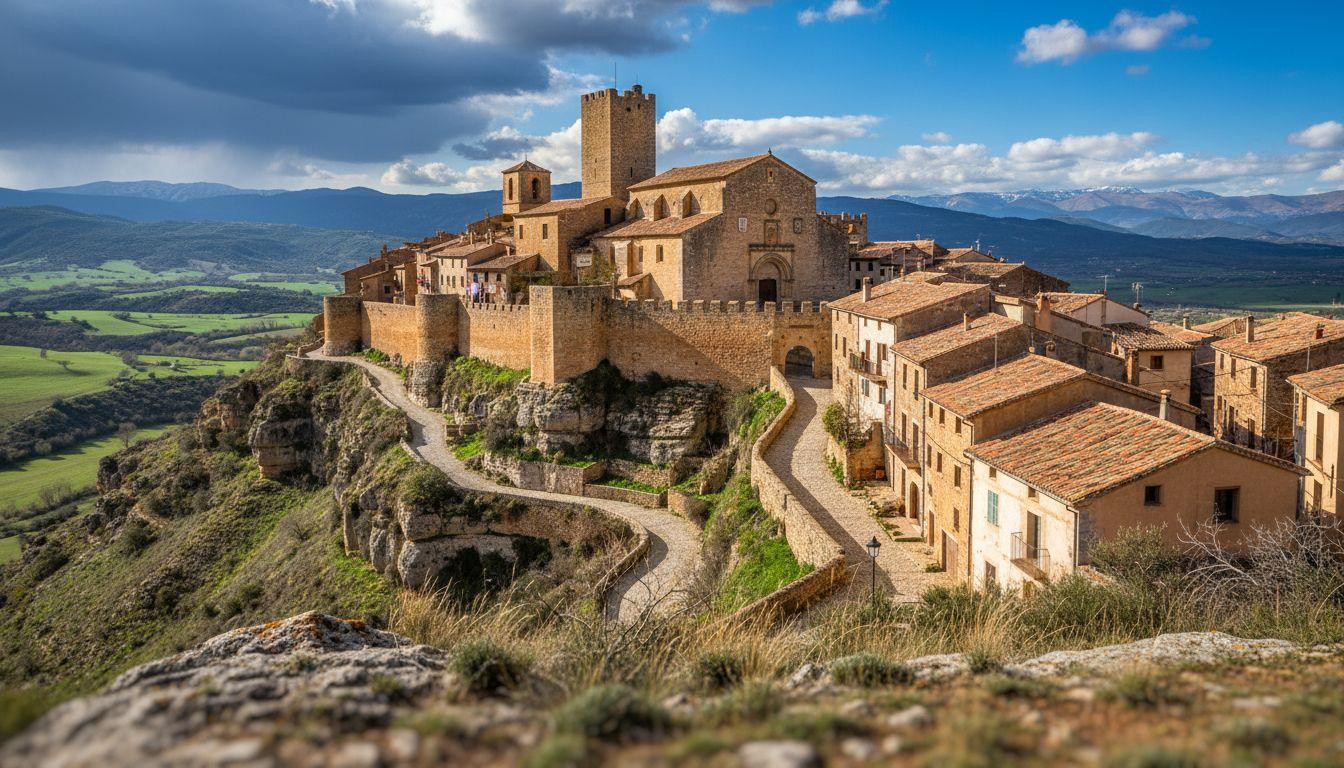
This medieval Spanish village perches on a rocky ridgeline where golden sandstone houses cascade down ancient terraces. Sos del Rey Católico sits at 2,100 feet altitude, its 498 residents preserving centuries of quiet history. Seven fortified gates pierce Gothic walls that once protected a royal secret. On March 10, 1452, Queen Juana Enríquez sought sanctuary here to birth the future Ferdinand II of Aragon. The child born in Sada Palace would unite Spain with Isabella of Castile. Today, visitors climb cobblestone streets where lambs still roam and church bells mark unhurried time.
Where Aragon meets the Pyrenees foothills
The village spreads along a rocky spur 68 miles from Pamplona, commanding valley views toward distant Pyrenees peaks. Winter mist rises from green pastures below while castle walls catch first light at 8:20 AM. The drive from Zaragoza Airport takes 90 minutes through rolling countryside dotted with medieval towers.
Border fortress positioning made Sos del Rey Católico strategically vital between Navarre and Aragon kingdoms. Defensive walls built in the 12th century still encircle the 25-acre historic core. Narrow access roads keep tour buses away, preserving the walking pace that defines daily rhythms here.
The village that raised a king
Ferdinand’s secret birthplace
Sada Palace occupies the village’s highest point, built atop castle ruins from the Reconquest period. Queen Juana fled here during civil war, fearing for her unborn child’s safety. The Gothic structure now houses an interpretive center displaying Ferdinand’s story through audiovisuals and medieval artifacts.
Ferdinand’s baptismal font remains in San Esteban Church, where Romanesque portals frame the entrance. The church crypt reveals 14th-century murals depicting saints and royal heraldry. Visitors trace the same stone steps that led to Spain’s unification in 1479.
Medieval walls frozen in stone
Seven gates pierce the defensive perimeter, each named for destinations they once guarded. The Queen’s Gate displays the most elaborate stonework, with pointed arches and defensive machicolations. Gourdon’s medieval craft traditions echo similar artisan heritage found in Sos’s Jewish Quarter.
The Jewish Quarter surrounds Plaza de la Sarten, where 30 houses show carved crosses from forced conversions. Stone carvings mark converso homes where families adapted to survive. Narrow alleys between houses create intimate spaces unchanged since Ferdinand’s era.
Walking through quiet centuries
Cobblestone rhythms
Morning walks through Plaza Mayor reveal sandstone buildings painted golden by early light. The town hall displays Renaissance facades while family-run shops open unhurriedly around 9 AM. Wrought iron workshops continue traditions passed down through generations of local craftsmen.
Parador Sos del Rey Católico integrates modern comfort within historic walls, offering rooms from $165 nightly. The hotel restaurant serves ternasco asado (roast lamb) for $28, paired with local Somontano wines. Castle viewpoints provide Pyrenees panoramas ideal for winter photography sessions.
Views from the castle
The castle keep rises 164 feet above valley floors, accessible via steep paths winding past ancient foundations. Sunrise illuminates terraced vineyards stretching toward Cinco Villas countryside. Valley mist creates atmospheric conditions perfect for landscape photography between 7:30-9:00 AM.
Artist sundials marking medieval walls inspire similar craftsmanship visible throughout Sos’s historic districts. Winter silence amplifies wind sounds through castle battlements and distant sheep bells from surrounding pastures.
The calm that stays
Annual visitor numbers remain below 5,000, compared to Carcassonne’s 2 million tourists. No parking meters exist within village walls. Local shepherds still drive flocks through cobblestone streets each evening around 6 PM.
Costs stay 25% below Spanish national averages due to rural location and limited tourism infrastructure. Sighișoara’s baroque towers demonstrate similar medieval preservation without mass commercialization. The March Ferdinand festival draws history enthusiasts but avoids overwhelming village capacity.
Your questions about Sos del Rey Católico answered
How do I reach this medieval village?
Fly into Zaragoza Airport (68 miles, 90-minute drive) or Pamplona Airport (50 miles, 75-minute drive). Car rental costs $35-45 daily with full insurance. Bus service from Zaragoza runs twice daily for $12-18 one-way, taking 2.5 hours with transfers.
What’s the best season for visiting?
March 4-13 features the Jornadas Fernandinas festival celebrating Ferdinand’s birth with medieval reenactments and concerts. Spring temperatures range 50-68°F with blooming valleys. Winter offers serene conditions with temperatures 36-50°F, ideal for uncrowded exploration and interior museum visits.
How does it compare to other medieval villages?
Historic towns preserving authenticity share similar appeal, but Sos maintains working village life rather than tourist attraction status. Accommodation costs 40% less than Tuscan hilltowns, with genuine local interactions replacing staged experiences common in restored medieval sites.
Evening light transforms sandstone walls into amber tapestries while sheep bells echo across silent valleys. The castle silhouette cuts against purple sky as village lights twinkle below ancient ramparts.