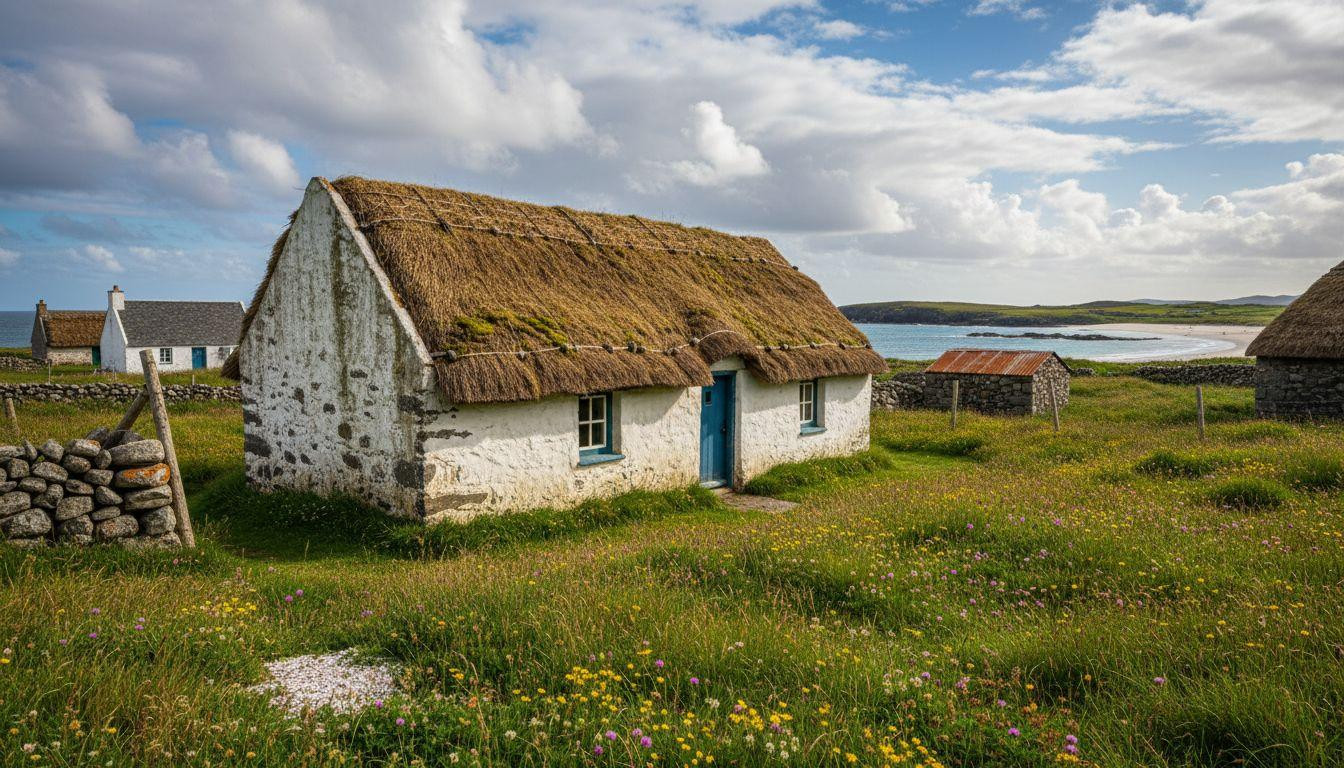
The ferry from Oban rounds Ardnamurchan Point and suddenly the sea appears on both sides. Tiree sits so flat that from the center you watch waves break east and west at once. Whitewashed houses with thatched roofs dot green machair like scattered shells. Population 653. Twelve traditional blackhouses still shelter residents under Atlantic skies where Scotland’s sunniest island keeps Gaelic alive in street names and morning greetings.
This is the island tourists miss while crowding Skye’s peaks. Tiree offers something rarer: living culture without performance, beaches without cafés, silence broken only by sheep and wind.
The land beneath the waves
Tiree’s Gaelic name translates to “land beneath the waves.” The island stretches 12 miles long, 3 miles wide, with Ben Hough topping out at just 390 feet. Stand anywhere inland and the Atlantic fills both horizons. Machair grasslands glow golden-green under light that earned Tiree its reputation: over 300 sunny days annually, more than London, rivaling southern Spain.
This flatness shaped survival. Wind necessitated low-slung blackhouses with walls 5 to 8 feet thick, double-layered stone filled with sand. Roofs curve like upturned boats, thatched with marram grass and secured by ropes weighted with stones. No other Scottish island preserves this many inhabited examples.
Atlantic light, Scottish time
The light here feels different. Winter storms pass quickly, leaving skies scrubbed clean. Summer evenings stretch past 10pm with golden hour lasting two hours. Photographers return for this clarity. Dark skies in winter reveal the Milky Way without light pollution. Balevullin Beach’s turquoise water could pass for Caribbean except for the 50°F temperature and the seals watching from rocks offshore.
Gaelic in the air
About 38% of residents spoke Gaelic in the last census, highest in the Inner Hebrides. Place names stay untranslated: An Sgeirinis for Scarinish, Dùn Mòr Bhalla for the Iron Age broch in Vaul. Locals wave on single-track roads, a ritual called the Tiree Wave. The island runs on unhurried time where ferry schedules bend to cattle sales and weather.
Blackhouses that still breathe
Twelve thatched blackhouses remain, clustered in Vaul, Balemartine, and Scarinish. These aren’t museum pieces. Families live here. Sheds store tools under thatch. The Anchorage in Scarinish rents to visitors who want to sleep under a roof that requires annual maintenance, not just paint.
The architecture tells stories. Thick walls muffle Atlantic gales that hit 60mph in winter. Small windows reduce heat loss. Whitewash comes from burned limpet shells, a centuries-old technique. Thatching involves local marram grass cut from dunes, layered thick, tied down with weighted ropes. One resident described the sound: wind over thatch heard more than over mountains.
Walking among them
Vaul holds several blackhouses within walking distance of Dùn Mòr Bhalla, an intact Iron Age broch. The 2,000-year-old stone fort and the thatched cottages create a timeline you can touch. No ropes, no tickets. Just a path through machair where corncrakes nest in summer and orchids bloom in May.
Heritage beyond museums
An Iodhlann Heritage Centre in Scarinish displays poems, relics, and the story of Skerryvore Lighthouse, Scotland’s tallest at 156 feet, built in 1844 by Alan Stevenson. The exhibits feel personal, curated by islanders who know these histories as family stories. Locals preserve rather than perform. A visitor from Brooklyn who moved here in 2019 noted the difference: people live this culture, they don’t stage it.
Where the ocean finds you
Tiree’s beaches stretch for miles without a single café or rental kiosk. Balevullin Beach, 5 miles from Scarinish, draws surfers for Atlantic swells that peak September through March. Water temperature hovers around 46°F in winter, 59°F in summer. Wetsuits mandatory. Balephuil Beach on the west coast faces open ocean with white sand and turquoise shallows that look tropical until you wade in.
Seals appear year-round, curious and unafraid. Winter brings better sightings when fewer people walk the shores. Birdwatchers come for corncrakes, a species declining elsewhere but thriving in Tiree’s machair. The island’s 1,400 hectares of machair grassland hold Site of Special Scientific Interest status for biodiversity.
Summer’s secret
The Tiree Music Festival arrives each July with the motto “whatever the weather.” About 1,500 people gather for three days of folk, rock, and Gaelic music in fields overlooking the sea. It feels more like a community gathering than a commercial festival. Families camp, locals volunteer, and nobody minds when rain turns the site muddy. Compare this to San Ginesio’s medieval festivals, where tradition shapes celebration.
Winter’s gift
Low season means empty beaches and dramatic storm-watching from Ben Hough’s summit. The 20-mile coastal loop by bike takes 3 to 5 hours with wind as your main companion. Scarinish Lodge serves meals by the fire when gales rattle windows. Photographers chase winter light that turns ordinary scenes cinematic. This quieter Tiree mirrors Kauai’s secluded coves where isolation becomes the attraction.
The quiet you earn
Tiree doesn’t announce itself. The ferry journey from Oban takes 4 hours, sailing past Tobermory and Ardnamurchan Point. Adult return fare runs about $65. Flights from Glasgow land at Tiree Airport three times weekly in winter, daily in summer, costing $130 to $260 return. No bridge connects this island to anywhere.
That distance filters visitors. Annual numbers hover around 15,000, a fraction of Skye’s million-plus. The ratio of tourists to residents stays low, maybe 20 to 1 in summer, far less in winter. This creates space for actual life to continue. Crofters tend cattle. Fishermen work the harbor at dawn. The co-op grocery stocks basics for residents, not souvenirs for tourists.
Bike hire costs about $20 daily. Car rental barely exists on-island; bring one via ferry for $200 to $325 return if you need wheels. Most visitors cycle the flat terrain, stopping wherever turquoise water or a thatched roof catches their eye. No parking fees. No entrance gates. Just machair, sea, and the occasional wave from a passing car.
Your questions about Tiree answered
How do I reach Tiree in 2026?
CalMac ferries depart Oban 3 to 4 times weekly in winter, daily in summer. Book 4 to 6 weeks ahead for peak season. The 4-hour crossing passes through the Sound of Mull. Loganair flies from Glasgow to Tiree Airport, reduced schedule in winter. Drive or bus to Oban from Glasgow takes 2.5 hours. Ferry crossings cancel in storms, common January through March.
Is Gaelic culture still living here?
Yes. About 38% of Tiree’s 653 residents speak Gaelic, the highest percentage in the Inner Hebrides. Place names remain untranslated in daily use. An Iodhlann Heritage Centre documents island history through local voices. The Tiree Music Festival in July celebrates Gaelic music alongside other genres. Visitors encounter Gaelic greetings and signage as part of normal island life, not tourist performance.
How does Tiree compare to Skye?
Skye draws over a million visitors annually with dramatic mountains and higher costs. Tiree sees about 15,000 visitors, stays flat, and runs 20% to 30% cheaper for accommodations and meals. Skye offers more infrastructure and famous landmarks. Tiree provides cultural immersion, empty beaches, and living traditions without crowds. Choose Tiree for authenticity and quiet. Choose Skye for peaks and convenience. Similar contrasts exist between Alonissos’s protected waters and busier Greek islands.
Morning fog lifts around 8am and for maybe ten minutes the whole bay turns gold. Whitewashed blackhouses glow against green machair. The ocean appears on both horizons. A local waves from a passing car. This is Tiree: Scotland’s last island where thatched villages wake to Atlantic light and time moves at the speed of wind over grass.