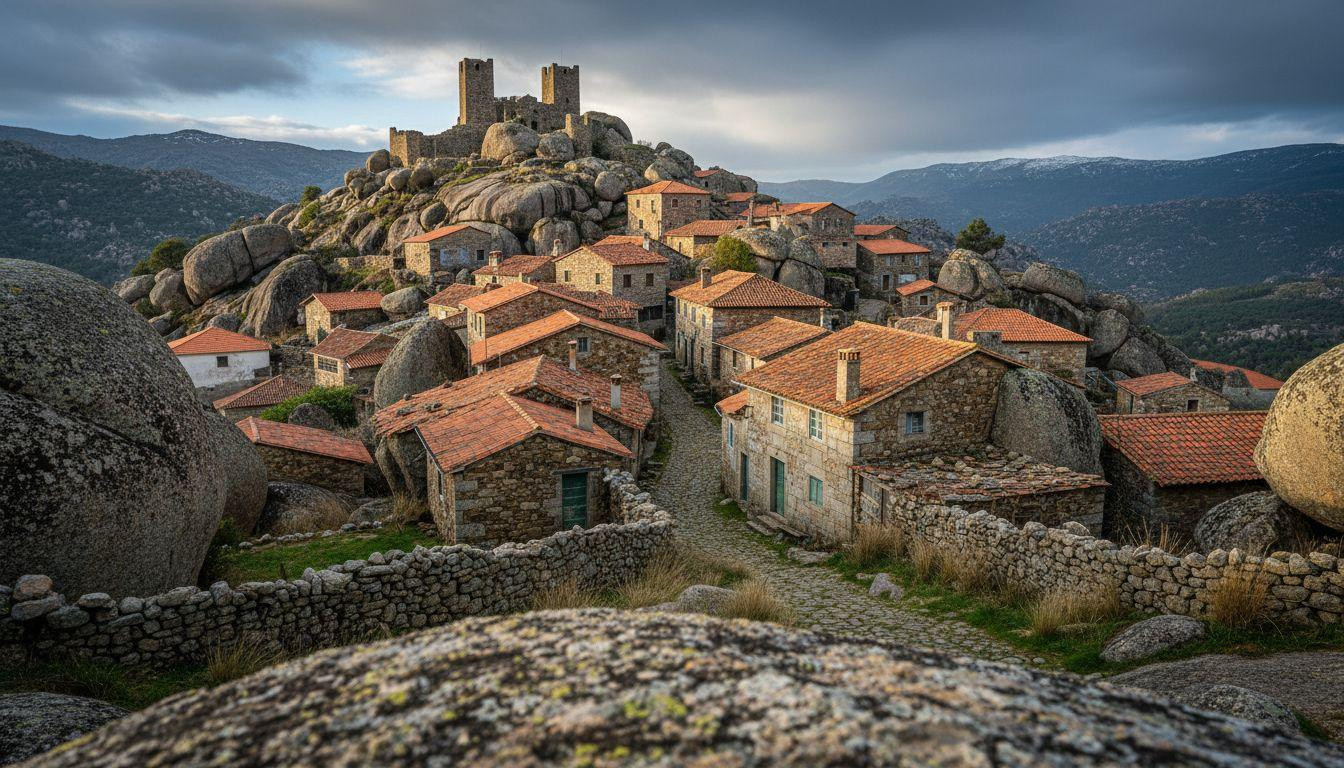
Granite boulders form walls where 300 Portuguese residents live inside medieval rocks. In Linhares da Beira, houses emerge from giant stone formations creating Europe’s most unusual village architecture. Perched at 2,690 feet in Portugal’s Serra da Estrela mountains, this overlooked settlement transforms massive boulders into living spaces.
The village quietly preserves a construction method lost elsewhere. Medieval builders integrated homes directly into granite outcrops, using natural stone as structural walls. Terra-cotta roofs crown these rock dwellings while a 12th-century castle commands the summit.
The geological architecture phenomenon
Massive granite boulders serve as foundation, walls, and sometimes ceilings for approximately 40% of Linhares da Beira’s historic homes. These aren’t houses built near rocks but dwellings carved into and around stone formations weighing hundreds of tons.
The technique dates to the 12th century when King D. Dinis established the fortress. Builders discovered that granite outcrops provided natural insulation and defense. Local tourism boards confirm these rock houses represent ingenious medieval adaptation to Serra da Estrela’s harsh mountain climate.
The castle itself demonstrates this integration. Ancient ramparts follow granite ridges while chambers tunnel through solid stone. From the fortress, panoramic views stretch across valleys where Eguisheim’s medieval circles offer similar preserved medieval charm.
Living inside stone walls
The House of the Jew and granite integration
The village’s most famous dwelling, known as the House of the Jew, showcases a rare Manueline window measuring 5.9 by 3.9 feet. This structure demonstrates how medieval residents carved living spaces directly into boulder formations. Golden-beige granite creates natural walls while families added wooden doors and shutters.
Recent visitor surveys conducted in 2025 reveal travelers spend hours photographing these architectural oddities. The integration appears so seamless that distinguishing natural rock from human construction becomes impossible. Morning light illuminates the interplay between hewn stone and natural granite surfaces.
Medieval mountain adaptation
This construction method provided crucial advantages during Portugal’s turbulent medieval period. Boulder-integrated homes offered natural fortification against attacks while granite’s thermal mass maintained comfortable temperatures year-round. Stone masonry traditions continue today as local craftsmen preserve these techniques.
The village maintains 300 residents who live surrounded by this geological architecture. Unlike Byzantine fortress communities with only 30 inhabitants, Linhares da Beira sustains authentic Portuguese mountain life.
Exploring granite streets and castle views
QR code trail and village walking
A village-wide QR code game launched in April 2024 guides visitors through key architectural points. The interactive system operates in Portuguese, English, and Spanish, revealing historical context at each boulder-house location. Cobblestone streets wind between granite formations creating a natural outdoor museum.
The walk from village center to castle summit covers 500 meters uphill. Comfortable footwear proves essential as uneven granite surfaces and ancient cobbles challenge modern shoes. The 15-minute climb rewards visitors with Serra da Estrela views stretching to snow-capped peaks.
Serra da Estrela cheese and mountain crafts
Local establishments serve traditional mountain fare including roasted goat and Serra da Estrela cheese produced from sheep milk. Family-run restaurants charge $12-18 for typical meals featuring this famous Portuguese cheese. Dining rooms often incorporate natural granite walls continuing the boulder-integration theme.
Artisan workshops demonstrate stone masonry, wood carving, and wool textile production. These crafts connect directly to the village’s geological heritage where mountain villages like Crestet preserve similar traditional techniques.
December mountain atmosphere
Winter temperatures range from 36-50°F while occasional snow dusts the surrounding Serra da Estrela peaks. December mornings bring dramatic mist that envelops boulder-houses creating ethereal photographic conditions. The village receives only 25 daily visitors during winter compared to 200+ in summer months.
Granite stones retain and slowly release heat creating microclimates around rock-integrated homes. Local residents describe how stone walls moderate indoor temperatures naturally. Fresh mountain air carries scents of pine and woodsmoke from hearths built into ancient granite foundations.
The quiet pace contrasts sharply with Portugal’s crowded coastal destinations. Here authentic rural life continues as mountain communities have preserved for centuries.
Your questions about Linhares da Beira answered
How do you reach this granite village?
Drive 93 miles northeast from Porto (2.5 hours) or 155 miles from Lisbon (3.5 hours). The nearest train stations operate in Celorico da Beira (6 miles away) and Guarda (22 miles away). Car rental proves essential as public transportation doesn’t reach the village directly.
When should you visit for optimal conditions?
Spring and autumn mornings offer pleasant temperatures between 50-68°F with minimal crowds. The village’s 2,690-foot elevation creates dramatic morning mist effects during these seasons. December provides winter mountain atmosphere but requires warm clothing for outdoor exploration.
How does this compare to Monsanto’s boulder architecture?
Monsanto features 52 permanent residents with homes built under massive balancing boulders creating more dramatic vertical integration. Linhares da Beira’s 300 residents live in horizontal boulder integration with greater accessibility. Both villages offer authentic granite architecture but Linhares provides more traditional Portuguese village life.
Golden hour light filters through granite streets illuminating red tile roofs and ancient stone doorways. The castle’s silhouette crowns boulder outcrops while mist rises from valleys below. This geological architecture continues sheltering families as it has for eight centuries.