“`html
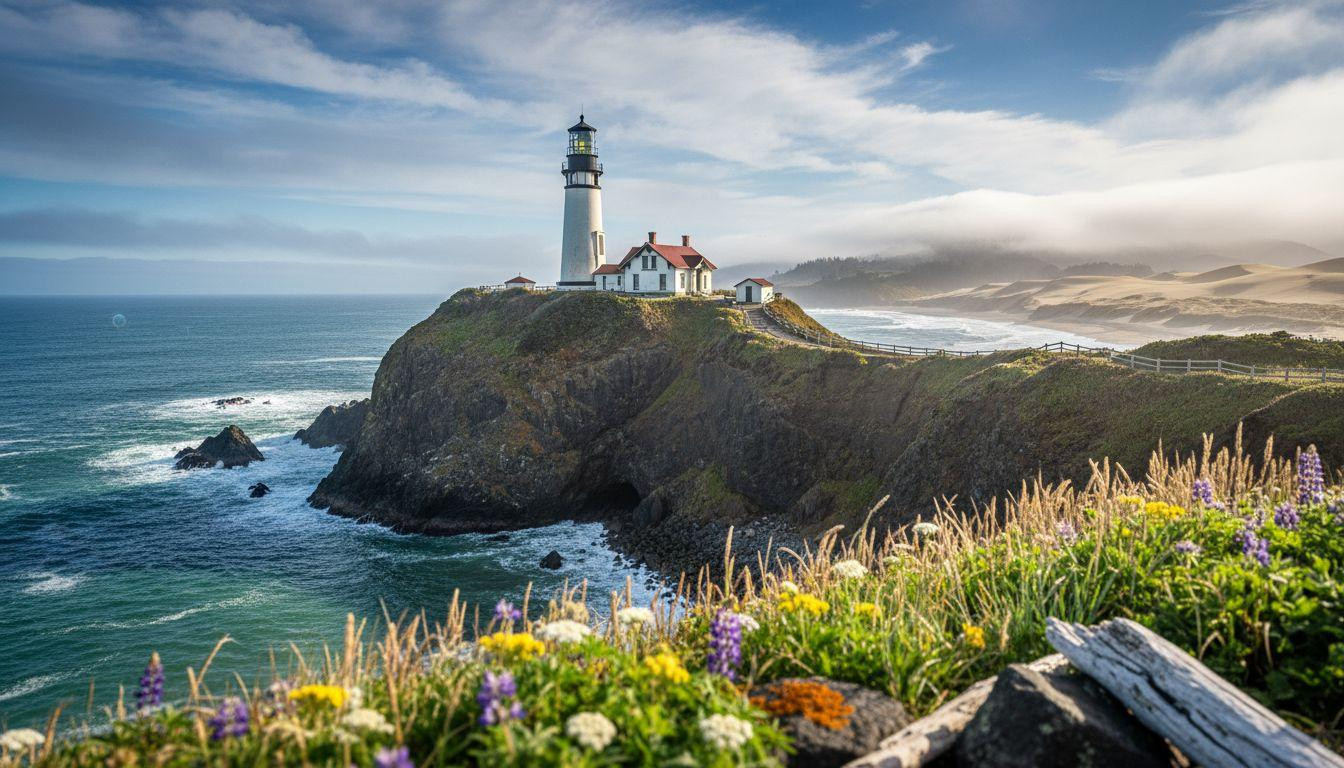
The lighthouse appears at 7:30am, then vanishes. Heavy fog rolls in from the Pacific, turning Heceta Head into a white void where only the beam cuts through. This happens most mornings in February along Oregon’s central coast, 60 miles west of Eugene. The 1894 tower sits on 205-foot basalt cliffs, its foghorn echoing across empty dunes and wild surf below.
Florence draws 500,000 visitors yearly, half the crowds at Cannon Beach. Winter fog keeps it quieter. The wharf, built in 1916 for timber shipping, now hosts crabbers and photographers. Old Town’s boardwalk preserves Victorian storefronts from the logging era. Population 9,500, lodging from $80 per night, meals averaging $15 to $25.
Where the coast disappears
Fog reduces visibility to under two miles most February mornings. The lighthouse keeper’s house, painted red and white, clings to the cliff edge. Marine layers wash over the headland’s west face, creating what locals call “the white silence.” Salt air mixes with mist at 50°F. Wind carries the foghorn’s low blast across 21 miles on clear nights, less when fog thickens.
The phenomenon peaks December through February, with overcast conditions 71% of the time. Sunrise at 7:16am reveals the tower in stages. First the beam, then the lantern room, finally the full structure as fog lifts or thickens again. Photographers arrive early for this sequence. The parking lot fills by 8am even in winter.
Basalt cliffs amplify wave sounds. Surf crashes 200 feet below, muffled by fog but constant. Driftwood piles on narrow beaches, salt-crusted and gray. The Oregon Dunes National Recreation Area stretches 40 miles south, 47,000 acres of windswept sand. In fog, dunes glow golden-white against gray sky.
The lighthouse built for fog
A beacon through 130 years
Construction finished in 1894 after materials were hauled by wagon from Florence, a four-hour trip. The First-order Fresnel lens came from Chance Brothers in England. It still rotates, visible 21 miles offshore. The site earned National Register status in 1978 for its role guiding ships through treacherous coastal waters.
The fog signal building stands separate from the tower. Local tourism boards confirm the foghorn remains one of the loudest on the Oregon coast. It sounds automatically when visibility drops. The keeper’s house operates as a bed and breakfast, rooms starting at $300 per night. Most visitors skip the inn and walk the grounds for free.
What fog reveals
Limited visibility changes perception. The tower becomes a reference point in whiteness. Morning arrivals see the beam first, a shaft of light piercing mist. Then the red roof appears, followed by white walls. For ten minutes, the scene shifts as fog moves. By 9am, either the whole structure emerges or fog thickens again.
A seven-mile trail network connects Heceta Head to Washburne Campground. Switchbacks climb through fog, creating what recent visitor surveys describe as “fairy-tale land” conditions. The trail gains elevation quickly. Steep sections near the lighthouse require caution in dense fog. Photographers note fog adds depth to shots but ruins 95% of attempts with lens droplets.
Twelve miles north of Florence, the site draws fewer tourists than Mendocino’s fog-wrapped bluffs. The experience feels similar to Scotland’s Outer Hebrides, minus the overseas flight. Fog here stems from the headland’s exposure, promoting persistent marine layers through winter.
Walking into white
The wharf in fog
The 1916 wharf sits five miles south of Heceta Head, a 20-minute drive. Pilings from a 1916 storm remain, locals call them “ghost ship” frames. Crabbers arrive before dawn. Dungeness crab season runs through spring, with chowder priced at $12 per bowl at wharf eateries. Surf pounds wooden supports, salt spray coating railings.
A restaurant called Surfside Salt opened in November 2025, focusing on local seafood. The wharf connects to Old Town’s boardwalk via a half-mile walk. Victorian buildings house galleries and cafes. Most stay open through winter, though foot traffic drops to under 20% of summer levels. Fog makes the boardwalk feel timeless, empty except for early risers.
Empty dunes at dawn
Oregon Dunes National Recreation Area spans 47,000 acres along 40 miles of coast. In February, fog turns dunes into a study in gray and gold. Windswept grass marks ridgelines. No footprints disturb the sand before 8am. The area allows hiking and photography, with a $5 day-use fee.
Sand boarding happens year-round but winter crowds stay minimal. Dunes reach 500 feet in height near Florence. Fog obscures distant peaks, creating an enclosed world of sand and mist. The experience compares to quieter Oregon trails that avoid summer rush.
The quiet season
February brings advantages beyond fog aesthetics. Average highs reach 50°F, lows 42°F. Rain probability sits at 51% daily, with 0.5 inches average. Wind speeds range 8 to 15 mph. Daylight lasts 10.5 hours. Lodging costs 30% less than summer, meals run 20% below US coastal averages.
Eugene Airport sits 60 miles east, a one-hour drive. Flights from major cities cost $200 to $400 one-way in winter. Rental cars run $50 per day. Gas for the round trip totals $20 to $30. No train service exists, though Amtrak buses connect from Portland in five to six hours for $50 to $80.
The moderate budget fits Florence’s character. No boutique hotels dominate. The general store sells bait and coffee from the same counter. Razor clam season runs February through April, with harvesting allowed on designated beaches. Gray whales migrate offshore December through February, visible from headlands on clear days between fog banks.
Visitor numbers drop to their lowest December through February. The lighthouse grounds stay accessible, though tower tours depend on weather. Parking lots rarely fill. The wharf sees local crabbers more than tourists. This creates the serene isolation that winter Oregon experiences deliver.
Your questions about Florence answered
When does fog peak at Heceta Head?
December through February sees the heaviest fog, with conditions persisting through mornings. Overcast coverage reaches 71% during these months. Best viewing happens at sunrise, around 7:16am in early February. Fog either lifts by mid-morning or thickens for the day. No pattern guarantees visibility, which adds to the experience.
What makes this different from Cannon Beach?
Florence draws 50% fewer tourists than Cannon Beach, with lodging costing 30% less. Both locations experience coastal fog, but Heceta Head’s elevation and exposure create more dramatic conditions. Cannon Beach sits four hours from Eugene versus one hour for Florence. The wharf and dunes offer experiences Cannon Beach lacks.
Is February worth visiting for fog photography?
Yes, if you accept unpredictability. Fog creates unique shots on lighthouse switchbacks and dune ridgelines. Early mornings provide the best light. Bring lens cloths for mist droplets. Study the rotating beacon timing for night shots. Winter access means fewer people in your frames. Compare this to Maine’s empty winter cliffs for similar conditions.
The ferry back to reality leaves at 4:30pm, metaphorically speaking. Most visitors make it with time to spare. The lighthouse beam cuts through fog one last time as you drive south. White silence follows you down Highway 101, salt air through cracked windows, the coast disappearing behind you.
“`