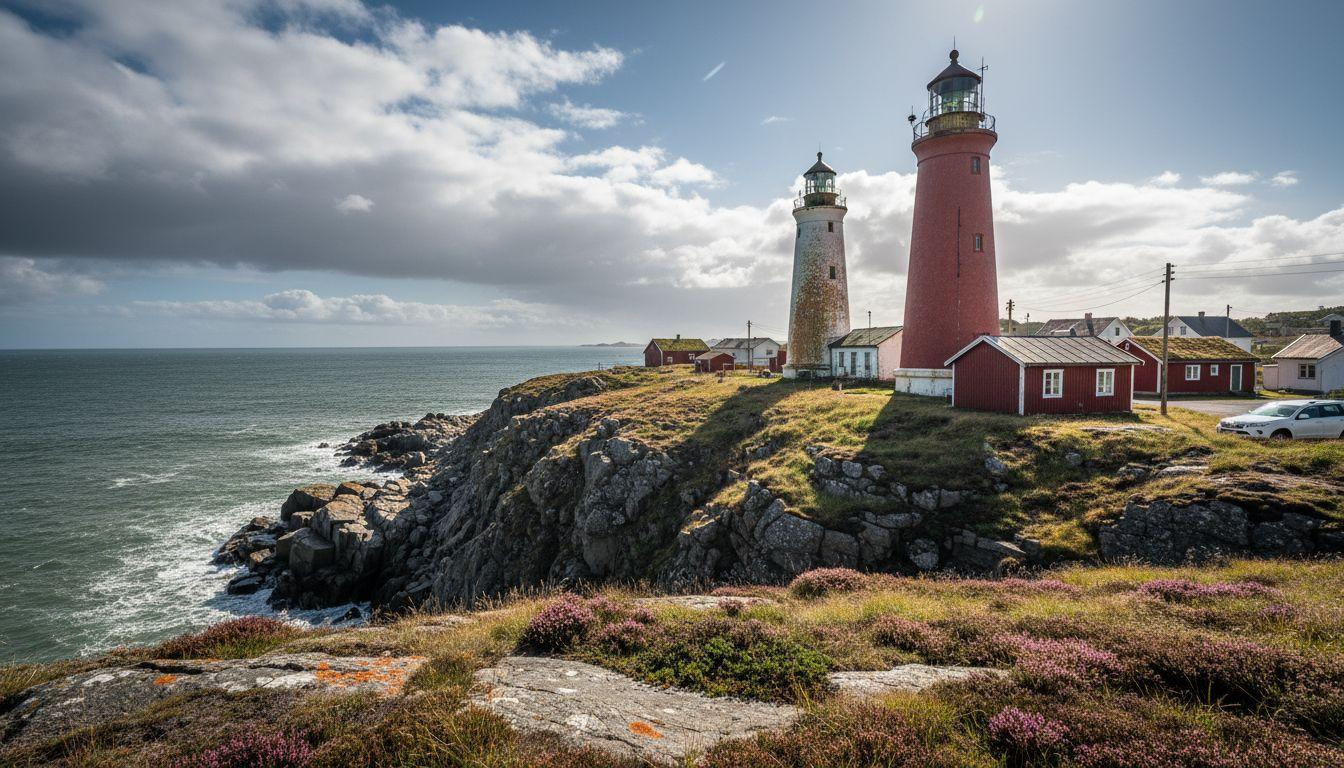
The ferry cuts through North Sea swells as Utsira’s twin lighthouse towers emerge from morning mist. Norway’s smallest municipality sits 11 miles offshore from Haugesund, home to just 207 residents who’ve maintained maritime traditions since 1844. This isolated island preserves the country’s only remaining twin lighthouse, standing 256 feet above churning waters that have guided ships for over 180 years.
Where twin towers mark the North Sea edge
Utsira Lighthouse commands Norway’s highest lighthouse elevation at 256 feet above sea level. The original twin structure was lit on August 15, 1844, designed to distinguish this remote outpost from other coastal beacons. One tower was decommissioned in 1890, but the surviving lighthouse still operates its original lens, flashing three white signals every 60 seconds visible for 26 miles.
The red stone building with white trim houses a first-order Fresnel lens generating 986,200 candela intensity. Weather observations have been recorded here since 1867 for the Norwegian Meteorological Institute. The lighthouse was automated in 1992 and listed as a protected heritage site in 1999.
Few visitors realize that this Croatian island keeps 4 fishermen and zero tourist crowds quiet, offering similar maritime isolation but in warmer Mediterranean waters.
The island that bird migration built
Why 300 species pass through
Over 300 bird species have been recorded on this internationally recognized birdwatching paradise, with 26 extremely rare species documented. Utsira sits at a critical junction in the North Atlantic flyway, serving as a vital stopover point for migrants traveling between Arctic breeding grounds and southern wintering areas.
The island maintains its own bird ringing station for research purposes. Spring and fall migration windows attract serious birders who document rare sightings from designated viewing areas across the windswept heath.
When tradition meets conservation
Åasa Helgesen made history here as Norway’s first female mayor, serving from 1926-1931 and establishing progressive local governance. The fishing community has balanced traditional livelihoods with growing eco-tourism, welcoming visitors without compromising the island’s authentic character.
Local tourism boards confirm that visitor numbers remain deliberately low to protect nesting habitats. The community operates on principles of sustainable access rather than mass tourism development.
Living on Norway’s smallest municipality
What 207 residents preserve
The free ferry from Haugesund requires advance booking but welcomes cars for a fee. The 6-square-mile island remains easily walkable, with distances between key points averaging under 2 miles. Utsira Church, dating to 1785, anchors the small village with maritime-influenced interior design.
Traditional red and white painted wooden houses dot the landscape. The community grocery store serves as an informal social hub where residents and visitors naturally intersect. Bike and canoe rentals operate through community huts, often at no charge.
The lighthouse accommodation experience
Since 2008, one lighthouse keeper’s building serves as tourist accommodation. Cabins range from 2-5 bedrooms with rates starting around $170 per night. Street art murals add unexpected color to quiet village streets, while the pink ‘Nyperosa’ art cabin near the lighthouse offers unique photo opportunities.
The ‘Green Hut’ art installation, constructed from marine debris, symbolizes ocean conservation. Coffee and waffles at the Lighthouse Café provide traditional Norwegian refreshment. Travel research published this year demonstrates that this Greek island glows turquoise where Venetian harbors meet olive silence, presenting a warmer alternative to North Sea isolation.
Standing where North Sea weather begins
Wind exposure creates dramatic conditions year-round. Winter temperatures hover between 32-41°F with strong winds, while summers reach 54-64°F with relatively stable weather. The weather station provides crucial North Sea forecasting data for maritime safety operations.
May through September offers the most reliable ferry service and optimal conditions for wildlife observation. Winter visits reward travelers with profound solitude but limited services. Ferry cancellations occur frequently during rough weather, requiring flexible travel plans.
Those seeking alternatives might consider this Caribbean island that refused cruise ships where 5000 residents keep harbor glass calm for year-round accessibility.
Your questions about Utsira answered
How do I reach Utsira from major cities?
From Stavanger Airport (the nearest major hub), drive 1 hour 45 minutes to Haugesund, then take the 1 hour 10 minute ferry to Utsira. Total journey time: 3 hours 20 minutes. Bergen requires 4 hours 30 minutes via E39. Ferry service operates 3-4 times daily in summer, 1-2 times in winter.
What makes the lighthouse unique?
Utsira preserves Norway’s only remaining twin lighthouse structure, originally designed to distinguish it from other coastal beacons. At 256 feet elevation, it sits higher than any other Norwegian lighthouse. The working lighthouse still uses its 1844 original lens, flashing three white signals every 60 seconds.
Is Utsira worth visiting in winter?
Winter offers complete solitude and dramatic storm-watching from the lighthouse, but ferry service becomes unreliable. Temperatures rarely drop below freezing, but winds intensify. Accommodation and dining options become extremely limited. Summer provides reliable access, active birdlife, and full services, making it ideal for first-time visitors.
For those preferring guaranteed winter warmth, 9 Lehighton experiences where Victorian Christmas meets Blue Mountain powder for half resort prices delivers snowy charm with reliable infrastructure.
Evening light bathes the lighthouse in golden hues as seabirds settle into cliff-side roosts. The beam sweeps across darkening waters, continuing its 180-year vigil over one of Europe’s most isolated communities.