“`html
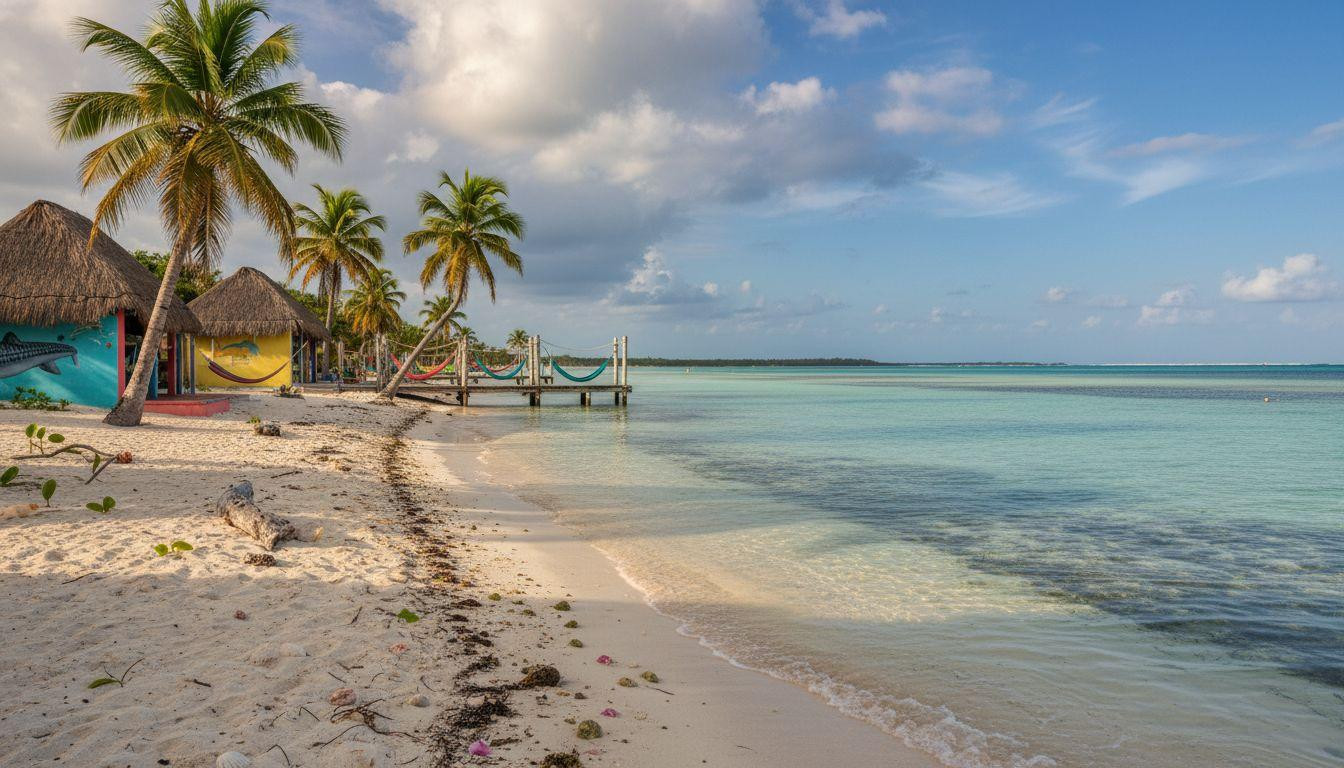
The ferry from Chiquilá takes 20 minutes. You step onto Holbox and the first thing you notice is sand under your feet where pavement should be. No car engines. No asphalt. Just sandy streets the color of pale wheat running between buildings painted Caribbean blue and coral pink. The second thing you notice is the water. Turquoise doesn’t quite cover it. The shallows at Playa Punta Cocos shift through seven distinct shades depending on depth and light, creating a gradient you can walk through for 200 meters without the water reaching your knees.
Where the Gulf meets the Caribbean in sandy streets
Holbox sits at the northern edge of Quintana Roo, inside the Yum Balam Biosphere Reserve. Population 1,200. The island measures 26 miles long, with 22 miles of uninterrupted beach. Cars are banned by law. Transportation happens by foot, bicycle, or golf cart rented for $10-$20 per day.
The town center clusters near the ferry dock. Colorful storefronts line sandy streets. No chain stores. The general store sells fishing bait and fresh coconuts from the same counter. Street art covers walls in murals of flamingos and whale sharks. Everything feels deliberately small scale, as if the island made a choice about what kind of place it wanted to be.
The seven-shade phenomenon at Punta Cocos
Holbox sits where the Caribbean Sea and Gulf of Mexico converge. This creates shallow sandbars extending far from shore. At Playa Punta Cocos, one mile west of town, the water depth changes gradually over hundreds of meters. Each depth reflects light differently, creating visible bands of color from pale turquoise near shore to deeper blue farther out.
What creates the gradient
The sandbar extends nearly 3 kilometers at low tide. Water stays ankle-deep for the first 200 meters. You can walk straight out, watching stingrays glide below and pelicans dive overhead. The sand is white and fine. The water is warm, averaging 77°F in February. No waves. No reef. Just shallow clarity that makes the color gradations visible from the beach.
February timing for best visibility
Winter dry season runs December through March. February brings the clearest skies and lowest rainfall of the year. Temperatures hold steady at 75-82°F. Water visibility peaks because summer’s plankton blooms have faded. Whale shark season ended in September. Bioluminescence won’t return until June. What remains is the water itself, undistracted by other phenomena.
Life at barefoot pace
The island operates on what locals call Holbox time. Breakfast happens when you wake up. Lunch stretches into mid-afternoon. Dinner starts after sunset. No one rushes. The absence of car noise changes the soundscape entirely. You hear waves, wind through palms, bicycle bells, the occasional golf cart puttering past.
Morning routines and beach bars
Dawn sandbar walks happen before 10am, when the light turns the shallows gold. Beach bars open around noon. Las Hamacas suspends hammocks over the water where you can lie for hours watching kitesurfers. A michelada costs $5. Fresh ceviche appears on boat tours to nearby islands, part of the Three Islands excursion that runs $80-$120 per person.
What you eat here
Holbox is a seafood town. Fish tacos cost $2-$3 from street vendors. Octopus preparations dominate restaurant menus, grilled or in broths. The catch arrives daily from local fishermen who unload at the pier each afternoon. Mid-range seafood meals run $8-$15. Upscale restaurants charge $20-$35. Fresh coconut water comes straight from the fruit, $3 at beach stands.
The contrast 140 miles south
Cancún sits 140 miles south, a 2.5-hour journey by car and ferry. The drive from Cancún International Airport to Chiquilá port takes 90 minutes. Private transfers cost $208-$255 one way. The ferry runs hourly. Once you arrive, the difference is immediate. Cancún’s hotel zone charges $200-$400 per night. Holbox’s guesthouses start at $40. Cancún’s beaches pack with tourists. Holbox’s sandbars stay mostly empty, even in February.
Similar to this Yucatán village where freshwater meets the Gulf, Holbox preserves a pace that feels removed from resort development. The island’s car-free policy isn’t a gimmick. It’s structural. No pavement means no cars. No cars means a different rhythm entirely.
Your questions about Holbox answered
How much does a Holbox trip actually cost?
Accommodation ranges from $40 for basic guesthouses to $150 for mid-range hotels. Luxury boutiques charge $200 and up. Street food keeps costs low: tacos $1-$3, full seafood meals $8-$15. Golf cart rental runs $10-$20 daily. The Three Islands boat tour costs $80-$120. Budget travelers can manage $60-$80 per day. Comfort seekers spend $150-$200 daily including lodging.
Is February the right time to visit?
February sits in the dry season sweet spot. Temperatures stay comfortable at 75-82°F. Rainfall drops to near zero. Water clarity peaks for snorkeling and sandbar walks. Crowds are moderate compared to summer’s peak season when whale sharks arrive. Winter delivers the best conditions for experiencing the water gradient without competing phenomena like bioluminescence or wildlife migrations.
How does Holbox compare to Isla Mujeres?
Isla Mujeres is more developed, busier, more expensive. It has paved roads and larger resorts. Holbox keeps its dirt roads and bohemian character. Isla Mujeres attracts day-trippers from Cancún. Holbox requires more commitment to reach, which filters the crowd. Similar to this 15-acre Belize island with private reef access, Holbox rewards travelers seeking quiet over convenience.
The ferry back to Chiquilá leaves at 4:30pm. Most visitors make it with time to spare. The ones who stay longer talk about the morning light on the sandbars, the way the water changes color as you walk deeper, the sound of nothing but waves and wind. By the third day, you stop checking the time. The island has its own clock, and it runs slower than yours.
“`