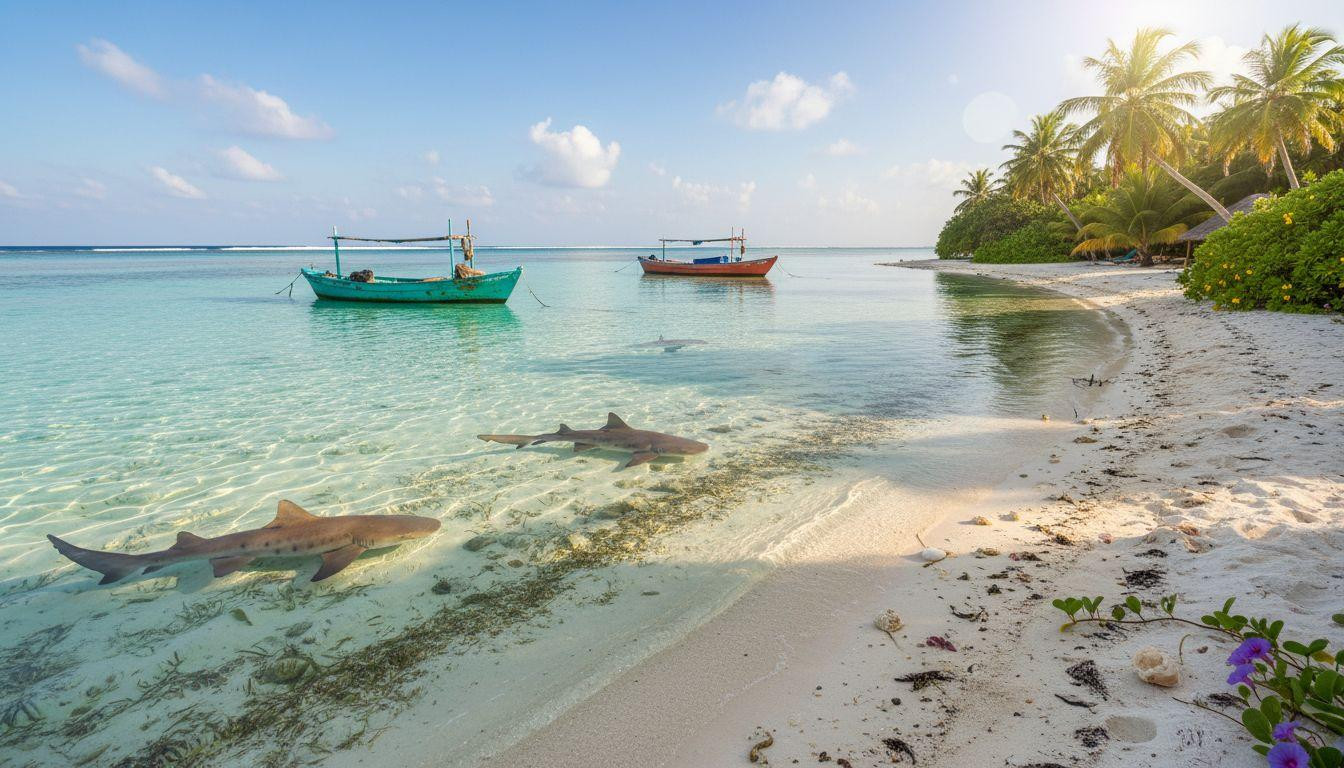
Standing knee-deep in Fulidhoo’s southwest lagoon, nurse sharks glide past your legs like underwater shadows. The water is so clear you can count fish 15 feet below. This tiny Maldivian island, just 62 miles from Malé, transforms a daily fishing routine into an extraordinary marine encounter. December 2025 brings perfect conditions for this shallow-water wonder that costs 70% less than resort islands.
Local fishermen created this accidental sanctuary through decades of routine. Every morning, they clean their catch at the southwest jetty. Fish scraps scattered in ankle-deep water drew hungry stingrays first. Nurse sharks followed, learning that dawn and dusk meant easy meals.
Where fishing boats created an accidental sanctuary
Fulidhoo measures just 2,300 feet long by 650 feet wide. You can walk the entire perimeter in 12 minutes. The southwest beach stretches 1,300 feet along a lagoon that never exceeds waist depth. White coral sand slopes gradually into turquoise water that deepens to sapphire blue at the reef edge.
Traditional dhonis (fishing boats) anchor 50 yards offshore each morning. Fishermen wade to shore carrying yellowfin tuna and red snapper. Similar reef lagoons in Tanzania protect marine life through conservation efforts. Here, protection happened by accident.
The feeding pattern established itself over 15 years. Now, up to 20 southern stingrays and 8-12 nurse sharks gather daily. Water visibility reaches 130 feet during December’s dry season. Morning light creates perfect conditions for photography and safe encounters.
The morning shark walk
What you’ll see in the shallows
Nurse sharks here average 4-6 feet long. They rest on the sandy bottom, occasionally rising to investigate movement. Local dive operators report no aggressive incidents in recorded history. These bottom-feeders prefer fish scraps to human interaction.
Southern stingrays arrive in groups between 8am-10am. Their diamond-shaped bodies glide through knee-deep water, wings rippling like silk. Green sea turtles occasionally join the morning gathering. Recent visitor surveys show 95% of tourists successfully spot marine life during their first visit.
Why December perfects the experience
December marks peak dry season in the Maldives. Northeast monsoons bring calm seas and minimal rainfall. Water temperature holds steady at 82°F. Japanese islands offer similar clarity but require longer travel times from major cities.
Tourist numbers drop 40% compared to February peak season. Guesthouses reduce rates to $80-120 per night. Morning encounters feel private with 5-8 other visitors instead of 20-30 during high season. Sunrise occurs at 6:15am, creating golden hour lighting for two hours.
Beyond the shark beach
Eastern bikini beach adventures
The designated swimwear beach stretches 1,000 feet along the eastern shore. Powder-white sand meets water so clear you see coral formations 40 feet out. Snorkeling reveals parrotfish, angelfish, and occasional blacktip reef sharks in the deeper channel.
Sandbank excursions depart twice daily at 9am and 2pm. Local operators charge $45 per person for 3-hour trips. Pacific atolls offer similar experiences with higher costs and longer travel requirements.
Island life at walking speed
A 400-year-old banyan tree dominates the island center. Its massive canopy shades a volleyball court where locals and tourists gather each evening. The coral stone mosque, built in 1847, welcomes respectful visitors outside prayer times.
Traditional Bodu Beru drumming sessions occur twice weekly at 8pm. Guesthouse owners organize these cultural exchanges without charge. Local women demonstrate palm leaf weaving and coconut oil production during afternoon workshops.
The authentic alternative
Private resort islands charge $800-2,000 per night for overwater villas. Fulidhoo guesthouses offer ocean views for $80-150. Seaplane transfers to resorts cost $400 per person. Speedboats to Fulidhoo charge $120 for the 90-minute journey from Malé.
Resort islands manufacture experiences through controlled environments. Caribbean alternatives provide similar value with different marine life. Fulidhoo delivers authentic Maldivian culture alongside world-class marine encounters. The trade-off: no alcohol sales due to Islamic customs.
Your questions about Fulidhoo answered
When’s the best time for shark encounters?
November through March offers optimal conditions. Early morning (7am-9am) provides highest shark activity. Low tide exposes more feeding areas, concentrating marine life. Fishermen arrive consistently at 6:30am, triggering feeding behavior patterns.
Is it safe to wade with nurse sharks?
Nurse sharks are docile bottom-feeders with no recorded attacks on humans at Fulidhoo. They’re habituated to human presence through 15 years of tourism. Thousands of safe encounters occur annually. Local dive operators provide safety briefings emphasizing respectful observation.
How does this compare to resort islands?
Water clarity matches resort lagoons with 60% lower costs. Cultural authenticity surpasses artificial resort environments. Real fishing village atmosphere versus manufactured luxury. Marine life encounters happen naturally rather than through organized excursions. Trade-off: basic amenities instead of five-star facilities.
Evening light transforms the lagoon into liquid gold. Nurse sharks rest on white sand while stingrays patrol the shallows. Children’s laughter echoes from the village as fishing boats return. This is how marine magic looks when tourism serves nature instead of conquering it.