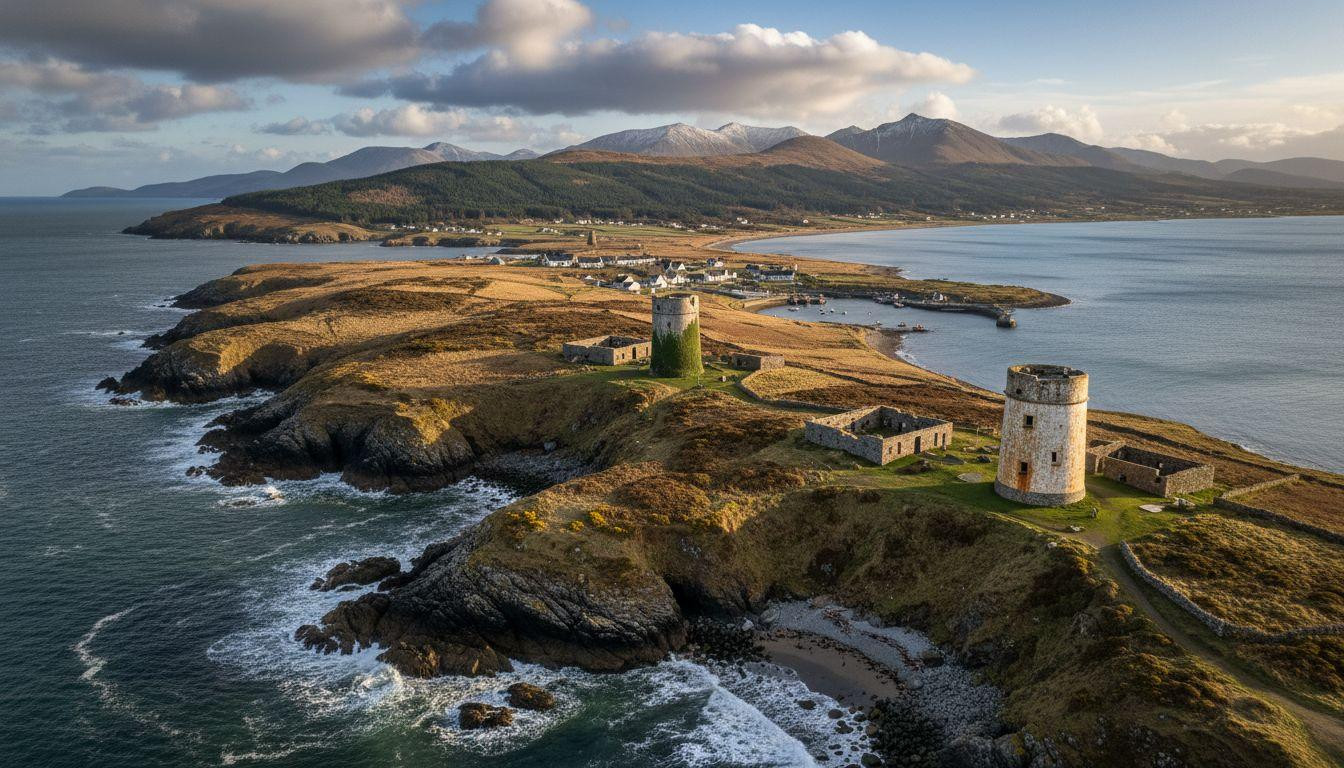
The morning ferry from Castletownbere cuts through gray Atlantic waters toward Bere Island. Two weathered stone towers emerge through the mist on distant headlands. These are Martello towers, cylindrical sentinels built by British forces in 1805 to guard Bantry Bay from Napoleon’s navy.
Most travelers heading to Ireland’s islands choose the crowded Aran Islands or restricted-access Skellig Michael. Bere Island receives barely 200 visitors on winter days, leaving its military ruins and 200 residents in peaceful isolation.
Where military history meets Atlantic silence
Four Martello towers once crowned Bere Island’s headlands after French warships attempted to invade Bantry Bay in 1798. Two cylindrical stone structures remain standing today: the Ardagh Tower overlooking Berehaven Harbour and the Cloughland Tower positioned on higher ground inland.
These towers rise 39 feet above sea level, their limestone walls weathered to pale gold. Each was designed to house one officer and 25 men, with 24-pound cannons positioned on rotating platforms. Adjacent rectangular ruins mark former barracks where Cornish stonemasons and British garrison soldiers once lived.
The island stretches 7 miles long by 4 miles wide, connected to communities that preserve traditional life away from tourist crowds. Lawrence Cove and Rerrin village maintain working harbors where fishing boats arrive before dawn.
The towers that guarded an empire
British coastal defense legacy
Construction began in 1804 as part of Britain’s largest coastal defense project. The Martello towers of Bere Island were among the first built in Ireland, completed by 1805 when Napoleon’s invasion threat peaked. Signal towers connected each position, creating communication networks across Bantry Bay.
The island served as a Treaty Port until 1938, hosting British naval operations through two world wars. Lonehort Battery and Rerrin Redoubt were built on sites where two other Martello towers once stood, demolished to make room for more modern military installations.
Deeper layers beneath
Bronze Age wedge tombs and standing stones predate the military structures by 4,000 years. Ardaragh wedge tomb and Gallán standing stone mark Neolithic settlements that flourished when early farmers cleared the island’s windswept hills.
Archaeological surveys reveal continuous habitation from prehistoric times through Gaelic fishing communities to modern residents who maintain traditional island rhythms. The Bere Island Heritage Centre in Ballinakilla Old School displays artifacts spanning these layered histories.
Walking among abandoned sentinels
Accessible military ruins
The Ardnakinna headland walk leads to the lighthouse and Ardagh Tower, offering panoramic views across Bantry Bay to the Beara Peninsula’s mountains. The Cloughland Tower sits within walking distance of Rerrin village, accessible via coastal paths that connect prehistoric monuments with military ruins.
Free guided walks operate from the Heritage Centre during summer months, though December visitors can explore independently. Coastal trails total 12 miles of marked routes, passing gun emplacements and signal tower foundations that reveal the island’s strategic importance.
Ferry crossings from Castletownbere take 10-15 minutes, costing $8 per person one-way. Remote islands throughout Europe offer similar military heritage, but few remain as accessible to independent exploration.
December’s empty advantage
Winter visits transform potential disadvantages into authentic experiences. Ferry schedules reduce from hourly summer service to 4-5 crossings daily, but passenger loads drop from summer highs of 40-50 people to winter averages of 8-12 travelers.
Morning light in December strikes limestone towers at low angles, creating golden glows against pewter skies. Atlantic storms reveal the defensive positions’ exposure while demonstrating why British planners chose these exact locations for maximum visibility across surrounding waters.
The island that tourism forgot
While Skellig Michael restricts access to 180 daily visitors at $110 per person, Bere Island welcomes anyone willing to take the short ferry crossing. No advance bookings or seasonal restrictions limit access to military sites or coastal walks.
Island pubs like O’Sullivan’s serve traditional Irish meals for $18-25, while self-catering accommodations range from $65-120 per night in renovated cottages. Local residents work in fishing, farming, and seasonal tourism while maintaining community traditions like the weekly parkrun every Saturday at 9:30am.
The contrast with Ireland’s crowded attractions becomes clear when comparing access restrictions elsewhere. Bere Island’s 200 permanent residents host visitors without overwhelming their daily rhythms or historic sites.
Your questions about Bere Island answered
How do I reach Bere Island in December?
Ferries operate year-round from Castletownbere with reduced winter schedules of 4-5 daily crossings. Check weather conditions one day ahead, as Atlantic storms can delay services. The 10-15 minute crossing costs $8 per person, $35 for vehicles.
Can you enter the Martello towers?
The Ardagh Tower was restored in 2010 but closed in 2024 due to structural concerns. The Cloughland Tower remains standing but isn’t officially accessible. The Heritage Centre offers detailed exhibits about tower construction and military history when open April through October.
How does this compare to Skellig Michael?
Skellig Michael restricts visitors to 180 per day at $110 each, requires advance booking, and operates only May-October. Bere Island welcomes unlimited visitors year-round for $8 ferry fare, with no booking restrictions or seasonal closures affecting military site access.
December afternoon light fades early over Bantry Bay, casting long shadows through tower doorways and across stone walls where lichen grows in patterns the Atlantic wind carved. The last ferry back to Castletownbere carries travelers who discovered Ireland’s most accessible military island, where ancient stones meet Atlantic isolation in perfect winter solitude.