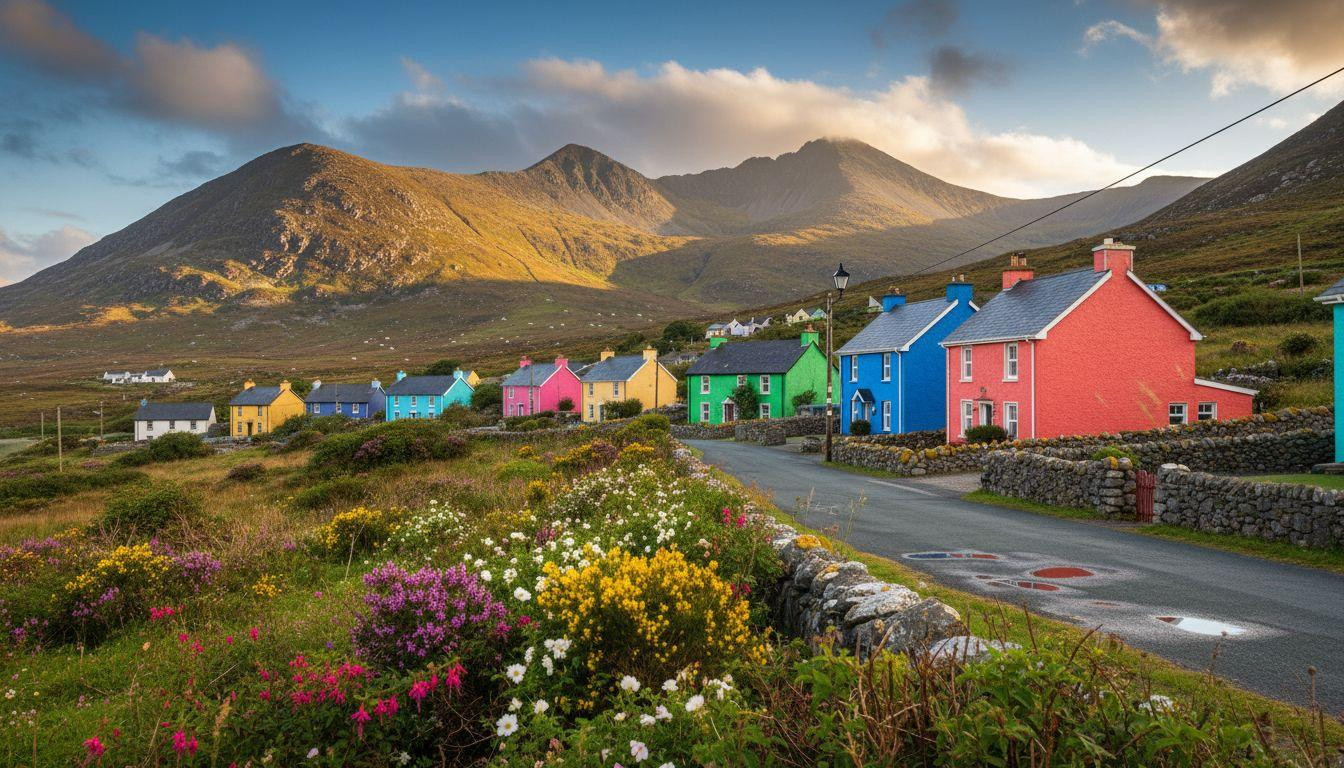
The N71 curves around Coulagh Bay and the houses appear. Reds, blues, yellows against gray-green mountains. Eyeries sits where 300 residents painted their village into something artists travel to see. Cork lies 62 miles east, but this feels like Europe’s forgotten edge.
Afternoon light hits these facades between 4pm and 6pm in summer. The glow lasts maybe 90 minutes. Then it’s gone.
Where paint became landscape
Beara Peninsula stretches between Bantry Bay and Kenmare River. Eyeries occupies the northern shore, tucked under Slieve Miskish Mountains. The highest peak, Maulin, rises 3,058 feet behind the village.
The color tradition started in the 1970s during Ireland’s Tidy Towns competition. Residents painted their cottages to stand out. The village won Silver Medal status in 2024, continuing decades of recognition.
Other Irish villages tried the same approach. Most faded back to whitewash. Eyeries maintained the palette. Flower boxes get replanted each spring. Paint gets refreshed every few years.
Why artists chose this light
The golden hour canvas
Coastal sun hits west-facing walls at an angle. Mountain shadows create contrast behind the village. The effect works best May through August when days stretch past 9pm.
Painters settled here for this specific quality. Anam Cara Writer’s and Artist’s Retreat operates year-round. The village appeared in “The Purple Taxi” in 1977 and “Falling for a Dancer” in 1998. Directors came for the backdrop.
The quiet that costs nothing
Tour buses skip Beara Peninsula. Ring of Kerry pulls millions annually. Eyeries sees maybe 15,000 visitors per year. Most drive through without stopping.
The local pub serves seafood chowder for $15. Milleens cheese comes from a farm 15 minutes away. Gaeilge gets spoken at the post office counter.
Walking the village
The color loop
The village core covers half a square mile. You can walk every street in 30 minutes. St. Kentigern’s Church holds stained glass windows commissioned in the 1980s. The harbor sits 5 minutes downhill.
No Instagram map needed. Every corner works. Morning light favors east-facing walls. Afternoon belongs to the bay side.
Beara Way trails
The Beara Way walking trail passes through the village. Day loops run 3 to 6 miles along coastal bluffs. Healy Pass sits 30 minutes north by car. The drive crosses the peninsula at 1,084 feet elevation.
Dursey Island cable car operates one hour west. The crossing costs $11. Six passengers maximum per trip. Sea lions gather on rocks below the cable line.
The cost Ireland forgot
Bed and breakfasts charge $55 to $88 per night. Self-catering cottages run $110 to $165. Ireland’s national average sits at $132 for basic lodging. Eyeries comes in 30 to 40 percent lower.
Causkey’s and The Urhan Inn serve dinner for $18 to $25. Fresh mussels from Coulagh Bay appear on menus daily. The general store sells supplies at mainland prices.
Car rental from Cork Airport costs $44 per day. The drive takes 1.5 to 2 hours via N71. Bus Éireann route 236 runs three times daily for $17 to $27. The bus trip takes 3 hours with one transfer.
Your questions about Eyeries answered
Best time to visit for the afternoon light?
Summer months from June through August deliver the longest golden hour. Temperatures reach 57°F to 64°F. Wildflowers bloom along roadsides. The village stays quiet even in peak season. Shoulder months of May and September offer similar light with fewer visitors and lower rates.
How does Eyeries compare to Ring of Kerry?
Ring of Kerry attracts tour buses and crowds year-round. Eyeries sits on the parallel Ring of Beara, which sees minimal traffic. Lodging costs 30 percent less than Kerry towns. The landscapes match. The experience differs completely.
Can you reach Eyeries without a car?
Bus Éireann route 236 connects Cork City to Castletownbere via Eyeries. Service runs Monday through Saturday. The schedule limits flexibility. Most visitors drive. Nearby Dingle Peninsula offers similar coastal access with more frequent bus options.
The houses glow brightest around 5:30pm in July. Locals walk dogs along the harbor. Fishing boats return with the day’s catch. The color fades slowly as the sun drops behind Maulin. No one rushes.