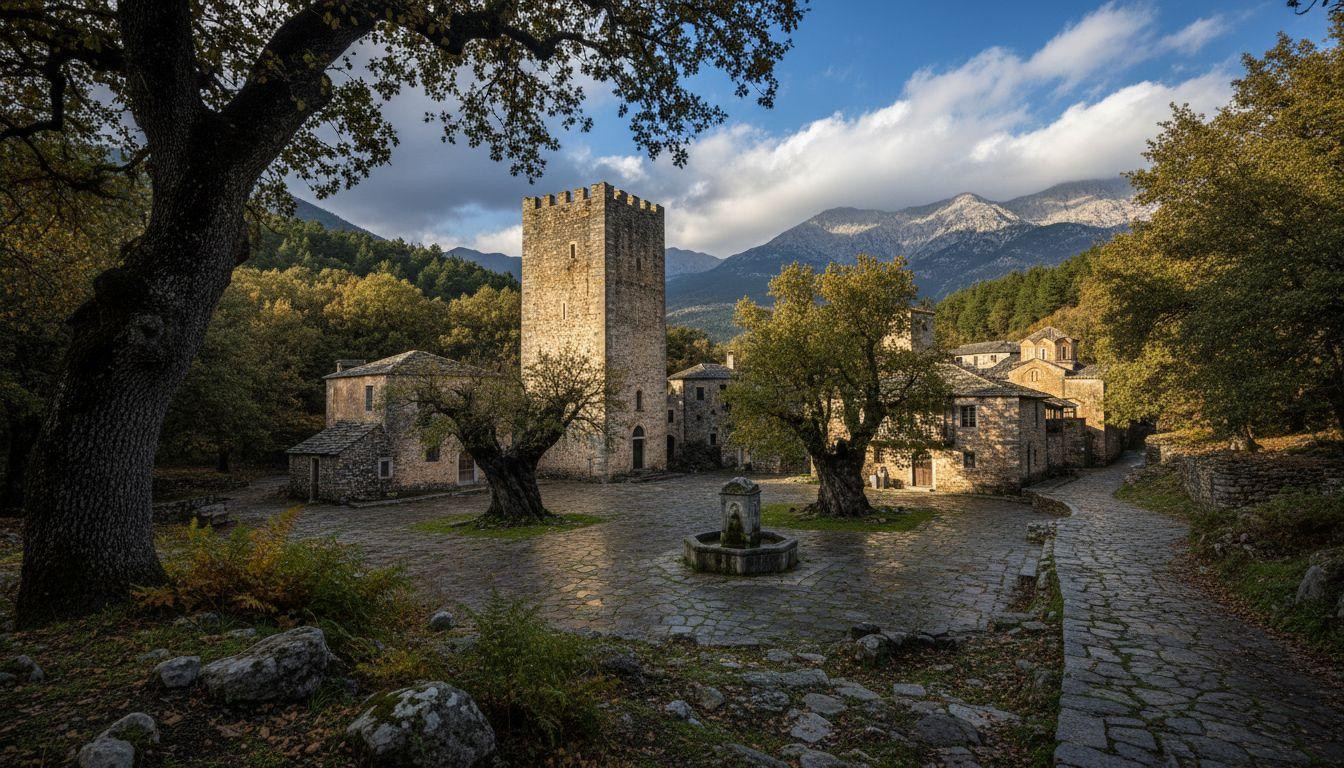
This Greek mountain village disappears beneath oak canopies where medieval stones guard Byzantine secrets in fortress silence. Kastania materializes only when you’re almost upon it, hidden at 1,837 feet on Taygetos slopes where 46 residents preserve 800-year-old churches without a single tourist sign. The village earned its invisibility through design: a natural fortress that once sheltered Greek independence hero Theodoros Kolokotronis and still shields itself from the modern world through walnut groves and ancient stone.
Where mountains swallow stone
The drive from Kalamata winds southeast for 31 miles through increasingly wild terrain. GPS coordinates 36.84214°N, 22.39996°E lead you up mountain roads where oak forests grow thicker with each switchback. Suddenly, gray-golden towers emerge from green shadows like a medieval mirage.
Kastania sits beneath Mavrovouna peak in Messinia’s Mani Peninsula, where Taygetos creates natural concealment. The village earned its “invisible fortress” reputation during 13th-century conflicts when builders positioned homes to vanish into rocky slopes. Winter temperatures hover around 46-54°F, perfect for exploring without summer’s heat or crowds.
Byzantine stones that remember centuries
Ten churches dot this tiny settlement, more religious architecture per capita than anywhere in Mani. The 11th-century Church of the Dormition anchors village life with Byzantine frescoes revealed only during August 15 celebrations. Local tradition opens these painted walls once yearly for the patron saint’s feast day.
The five-story Dourakis Tower rises 49 feet
Captain Dourakis built this 18th-century stone fortress during Mani’s feuding era. Theodoros Kolokotronis, later hero of Greek independence, hid here from Ottoman persecution between 1803-1806. The protected monument still dominates Kastania’s pretty square, though the taverna mentioned by medieval fortress villages remains intermittently closed.
Ai-Stratigos temple waits 1.2 miles down forest paths
This Late Byzantine church sits in complete isolation southwest of the village. No signs mark the way through wild greenery where walnut trees drop their fruit on ancient stone paths. The walk takes 25 minutes through increasingly dense forest to reach architecture that seems untouched by time.
Living in fortress time
Daily life moves at medieval pace in Kastania. Residents tend small gardens between tower houses while spring-fed streams provide mineral-clear water year-round. The population dropped from 205 in 1981 to today’s 46, creating an intimacy where everyone knows each visitor’s arrival.
Spring water runs cold and transparent
Unnamed streams flow from Taygetos snowmelt, creating crystal-clear pools below walnut groves. No facilities exist for swimming, but locals collect drinking water directly from mountain springs. The sound of running water mingles with oak leaves rustling in constant Mani breezes.
Maniot hospitality follows ancient codes
Coffee appears automatically when visiting local homes, a tradition rooted in Mani’s harsh history. Residents maintain reserved demeanor inherited from generations of feuding, yet warmly share knowledge about hidden churches and tower histories. Siglino (smoked pork) and ladenia flatbread represent regional specialties when available.
The quiet after discovery
Kastania’s invisibility feels intentional rather than accidental. Tourism bypasses the village for coastal Kardamyli 9 miles away, leaving Byzantine stones to weather in peace. Morning silence breaks only with distant goat bells and oak branches creaking in mountain winds.
This preservation through neglect creates rare authenticity. Unlike commercialized hill towns elsewhere, Kastania offers no gift shops or guided tours. The village exists purely for its 46 residents who maintain medieval rhythms in granite houses their ancestors built to disappear.
Your questions about Kastania answered
How do I actually reach this invisible village?
Rent a car at Kalamata International Airport (KLX) for $45-60 daily and drive 1.5 hours southeast. The route via Kardamyli uses paved roads throughout, though final mountain approaches involve hairpin turns through dense forests. No public transport serves Kastania directly. Park respectfully near the square without blocking narrow village lanes.
Where can I stay and eat nearby?
Kastania offers no accommodation or restaurants. Stay in Kardamyli at guesthouses from $55-80 nightly and visit Kastania as a day trip. Pack food and water since village facilities remain unreliable. Nearest tavernas operate in Kardamyli’s harbor area year-round.
Why choose Kastania over other Mani villages?
Kastania contains more Byzantine churches (10) than similar-sized settlements while maintaining complete invisibility from tourism. Unlike Kitta or Nomia, this village literally disappears into forest until you arrive. The Dourakis Tower and Kolokotronis connection add historical significance missing from purely architectural sites elsewhere in Mani.
Gray stone towers catch afternoon light through oak branches while spring water sounds echo off medieval walls. Kastania keeps its secrets in fortress silence, measuring time by church bells rather than tourist seasons.