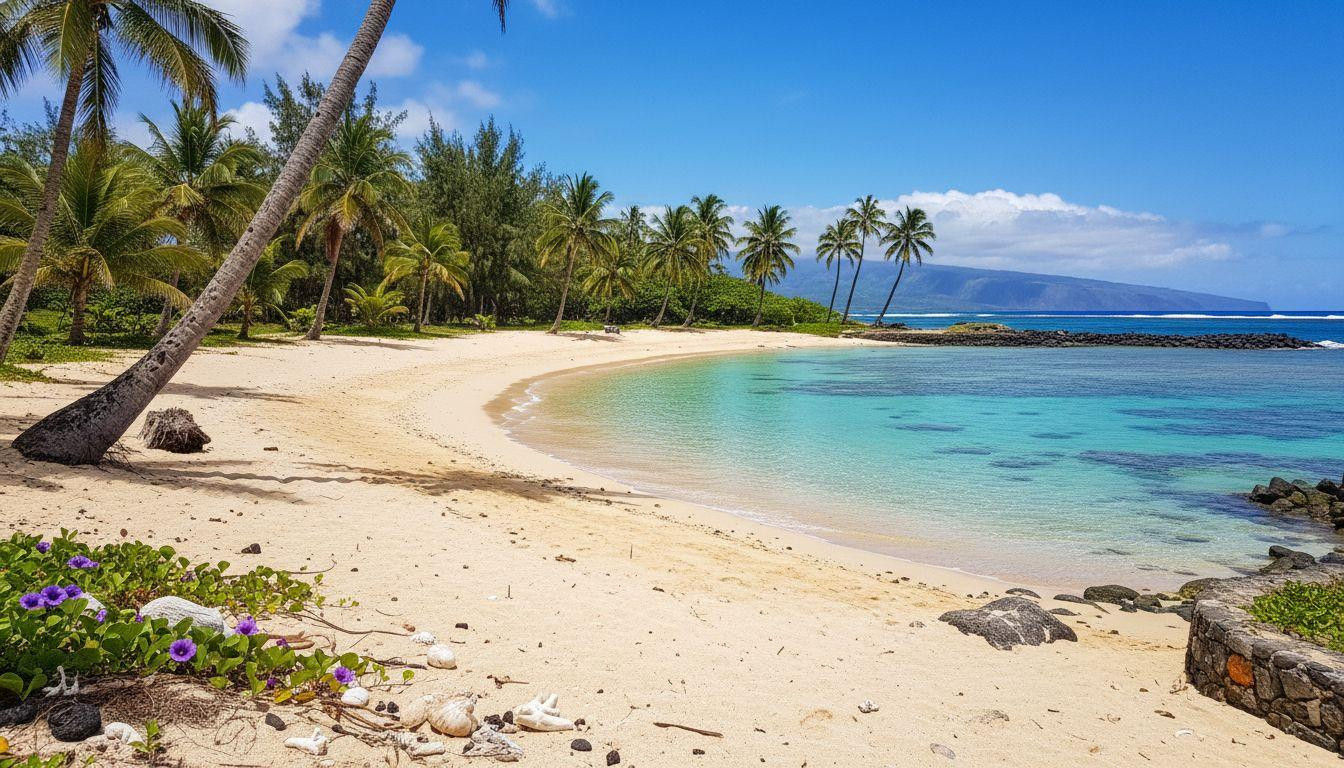
Highway 450 narrows to a single lane past mile marker 20, where most drivers turn around. They miss what lies just before: a golden sand crescent where Molokai’s clearest reef water laps against an empty shore. Kumimi Beach sits in plain sight, yet remains overlooked even by locals rushing to reach the road’s dramatic end.
The offshore reef creates something rare in Hawaii. Shallow turquoise lagoons stretch 620 feet from shore, protected from ocean swells that crash beyond the coral barrier. Palm trees cast afternoon shade over sand that shifts from white to gold as light changes through the day.
Where the highway meets the sea
The small parking area overlooks the entire beach from Highway 450. Twenty miles east of Kaunakakai, this stretch of southeastern Molokai feels worlds away from the island’s main town. The narrow road winds through ironwood groves before opening to reveal Maui’s silhouette across the channel.
No facilities exist here. No restrooms, no showers, no snack bars selling overpriced sodas. The reef flat extends from an ancient Hawaiian fishpond at the eastern end, where 450 feet of stone walls once trapped juvenile fish in 1.69 acres of calm water.
GPS coordinates 21.1075°N, 156.75139°W mark this spot at 299 feet elevation. The volcanic shores elsewhere on Molokai contrast sharply with this gentle crescent.
The reef that keeps water clear
Shallow turquoise lagoons
Three feet of water over the reef flat creates perfect snorkeling conditions when trade winds calm. The coral heads farther out show more life than the dead patches near shore, where decades of runoff have taken their toll. Yet fish still dart through the shallows in surprising numbers.
Summer brings the clearest conditions from May through October. Winter swells can make the water murky and dangerous, with treacherous currents beyond the protective reef. Local visitors know to check conditions before the drive.
Why locals protect this quiet
Molokai’s 7,345 residents maintain their island’s reputation as Hawaii’s most Hawaiian place. No traffic lights interrupt the 40-minute drive from Kaunakakai. No resort developments crowd the coastline. The tourism board calls this “Molokai’s favorite snorkel spot,” yet visitor numbers remain modest.
Traditional ahupua’a boundaries still define this stretch of coast. The Kumimi district extends from mountain to reef, preserving ancient connections between land and sea that modern development has severed elsewhere.
Swimming between the islands
When to visit for best conditions
January through March brings rough conditions as southern swells wrap around the island. The emerald green water that attracts photographers turns choppy and unsafe for swimming. High tide provides the deepest water for snorkeling, though even then depths rarely exceed six feet.
Recent visitor surveys show summer occupancy rates 60% higher than winter, though both seasons remain quiet compared to crowded Caribbean beaches. The rocky bottom requires reef shoes, and the few palm trees provide limited shade during midday sun.
What you’ll see beneath the surface
Fish populations surprise first-time snorkelers despite coral bleaching visible near shore. The eastern section of Molokai’s 24-mile South Reef system terminates here, creating habitat diversity that supports marine life. Schools of yellow tangs flash against darker coral heads while parrotfish graze on algae-covered rocks.
No gear rental exists at the beach. Shops in Kaunakakai charge around $20 per day for snorkel equipment, making the 40-mile round trip worth planning. Gas costs approximately $12 for the journey from town.
The contrast Maui can’t provide
Maui’s resort beaches handle 3 million visitors annually. From Kumimi’s shore, you can see those crowded developments across the channel while floating in water touched by perhaps 50 people that day. The irony strikes every visitor: Hawaii’s best snorkeling might exist in view of its busiest shores.
Accommodation costs on Molokai run 30-50% below Maui rates. Local inns near Kaunakakai charge $150-250 per night compared to $300-500 for equivalent Big Island oceanfront properties. The drive to Kumimi becomes a daily ritual rather than a one-time excursion.
Your questions about Kumimi Beach answered
When should I visit for the best snorkeling?
Summer months from May through October offer the calmest conditions and clearest water visibility. Winter brings southern swells that create dangerous currents and murky water. Check local weather reports and avoid rough surf days entirely.
How does this compare to other Hawaiian beaches?
Kumimi receives fewer daily visitors than most Oahu or Maui beaches see hourly. The reef system provides better fish diversity than many resort snorkel spots, though coral health shows impact from land-based pollution. Authenticity and solitude compensate for limited facilities.
What facilities are available at the beach?
None exist beyond the small parking area. Bring water, food, shade, and all snorkel gear from Kaunakakai. The nearest restrooms and dining options remain 20 miles away in town. Plan for a full day trip with complete self-sufficiency.
Morning light transforms the reef into sheets of liquid glass, doubling palm reflections in water so still it mirrors clouds. Fish move like silver coins scattered across turquoise sand. The only sounds: gentle waves over coral, trade winds through ironwood branches, and the distant hum of a world that feels very far away.