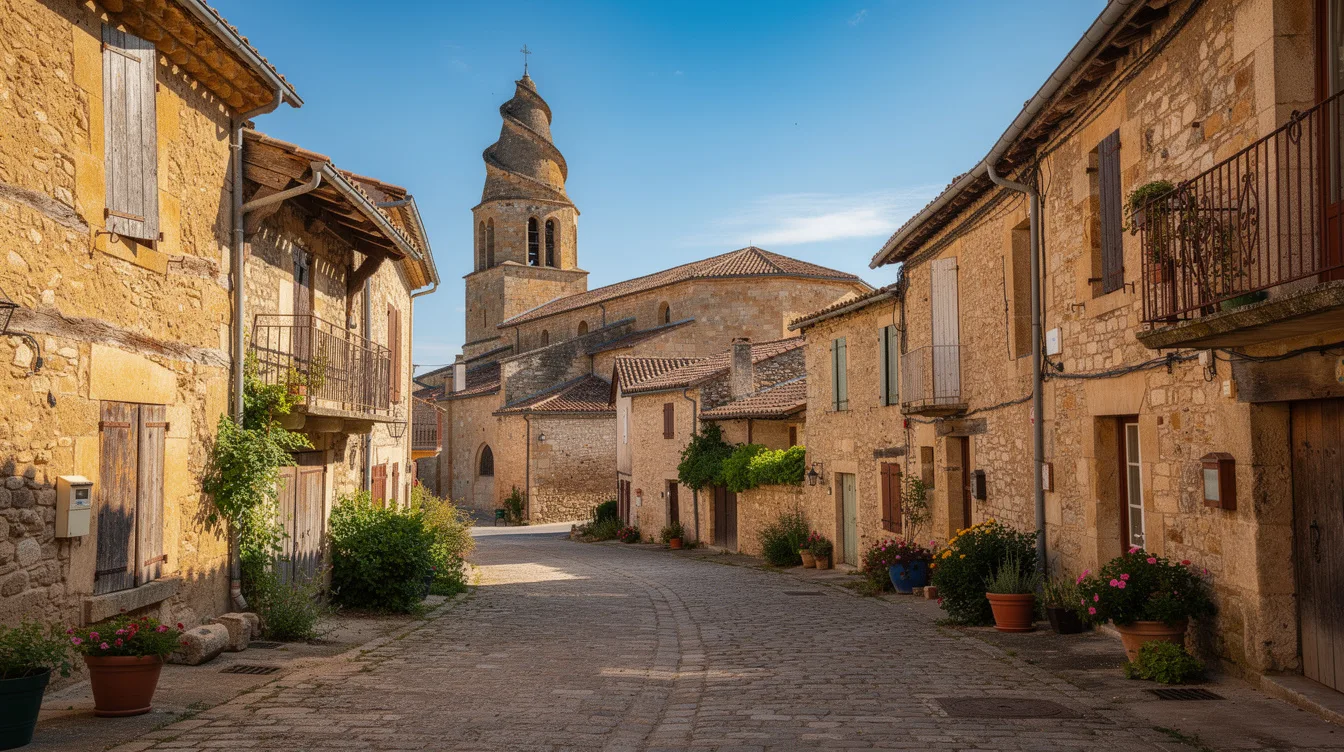
Saint-Côme-d’Olt is a French village with a twisted spire, built in the 16th century, rising above a nearly circular old center in Aveyron’s Lot Valley, near Espalion.
You’ll spot the tilt before you understand the streets below it. That’s the appeal: the village gives you one unmistakable image, then makes you work through stone lanes and fortified gates to reach it.
A spire built between 1522 and 1532
Église Saint-Côme, Saint-Damien has a flamboyant Gothic twisted bell tower built between 1522 and 1532. It’s the village emblem, and rightly so. The corkscrew silhouette makes the roofline feel slightly unsettled, even on a quiet day.
But don’t treat the church as a quick roadside photograph. Walk toward it through the old center, because the narrow approach makes the tower’s shape more surprising when it finally clears the roofs.
The building sits on the Via Podiensis, the Le Puy route of the Way of St. James. Pilgrims arrive from Saint-Chély-d’Aubrac and continue toward Espalion, so you may share the lanes with walkers carrying the practical weight of a long route.
The old town still keeps its circle
Saint-Côme-d’Olt has three fortified gates, former defenses folded into the village fabric. Its old center is almost circular, and that shape changes the visit: you can wander without feeling pushed along a single sightseeing route.
And you should let yourself take wrong turns here. Stone houses, tight passages, and Renaissance-era details reward a slower look, while the tower remains a useful point of reference whenever the lanes begin to loop back.
Look up at the local “carène” roofs, shaped like overturned boat hulls. It’s a small architectural detail, but it gives the village a distinct profile. The streets are compact, yet they don’t feel cramped.
Château de Castelnau is now the town hall, which makes it less theatrical than a museum palace. That’s a good thing. The old structures still belong to daily village life rather than being sealed behind an admission desk.
A pilgrim stop with a quieter rhythm
The Chapelle des Pénitents was once a hospice for pilgrims and is now an exhibition space. You’ll find the same layered history throughout Saint-Côme-d’Olt: religious routes, defensive walls, and civic buildings occupy the same small circuit.
But this isn’t a place to rush through with a checklist. Its scale asks for a different pace. You’re visiting a lived-in commune, not an open-air set.
Its inclusion among Les Plus Beaux Villages de France brings a clear expectation of polished old stone and memorable corners. The designation fits, though the twisted tower is what keeps the place from feeling interchangeable with other historic French villages.
The Lot gives the visit room to breathe
Beyond the gates, the Lot’s banks offer a softer counterpoint to the enclosed center. The water and the village belong in the same walk, because the river loosens the view after those narrow stone passages.
You can also head to the Calvaire viewpoint on Puech de Levade for a look over the village and valley. The climb adds perspective, but the notes don’t promise an effortless route, so wear shoes you’re happy to walk in.
It sits at the foot of Aubrac, which helps explain why the village feels tied both to the river corridor and to the higher country beyond it.
Give Saint-Côme-d’Olt the time it needs
Plan roughly 1.5 to 3 hours to enter through a medieval gate, see the church, pass the château and chapel, then follow the village down toward the Lot. That’s enough time to notice the roofs instead of merely recording them.
And pair it with nearby Espalion if you’re exploring this stretch of Aveyron. Saint-Côme-d’Olt is small, but its compact plan makes it satisfying on foot. There’s little need to force an itinerary beyond the old streets and the river.
By the time you return to the church, the twisted spire has become less of a curiosity and more of a compass, rising above the pale stone roofs with its stubborn, deliberate turn.