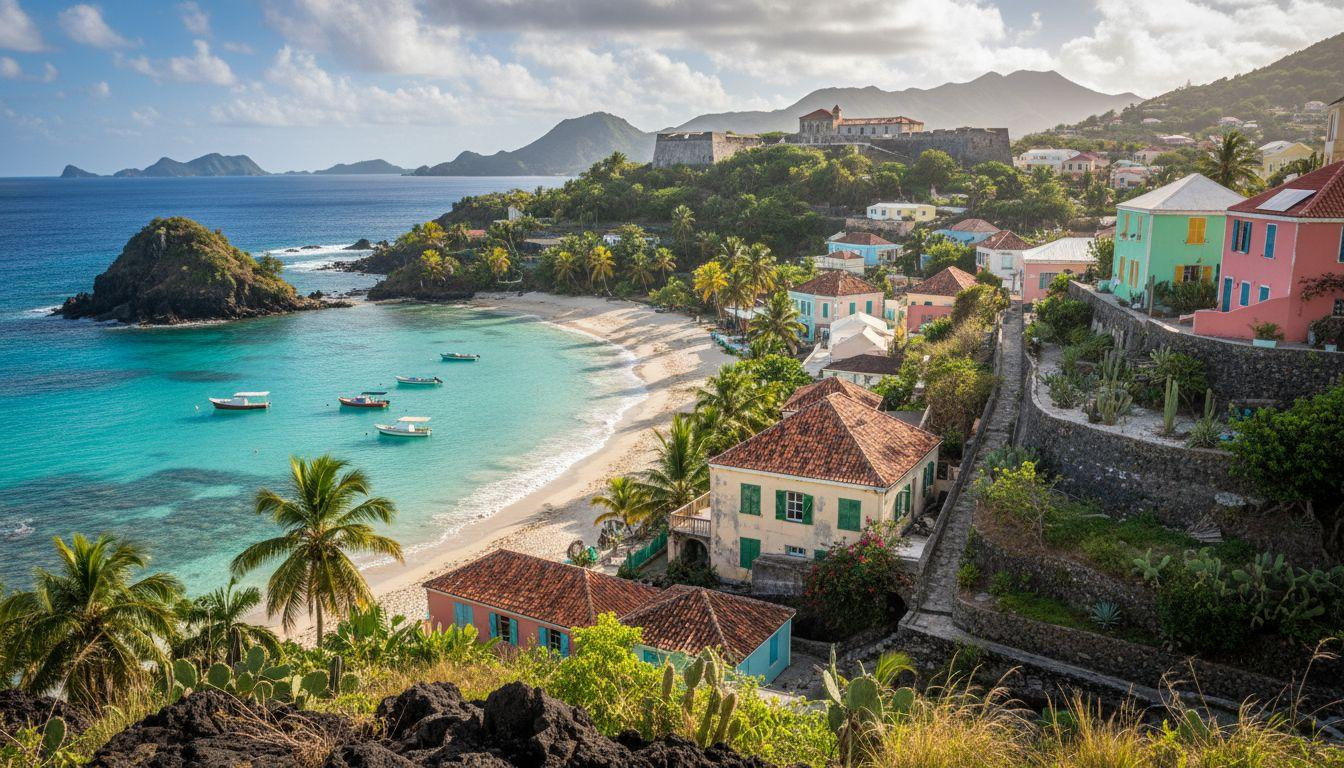
The ferry pulls away from Trois-Rivières, and within minutes, something extraordinary emerges from the turquoise water ahead. Les Saintes archipelago rises like a mirage, red-roofed houses climbing volcanic hills above crystalline bays. This isn’t the Caribbean you know from postcards.
At just 4.9 square miles total, these French islands preserve what the mainstream Caribbean lost decades ago. Authentic village life where 2,000 residents still fish at dawn and bake tourment d’amour pastries by hand.
An archipelago preserved by distance
Geography created this accidental sanctuary. The 25-minute ferry ride from Guadeloupe filters out casual tourists, leaving Les Saintes to visitors who actually want to be here. No cruise ships dock at Terre-de-Haut’s tiny harbor.
The village wraps around a protected bay like a Mediterranean postcard translated to the tropics. Stone houses with colored shutters line narrow streets where golf carts replace cars. Fort Napoléon watches from its ridge, an 18th-century sentinel turned peaceful museum.
Local tourism boards confirm that infrastructure stays intentionally small-scale. Ferry-accessible islands worldwide face the same choice: develop or preserve. Les Saintes chose preservation.
Pain de Sucre reveals what turquoise actually means
Where coral reefs begin at your feet
Pain de Sucre Beach redefines turquoise. The water achieves colors cameras struggle to capture, thanks to white sand meeting deep volcanic channels. Sunlight refracts through 100 feet of visibility, creating liquid sapphire.
Coral formations start 50 feet from shore. What Maldives resorts charge $300 daily for, here costs nothing but snorkel gear rental at $15. December through April brings 82°F water temperatures and crystalline conditions.
The geological accident behind the color
Recent geological surveys conducted in 2025 reveal why this turquoise differs from other Caribbean waters. Shallow white sand plateaus drop suddenly to 200-foot volcanic channels. The contrast creates optical magic as morning light penetrates the clear water.
Local fishing boats share these waters with snorkelers. Fishermen work mornings, tourists explore afternoons. Everyone respects the same pristine ecosystem that makes this possible.
The village that stayed itself
Golf carts and morning markets
Terre-de-Haut banned cars without meaning to. The island’s lanes never widened beyond colonial proportions. Today, electric golf carts putter past painted houses at a pace that matches island time.
The morning market operates like it has for generations. Fishermen sell their catch direct from boats. The baker whose family has run the shop since 1953 still makes tourment d’amour pastries using recipes passed down through generations. Tourism found authenticity, not the other way around.
Fort Napoléon’s quiet command
The fortress-turned-museum charges just $6 for entry to 18th-century military history and botanical gardens. According to historical records from the town archives, French colonial soldiers once watched for British sails from these same stone terraces.
Golden hour transforms the fort into a natural observatory. Visitors climb worn stone steps to 360-degree bay views. Caribbean ferry-access destinations rarely offer such preserved historical context with their natural beauty.
December delivers what summer obscures
Winter season reveals Les Saintes at its finest. Water clarity peaks during December through April, when trade winds calm the seas and rainfall drops to minimal levels. Visibility underwater reaches 100 feet consistently.
Crowd levels drop 60% compared to summer months. Guesthouses that cost $180 nightly in summer offer rates from $90 in December. Ferry schedules remain reliable, but daytripper volume allows the islands to show their real character.
A local innkeeper who’s welcomed travelers for two decades confirms that winter visitors experience the authentic pace. When ferries depart at sunset, the islands exhale and return to fishing village rhythms.
Your questions about Les Saintes answered
Is Les Saintes worth a full stay or just a day trip?
Daytrippers miss the evening magic when the last ferry departs. Sunset from Fort Napoléon, village dinners as fishing boats return, the quiet that settles over Terre-de-Haut after 6pm. Minimum two nights recommended to experience island time actually slowing down.
How do you actually get there from the US?
Fly to Pointe-à-Pitre Airport (PTP) with connections through Miami (3.5 hours) or New York (4.5 hours with one stop). Ferry from Trois-Rivières takes 25 minutes and costs $18 round-trip. December through March requires advance ferry booking.
What makes this different from Saint-Martin or Antigua?
Scale and preservation set Les Saintes apart. While mainstream Caribbean destinations accommodate 80,000 tourists, Les Saintes maintains village life for 2,000 residents. No casinos, no resort corridors, no cruise terminals. French Caribbean authenticity without Saint-Barth prices.
Evening light catches the harbor as fishing boats return with the day’s catch. Children play in village squares while tourists sip local rum on café terraces. The ferry that brought morning visitors has long departed, leaving Les Saintes to its quiet rhythms once more.