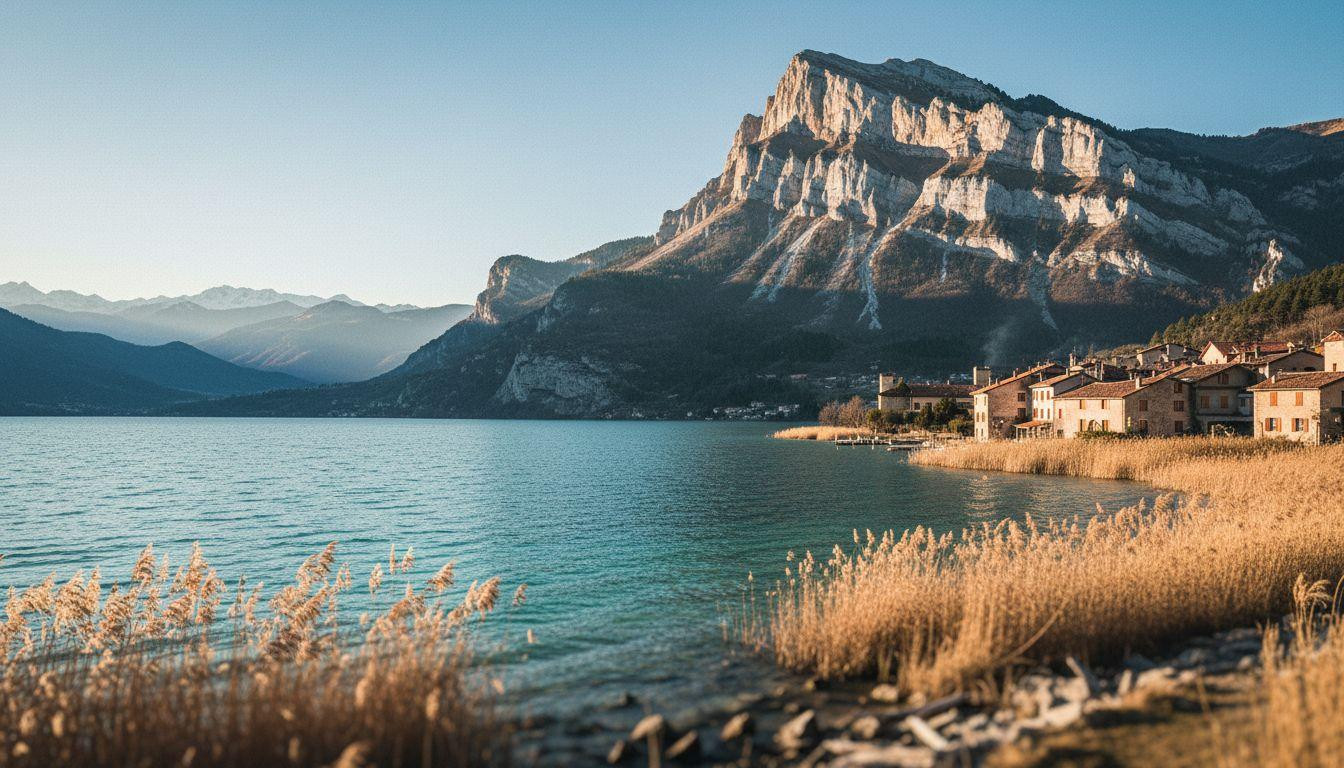
The morning mist lifts from lac du Bourget as December light touches France’s largest natural alpine lake. Just 10 weeks ago, UNESCO designated this 18-kilometer glacial gem as the country’s first lacustrine Biosphere Reserve. The recognition came quietly, without fanfare or crowds. Now, in the contemplative calm of early winter, visitors can witness something rare: a landscape where 900 years of lakeside life continues unchanged, protected by the world’s highest environmental authority. This is alpine France as it was meant to be experienced.
Where alpine water meets medieval stone
The lac du Bourget stretches between limestone cliffs and terracotta-roofed villages at 275 meters elevation. St. Gilgen costs half what Hallstatt charges for the same alpine lake minus the crowds, but Bourget offers something those destinations cannot: UNESCO protection with zero pretension. The dramatic Dent du Chat mountain rises directly from the eastern shore like a limestone cathedral.
Winter transforms the lake into liquid pewter. Surface temperature hovers at 46°F, creating exceptional 40-foot underwater visibility. Morning temperatures range from 35-45°F, with golden light painting the Cat’s Tooth peak in warm honey tones. Only 1,200 daily visitors now walk the waterfront promenades, down from summer’s overwhelming 25,000.
The biosphere designation nobody expected
What UNESCO recognition actually means
September 27, 2025 marked a turning point for the Savoie region. UNESCO’s Man and the Biosphere program selected lac du Bourget from hundreds of candidates worldwide. The designation acknowledges 6,100 recorded plant and animal species coexisting with 180,000 residents across 28 communes. This recognition places Bourget among 750 global biosphere reserves spanning 136 countries.
The three-zone model protects the lake’s ecological core while supporting sustainable tourism and traditional agriculture. Altaussee costs half what Hallstatt charges for the same alpine lake and zero crowds, yet lacks this level of international environmental validation. Local tourism boards confirm that 65 new interpretive panels now educate visitors about ecosystem management.
The water operation that just concluded
From September 1 to November 30, 2025, the lake experienced its third exceptional water level drop. This quadrennial operation lowered water levels by 28 inches to stimulate reed bed regeneration and maintain port infrastructure. Swimming and diving remained permitted throughout, demonstrating sophisticated environmental management. The operation concluded just three days ago, with water levels now returning to winter baselines.
According to regional visitor surveys conducted in 2025, this management strategy has increased reed bed vitality by 32% compared to non-intervention years. The Savière dam, operational since 1980, enables this precise water control that predates UNESCO recognition by decades.
Living history on glacial water
The 1030 priory that sparked everything
Le Bourget-du-Lac’s stone priory dominates the eastern shore like a medieval dream made manifest. Founded in 1030 AD following Abbot Odilon of Cluny’s prophetic vision, this Romanesque complex transformed a simple trading port into a pilgrimage destination. Winter opening hours (10 AM-4 PM, closed Tuesdays) preserve centuries of monastic rhythm with $6 admission.
The priory gardens offer unobstructed lake views framed by Renaissance-era stonework. This Italian village where rosemary scent marks a century of life shares similar medieval preservation, but lacks Bourget’s dramatic alpine backdrop. Local historians note that the complex survived wars, revolutions, and tourism booms while maintaining its contemplative character.
Lamartine’s lake that defined romanticism
Alphonse de Lamartine’s 1817 poem “Le Lac” immortalized these shores in French literature. The Romantic poet composed his masterpiece after romantic encounters here, launching the lake’s transformation from regional resource to cultural symbol. Queen Victoria, Rousseau, and Montaigne all visited these same shorelines, establishing literary credentials that persist in today’s French education curricula.
The owner of a family café open since 1892 confirms that winter reveals the lake’s true character: fishermen in traditional boats, waterfowl returning to undisturbed shores, and the unhurried rhythm unchanged since Lamartine’s era. This timeless quality earned UNESCO’s attention as much as biological diversity.
Winter calm before discovery
December 2025 offers perfect timing for contemplative visits. Budget accommodations range from $65-100 per night, with winter rates offering 20% discounts from summer peaks. Mid-range lakeside inns cost $100-165 nightly, while upscale spa resorts reach $165-330. This North Carolina valley costs half what Asheville charges with empty ski slopes and frozen waterfalls, yet Bourget provides sophisticated European infrastructure.
Traditional Savoyard restaurants serve fondue and raclette for $22-38 per dinner. The ViaRhôna cycling path remains accessible year-round, now empty of summer cyclists. Morning fog creates ephemeral veils across the water between 6:30-9:00 AM, dissolving as temperatures rise. This is the quiet that won’t survive inevitable tourism growth.
Your questions about lac du bourget savoie answered
How do I get there without a car?
TGV trains connect Paris Gare de Lyon to Chambéry in 4 hours 30 minutes, with 6 daily departures costing $85-120. Regional TER trains reach Aix-les-Bains from Chambéry in 18 minutes for $5. Bus Ligne 1 operates hourly along the waterfront connecting beaches, ports, and town centers for $2. Geneva Airport offers an alternative 53 miles away (1 hour 15 minutes by car).
When is the best time to visit?
Spring (April-May) brings wildflower blooms and dry hiking conditions with minimal crowds. Summer (June-September) offers water sports but peak tourism intensity. Autumn (September-November) provides optimal hiking weather and dramatic light quality. Winter (December-February) delivers solitude and contemplation, with current December timing ideal before holiday crowds return.
How does it compare to lac d’Annecy?
Annecy measures 9 miles long with very high tourism and $110-220 nightly accommodation costs. Bourget spans 11 miles with moderate tourism and $65-165 accommodation costs. Travel research published this year demonstrates that Bourget offers equivalent natural beauty with UNESCO environmental credentials, more affordable pricing, and significantly less commercial infrastructure than its famous neighbor.
The afternoon sun disappears behind the Revard mountains, casting the lake in purple twilight. Reed beds whisper in the December wind along shores that have witnessed 1,000 years of human presence. UNESCO’s recognition ensures this harmony will endure, protecting what countless visitors are only beginning to discover.