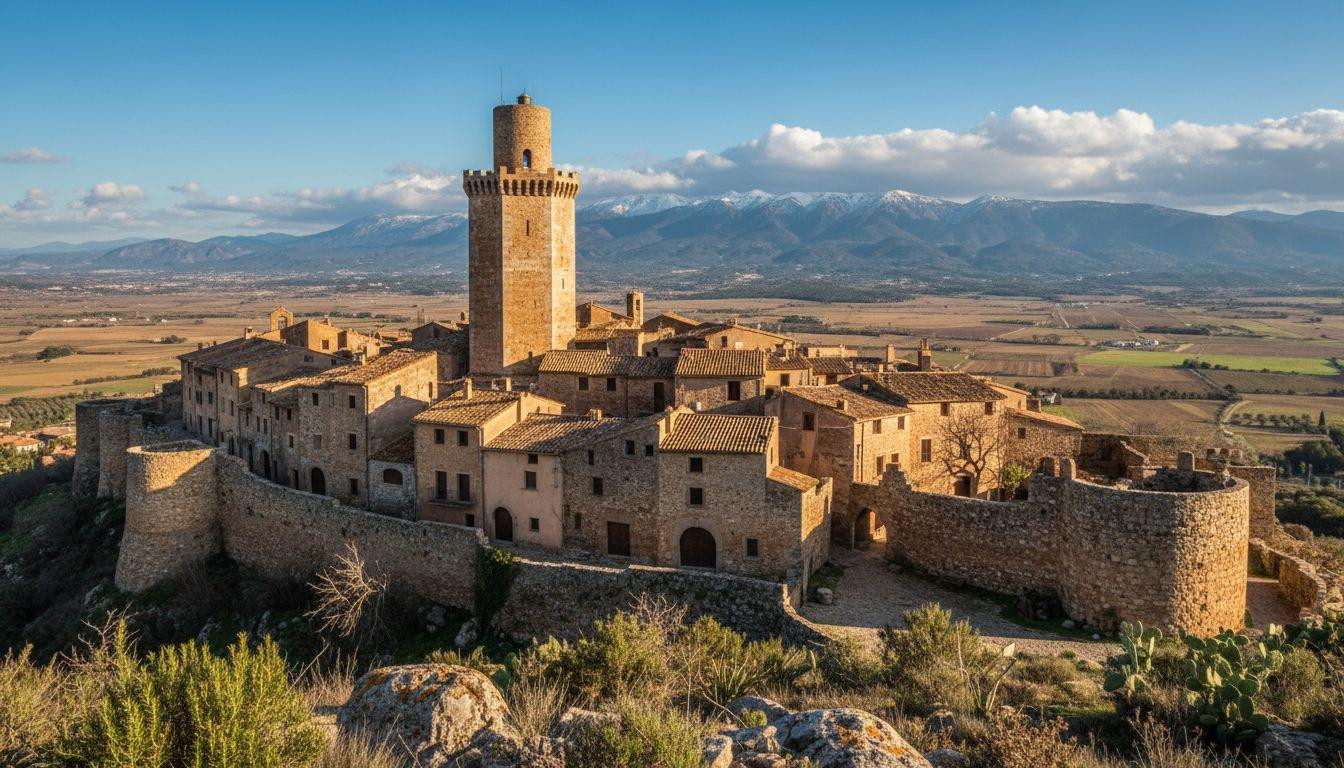
January sunlight filters through narrow stone passages in Pals, casting amber shadows that haven’t changed for eight centuries. This Catalan village of 2,800 residents sits quietly on its hilltop perch, 30 miles from Girona, while medieval walls shelter cobblestone streets where modern life moves at the pace of centuries past. The Torre de les Hores watchtower rises above honey-colored stone houses, offering 360-degree views across the Empordà plain to the Pyrenees. Here, authenticity isn’t performed for tourists. It simply exists.
Winter reveals Pals at its most intimate. Crystalline morning air makes distant mountains appear close enough to touch. Local families emerge for their daily routines along car-free streets barely wider than 6 feet.
The medieval quarter that tourism forgot
Entering Pals feels like stepping through a temporal doorway. Medieval defensive walls encircle the historic center, their weathered stones glowing golden in afternoon light. The Torre de les Hores dominates the skyline, its 65-foot height commanding views that once warned of Moorish raids.
Narrow cobblestone alleys wind between 13th-century stone houses. Ancient wooden doors display iron reinforcements and hand-forged bolts. Terracotta roof tiles create warm russet patterns against limestone facades. No chain restaurants interrupt the medieval streetscape. No souvenir shops cluster around the watchtower base.
The village preserves what historic American seaports lost to modern development. Here, architectural authenticity remains intact across 25 acres of medieval quarter. Stone archways connect buildings, creating organic passages through the old town center.
What 2,800 residents preserve
Daily rhythms vs tourist spectacle
Evening paseo begins at 5pm when residents emerge for leisurely strolls. Families gather in the village square while children play between medieval stones. Local cafés serve pa amb tomàquet (bread rubbed with tomato) and glasses of Empordà wine for $8-12.
The village baker opens at 6am, filling narrow streets with fresh bread aromas. A family-run pharmacy has operated from the same medieval building since 1953. The post office occupies a converted 14th-century merchant house.
Empordà agricultural heritage
Cork oak forests surround Pals, supporting centuries-old harvesting traditions. Local wine cooperatives produce distinctive Catalan varietals on 3,500 hectares of surrounding vineyards. Regional specialties include escalivada (roasted vegetables with olive oil) and botifarra sausage grilled over wood fires.
Weekly markets feature produce from family farms dating to medieval times. Mediterranean villages like Anafi share this agricultural authenticity, though Pals maintains stronger medieval architectural continuity.
The watchtower experience
360-degree panoramas
Climbing Torre de les Hores costs just $5 and rewards visitors with sweeping views across the Empordà plain. On clear days, the Pyrenees create dramatic northern backdrops while Mediterranean coastline glimmers 20 miles east. Morning light reveals agricultural terraces and cork forests extending to distant mountain ranges.
The watchtower’s crenellated battlements frame perfect compositions. Medieval stone creates foreground interest while endless Catalan countryside stretches toward horizons. Golden hour (5-6pm) bathes honey-colored stones in warm light that photographers dream about.
Medieval defensive purpose
The tower served dual functions as defensive fortification and village timekeeper. Its strategic hilltop position allowed guards to spot coastal raiders hours before arrival. Church bells marked daily hours from this central location, making it both military installation and community clock tower.
Medieval engineering remains visible in thick stone walls and narrow defensive windows. Historic Spanish engineering created similar defensive masterpieces, though few retain Pals’s intimate village atmosphere.
Winter’s quiet revelation
January temperatures range from 41-54°F, requiring light jackets but offering incomparable clarity. Mediterranean sunshine illuminates medieval stones without summer’s harsh glare. Village cafés welcome lingering conversations over cortados and local pastries.
Winter crowds number fewer than 50 visitors daily, compared to summer’s 200-300. This seasonal solitude reveals Pals as residents experience it. Local shopkeepers share stories about village history. Remote communities like Whittier understand this intimate scale, though Pals offers centuries more historical depth.
Crystalline winter air makes Pyrenees peaks appear startlingly close. Stone-and-shadow patterns create dramatic afternoon compositions. Village silence amplifies footsteps on ancient cobblestones and distant church bells marking traditional hours.
Your questions about Pals answered
How do you actually get there?
Pals requires a rental car from Barcelona (2.5 hours, $50-70 daily) or Girona (45 minutes). No direct public transportation serves the village, though buses connect to nearby Begur (6 miles away). Driving through cork oak forests and agricultural landscapes becomes part of the authentic experience.
What’s the medieval authenticity level?
Pals preserves original medieval architecture across 80% of its historic quarter. The watchtower dates to the 13th century with minimal reconstruction. Stone houses maintain original dimensions and materials, unlike heavily restored destinations such as Carcassonne. Village streets follow medieval layouts unchanged since 1300.
Why not just visit Girona instead?
Girona attracts 400,000 annual visitors following Game of Thrones tourism. Pals welcomes roughly 25,000, creating vastly different experiences. Girona offers urban amenities and famous attractions. Pals provides village intimacy and temporal authenticity. Both complement each other perfectly within a 45-minute drive.
Stone passages glow amber in late afternoon light, church bells echo across centuries, and the Empordà plain stretches endlessly toward distant Pyrenees peaks where winter clarity makes mountains seem close enough to touch from medieval battlements.