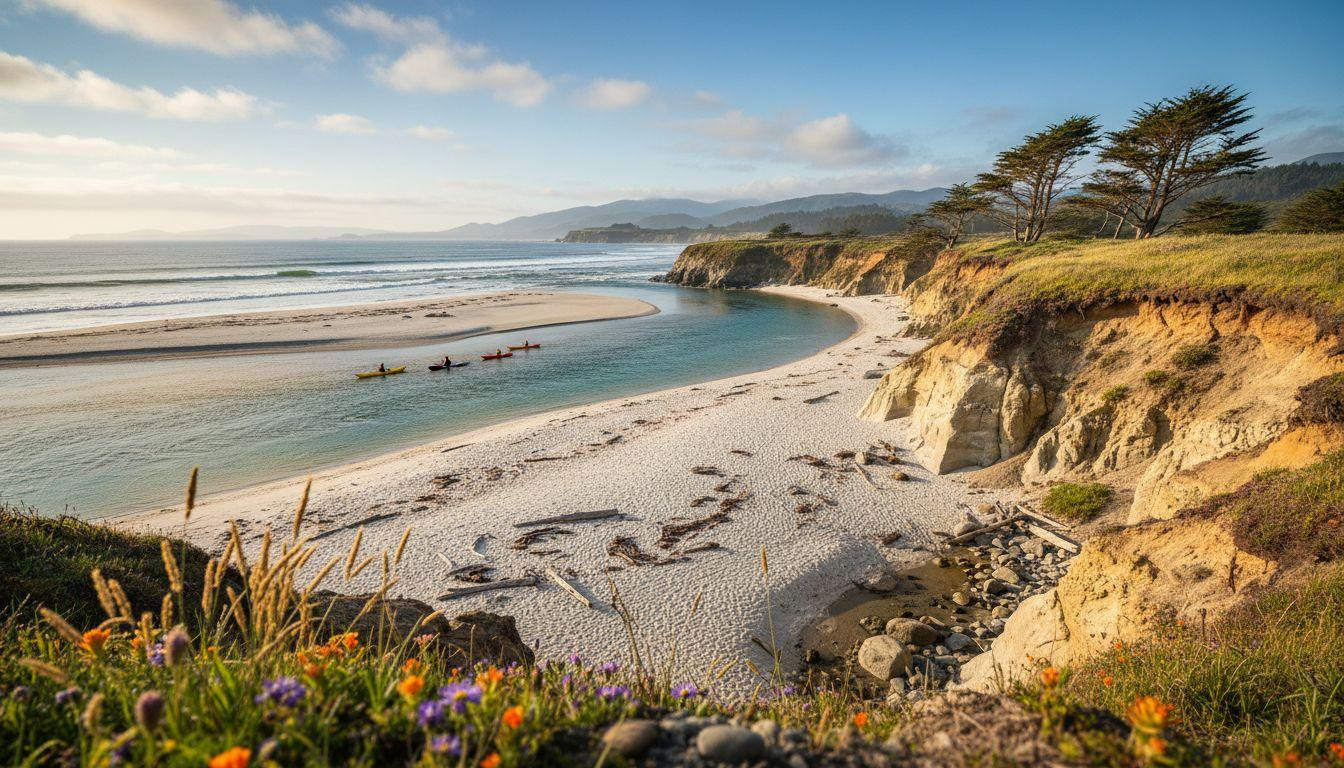
This Northern California village sits where the Gualala River meets the Pacific Ocean, creating a rare geographic confluence that locals call the “banana belt.” While fog blankets Big Sur and Mendocino in gray shrouds, ocean winds push the mist offshore here, leaving golden coastal bluffs bathed in clear light. With only 2,093 residents and dramatically fewer tourists than its famous neighbors, Gualala offers something increasingly precious: authentic coastal serenity where river mouth ecosystems meet architectural minimalism.
Where fresh water surrenders to salt
The Gualala River completes its 32-mile journey at coordinates 38.7694° N, 123.5325° W, where white-sand dunes frame the estuary’s entrance to the Pacific. Standing at Whale Watch Point in Gualala Point Regional Park, visitors witness this daily drama of convergence. Fresh water flows over a sandbar that blocks the river mouth from late spring until late fall, creating protected pools perfect for novice kayakers.
Adventure Rents downtown offers kayak rentals for $40-60 per hour, allowing paddlers to explore unusually calm waters despite the ocean’s proximity just beyond the dunes. Coho salmon and steelhead trout breed in these protected waters, while pelicans and great blue herons patrol the shallows at dawn. This Idaho lake mirrors 10,000-foot Sawtooth peaks in turquoise glacial water, offering similar reflective tranquility in an alpine setting.
The fog that never arrives
Science behind the banana belt
Local tourism boards confirm that Gualala’s microclimate creates consistently clearer conditions than neighboring coastal areas. Ocean winds tend to keep fog offshore, creating temperatures ranging from 45-60°F in winter to 55-70°F in summer. January 2026 offers optimal whale watching conditions, with gray whales migrating offshore from December through April without summer’s persistent fog bank.
Sea Ranch’s minimalist architecture
Five miles south, Sea Ranch community features low-profile wood homes that disappear into the coastal bluffs. The non-denominational chapel, designed with a shell-shaped structure and wave-pattern stained glass, serves as a meditation space open to visitors. Golf courses charge approximately $100 per round, while respecting the development’s “leave-no-trace” philosophy that has preserved 10 miles of bluff-top trails. This Maine island sits 20 minutes offshore where 570 residents keep winter fog sacred, sharing similar coastal fog culture and small-town preservation ethics.
River calm versus ocean power
Paddling protected waters
The Gualala River’s mouth creates perfect conditions for beginners, with protected estuary waters contrasting sharply with Pacific surf beyond the sandbar. Local kayak guides note that even novice paddlers can navigate upstream safely, while experienced ocean kayakers challenge the waves just 300 feet away. Morning departures at 7am offer the calmest conditions and best wildlife viewing opportunities.
Bluff trails over both elements
Pelican Bluffs Trail forms a 1.2-mile loop through grasslands and ocean edges, offering elevated views of both river mouth and Pacific horizons. The Coastal Bluff Trail within Gualala Point Regional Park extends 2.9 miles, connecting beach access with clifftop vantage points 50-100 feet above sea level. This Oregon spring holds 102°F crystal water where brutal roads keep crowds at zero, demonstrating how difficult access preserves natural beauty in the Pacific Northwest.
The quiet authenticity you’re missing
Recent visitor surveys conducted in 2025 reveal that Gualala receives approximately 100,000 annual visitors compared to Big Sur’s overwhelming millions. Costs run 15% below national coastal averages, with meals at Seafood Shack averaging $18 for fish and chips, while Miramar serves Mexican specialties for around $20. The Gualala Arts Center, established in 1958 on 11 acres of redwood forest, hosts year-round exhibits and expanded workshop programs following 2025 renovations.
Weekend farmers’ markets feature Dungeness crab from local fishermen and organic produce from nearby Sonoma County. Dolphin Gallery and Studio 391 showcase local artists’ sculptures, jewelry, and paintings without the commercial pressure found in touristy coastal towns. Accommodations range from $100-180 per night at local motels to $200-350 at inns like St. Orres. 8 Big Corn Island beaches where turquoise water stays empty and lobster costs under $10, offering similarly authentic seafood experiences without tourist inflation.
Your questions about Gualala answered
When does the banana belt effect work best?
January through March 2026 offers the clearest demonstration of Gualala’s microclimate advantage. While neighboring coastal areas often experience heavy fog, ocean winds consistently push moisture offshore here. Winter months provide optimal whale watching conditions with minimal fog interference, though summer occasionally sees light coastal mist.
Is Sea Ranch accessible to day visitors?
Sea Ranch maintains primarily residential status, but public beach access exists via designated trails. The architectural chapel remains open for non-denominational meditation. Golf courses welcome public players for approximately $100 per round. Visitors must respect the community’s conservation ethos and park only in designated areas.
How does Gualala compare to Big Sur?
Both destinations offer dramatic coastal cliffs meeting Pacific waters, but Gualala maintains authentic village character with 90% fewer tourists. Accommodation costs average 25% less than Big Sur, while restaurant prices remain 15-20% below coastal California norms. The river mouth ecosystem provides unique wildlife viewing opportunities absent in Big Sur’s primarily cliff-focused landscape.
Dawn breaks over Whale Watch Point as gray whales breach offshore, their spouts catching golden light while river water flows silently toward the sea. Morning fog lifts from distant headlands, leaving Gualala’s bluffs clear and the village stirring slowly to another unhurried day.