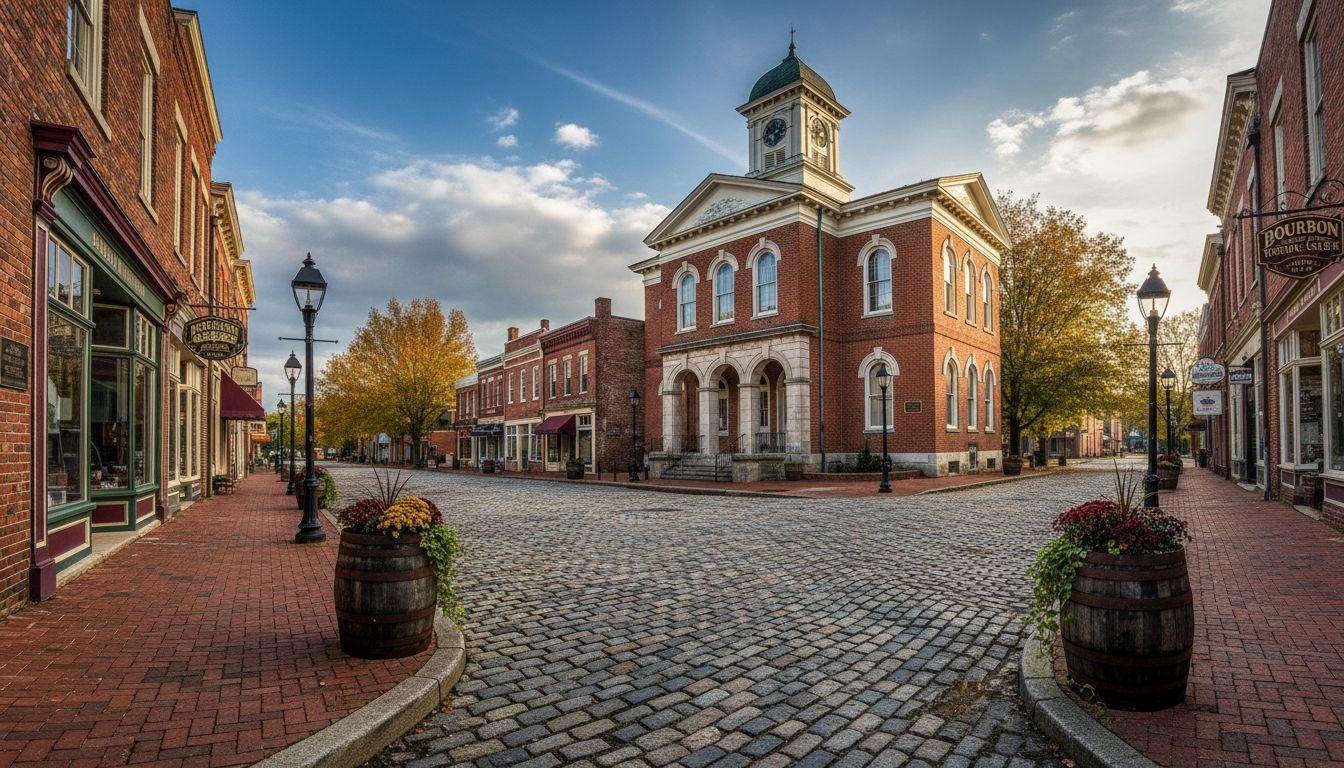
Golden bourbon barrels catch the afternoon light through century-old warehouse windows. The soft crunch of cobblestones underfoot leads past red brick Federal mansions. This is Bardstown, where 279 historic buildings preserve America’s bourbon heritage in a living town that tourism somehow forgot.
Just 40 minutes south of Louisville, this Kentucky settlement of 13,600 residents operates as the unofficial Bourbon Capital of the World. Eleven active distilleries sit within 16 miles of Court Square’s cobblestone paths. Yet visitor counts remain under 500,000 annually while Asheville draws 11 million to its craft scene.
Where bourbon heritage froze in Federal brick
Bardstown claimed Kentucky’s second-oldest city status when founded in 1788. The Civil War swept through, leaving museums and battlefield memories. But preservation laws in 1965 locked the town’s architectural DNA in place.
The Bardstown Historic District spans 26 blocks with over one-third featuring Federal and Georgian architecture from the 1780s-1850s. Flemish bond brickwork, Tuscan colonettes, and fanlight windows create visual cohesion modern zoning couldn’t replicate. Newburyport’s Federal brick streets froze maritime history like Bardstown preserved bourbon heritage.
My Old Kentucky Home State Park anchors the southern edge. The mansion began as a one-story brick farmhouse around 1795, expanding to Federal-style grandeur by 1818. Stephen Foster’s 1853 song immortalized the site, performed live in the outdoor amphitheater each summer.
The architecture of slow time
Red brick mansions with white columns line walkable downtown streets. Weathered timber accents complement the Federal Revival aesthetic. The Basilica of St. Joseph Proto-Cathedral, completed in 1819, holds the distinction of first Catholic cathedral west of the Allegheny Mountains.
Preservation without theme parking
Court Square maintains its 1797 grid layout across 24 original blocks. Local families still occupy historic homes. The Nelson County Historical Society ensures authenticity over commercialization, avoiding the Williamsburg treatment that turns living towns into museums.
Eleven distilleries within sixteen miles
Heaven Hill Bourbon Heritage Center offers tastings for $25 with barrel-aging demonstrations. The facility showcases bourbon’s technical evolution from sour mash fermentation to charred oak aging. Lux Row Distillers earned TripAdvisor’s top rating at 4.8 out of 5 stars for their barrel sampling and chocolate pairing experiences.
Willett Distillery maintains family-owned intimacy in their operations. The Oscar Getz Museum displays what curators claim is a 1790s whiskey jug, potentially America’s oldest known whiskey artifact. The Cumberland Gap’s Appalachian passes once connected Bardstown’s bourbon trade to Atlantic markets.
What makes Bardstown different
No resort-style crowds dominate the distillery scene unlike Napa Valley wine country. Family-owned operations maintain personal touch in tours and tastings. This remains a working town where locals live alongside tourists, not a preserved historical attraction.
January timing advantages
Off-peak season delivers 20% lodging discounts at historic inns. Cozy indoor tastings replace summer’s outdoor crowds. The Abbey of Gethsemani, 20 minutes away, offers contemplative winter retreats perfect for bourbon meditation.
The experience of earned quiet
Morning walks along the Historic Cobblestone Path reveal mist-shrouded mansions at dawn. The soft morning air carries faint bourbon mash scents from nearby rickhouses. Horse farms hum in the distance beyond town limits.
Hurst Soda Fountain serves Kentucky hot browns (open-faced turkey sandwiches) for around $16. Local bourbon balls cost $5 per dozen, representing edible heritage tourism. Louisville’s Ohio River brewery district mirrors Bardstown’s distillery heritage 40 minutes north.
Activities beyond bourbon
My Old Kentucky Home golf course charges $30-50 per round. Bernheim Arboretum features massive tree sculptures called “friendly giants” about 20 minutes from Court Square. The Bourbon Capital Entertainment District allows to-go cocktails for leisurely downtown strolling.
Why locals stay
Church-centered community life revolves around the Basilica. Southern hospitality maintains an unhurried pace with genuine “y’all” greetings. Roots-deep community connections resist the commercialization that tourism typically brings to heritage destinations.
The final sip
Sunset casts golden light across My Old Kentucky Home’s mansion columns. Rolling countryside stretches beyond manicured grounds. This scene captures what Tuscany delivers at wine country prices without the European flight costs.
Bardstown achieves what Asheville commercialized away. Authentic bourbon heritage survives in a functioning community. Rothenburg’s medieval authenticity at $165 compares to Bardstown’s bourbon heritage at similar mid-range pricing. The difference lies in crowd levels and cultural preservation.
Your questions about Bardstown answered
How does Bardstown compare to Asheville for bourbon tourism?
Bardstown attracts under 1 million visitors versus Asheville’s 11 million annually. Lodging costs 30% less at $150-250 nightly compared to Asheville’s $250-400 range. Authentic bourbon heritage spans centuries while Asheville’s craft scene represents recent trends.
What’s the best season for bourbon tours?
Spring through fall offers ideal weather for outdoor tastings and distillery walks. January 2026 provides quiet season advantages with uncrowded tours and cozy indoor experiences. Summer features the Kentucky Bourbon Festival (September 5-7, 2026) and National Bourbon Week (June 9-15).
Can you visit without a car?
Difficult without personal transportation. No direct train service exists to Bardstown. Uber from Louisville Muhammad Ali International Airport costs approximately $50 for the 40-minute drive. Downtown remains highly walkable, but distillery tours require driving between locations.
The cobblestone path catches the last amber light of evening. Bourbon barrels rest in darkening warehouses. Time moves slowly here, measured in oak aging cycles rather than tourist seasons.