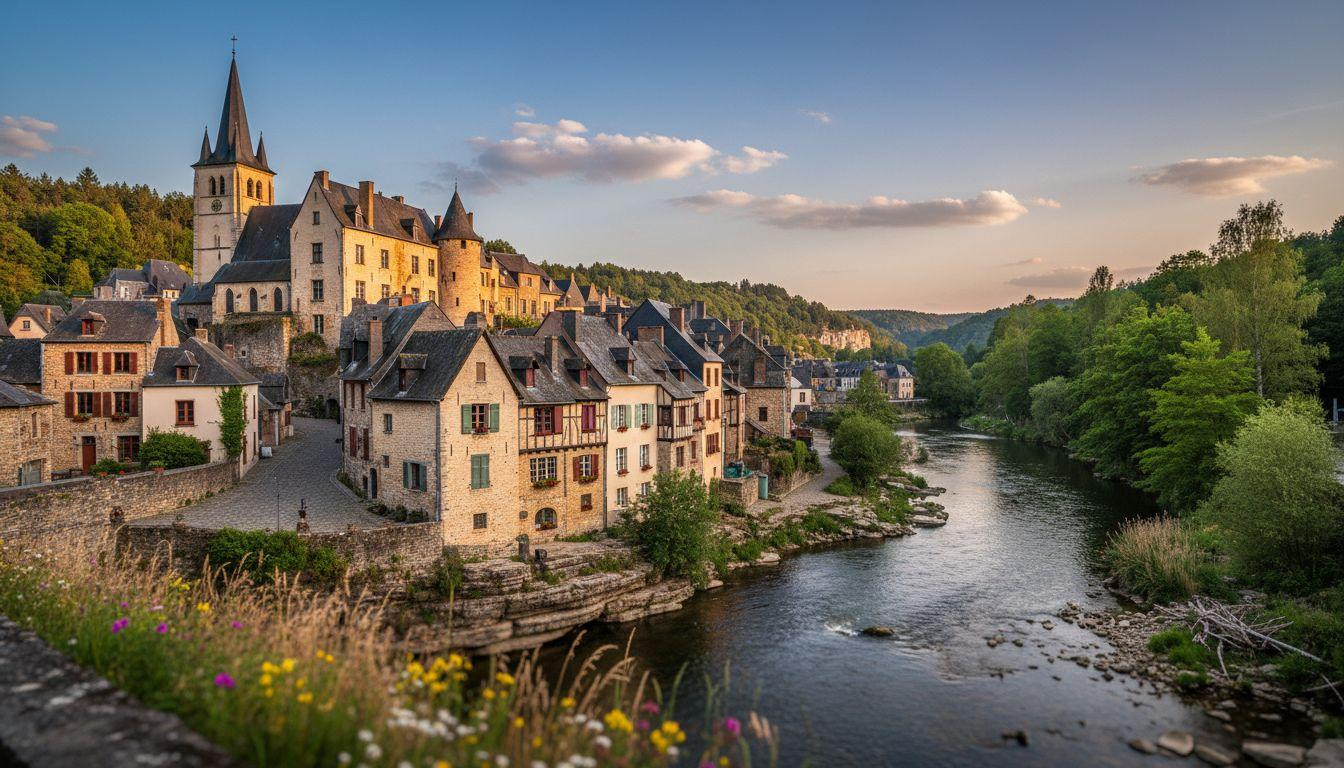
Durbuy sits along the Ourthe River in Belgium’s Ardennes, 75 miles from Brussels. The town holds a city charter from 1331. Population in the historic core: 400 residents. When evening light hits the 17th-century limestone facades between 6:30pm and 8pm from April through September, the gray stone turns honey-gold. The glow lasts maybe twenty minutes before fading to dusk.
Most visitors arrive on day trips from Brussels and leave by 5pm. The quiet after tour buses depart reveals why locals protect this place. Walk the entire old town perimeter in fifteen minutes. The scale makes sense once you see it.
Where the river bends through the Ardennes
Durbuy occupies a rocky promontory above the Ourthe River, elevation 820 feet. Dense forest valleys surround the town on three sides. The river runs 65-100 feet wide here, flowing at 350-700 cubic feet per second depending on season. Water stays clear enough to see the limestone riverbed.
The Château d’Ursel sits on the highest point, overlooking the river bend. Built in the 16th century and restored in 1880, the castle anchors the skyline. Below it, cobblestone streets follow the medieval layout. Houses date primarily to the 1600s, built from local pale limestone with dark timber frames. Slate roofs angle steeply to shed Ardennes snow.
John I of Luxembourg granted Durbuy city status in 1331, establishing market rights and fortifications. The charter made this a regional trade center despite its size. For context, Dinkelsbühl’s preserved medieval streets in Germany follow a similar timeline but house 12,000 residents today.
The light that shapes the stone
How evening transforms the facades
The town faces east and north, with the Ourthe Valley funneling western sunlight onto building fronts at dusk. Limestone absorbs the warm spectrum during golden hour. Gray walls shift to honey, then amber, then fade. Photographers favor the Sentier L’Anticlinal viewpoint, a ten-minute uphill walk from Place aux Foires.
The texture matters as much as color. Limestone weathers unevenly, creating shadows that deepen as light angles lower. Timber frames stay dark, increasing contrast. The effect peaks in May and June when sunset arrives around 9pm, giving longer golden hour windows than March’s 6:45pm fade.
A city of four hundred people
Durbuy markets itself as the world’s smallest city, though Belgium officially recognizes Mesen (population 1,000) for that title. The 1331 charter remains valid. No one revoked city status when the population declined. The historic core spans 25-37 acres, small enough to jog in six minutes according to local guides.
The greater Durbuy municipality counts 11,395 residents across 60 square miles. Most live outside the old town. Inside the medieval walls, 400 people maintain homes amid 500,000 annual visitors. That ratio explains the quiet after 6pm. Similar to Sark’s car-free preservation, residents here protect unhurried rhythms against tourism pressure.
What happens in five minutes of walking
The tourist train circuit
An eight-dollar tourist train runs one-hour loops through the old town and surrounding countryside. The route covers the 15th-century grain hall (now Durbuy History and Art Museum), the Church of Saint Nicholas built in 1630, and castle exterior views. Children enjoy the scale. Adults realize they can walk faster.
Europe’s largest topiary park sits half a mile from the town center. Over 250 boxwood sculptures include elephants, ducks, and human figures. Some pieces date back 120 years. Spring 2026 brings fresh growth after winter pruning. Admission costs $16. The walking loop takes 30-45 minutes. Photography is unrestricted. The manicured aesthetic fits Durbuy’s preserved character.
Ardennes terroir on cobblestone streets
Friday markets run from 8am to 1pm in Place aux Foires. Vendors sell Ardennes smoked ham at $22 per pound and goat cheese from nearby Ozo farm at $17-22 per pound. Artisanal jams cost $5 per jar. Local restaurants emphasize farm-to-table sourcing. Le Sanglier des Ardennes serves regional game and river fish. Reservations help on weekends.
Meal costs average $22-38 per person for mid-range dining. That runs 10-15% below Bruges prices for comparable quality. Hotel rates range from $110-165 for boutique properties in spring 2026, about 20% less than Bruges equivalents. Central parking lots charge $2-5 daily. Much like Lautrec’s rampart-encircled old town, Durbuy offers medieval atmosphere without premium pricing.
The quiet they keep after dark
Tour buses depart by 5pm. The old town empties. Residents reclaim their streets. Terraces stay open but conversation drops to murmurs. The Ourthe River provides steady background flow at 350-700 cubic feet per second. Church bells from Saint Nicholas mark hours. No car traffic penetrates the pedestrian core.
Morning brings different quiet. Sunrise around 6:30am in spring 2026 illuminates the castle before reaching the town. River mist rises. Bakers open. The smell of fresh bread reaches cobblestone streets. This hour, before day-trippers arrive from Brussels at 11am, shows why 400 people stay. Visitor testimonials mention this calm more than any landmark.
Your questions about Durbuy answered
When does the stone glow happen?
Golden hour runs from one hour after sunrise to one hour before sunset. For spring 2026, that means roughly 7:30-8:30am and 6-7pm in March, extending to 8-9pm by May. Best viewing months are May through September when evening light lasts longest. The Sentier L’Anticlinal viewpoint requires a ten-minute uphill walk from central parking at Place aux Foires. Wear sturdy shoes for uneven cobblestones.
How does this compare to Bruges?
Both towns preserve medieval architecture and cobblestone streets. Bruges receives over 7 million visitors annually. Durbuy sees 500,000. That creates crowd density ten times lower. Accommodation and dining cost 10-20% less in Durbuy. Both sit roughly 75 miles from Brussels. Bruges offers canal tours and larger museums. Durbuy provides quieter exploration and Ardennes forest access. Choose based on tolerance for crowds.
What time commitment does Durbuy need?
Half a day covers the old town and topiary park. A full day allows river trails and extended dining. Weekend stays capture morning and evening light shifts. The town works well as a Brussels day trip (90-minute drive each way) or as a base for exploring the Ardennes. Winter months (December-February) feature Christmas markets but shorter daylight. Spring (March-May) offers shoulder-season serenity before summer peaks.
The last light fades around 8pm in May. Stone returns to gray. The river keeps flowing. Four hundred residents close their shutters. Tomorrow the cycle repeats.