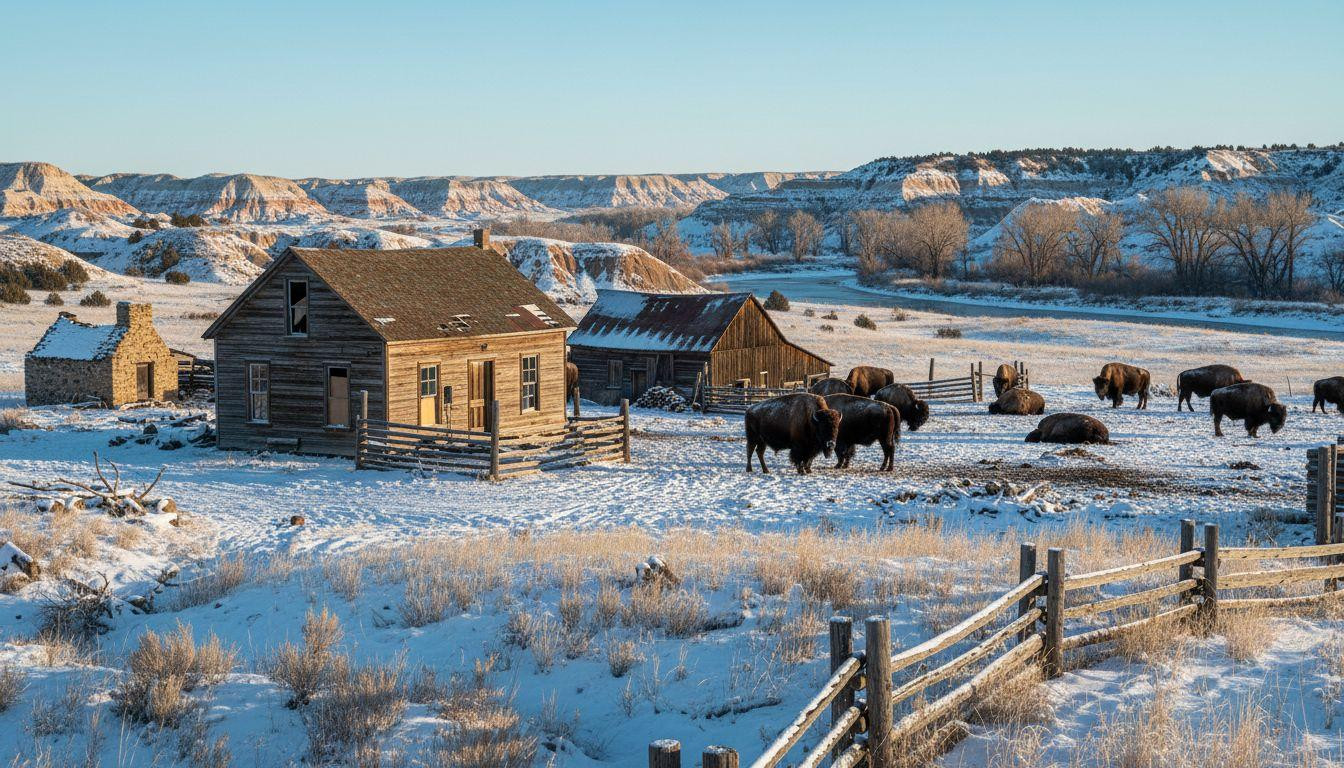
This North Dakota ranch where winter frost reveals 1885 badlands solitude sits three miles from Medora, cradled by layered clay ridges that glow ivory and rust under December snow. Morning light touches weathered ranch house boards while bison move like dark shadows across white prairie silence.
Most visitors rush through Theodore Roosevelt National Park in summer heat. They miss what winter unveils at Peaceful Valley Ranch.
Where Theodore Roosevelt’s frontier still stands
The South Unit Scenic Loop winds through badlands carved by ancient rivers. Snow dusts eroded buttes that frame the only original ranch house remaining in this section of the park.
Built in 1883 by rancher Eldridge Paddock, this two-story frame structure survived when neighboring homesteads crumbled. Federal acquisition in 1936 preserved what private ownership might have lost. The ranch served as park headquarters until 1959, then hosted guided horseback rides until 2014.
Functional architecture defines frontier building. Simple wood frame construction withstands badlands wind and temperature swings from 10°F winter lows to 90°F summer highs. No decorative elements distract from utilitarian purpose.
Weathered lumber tells stories of Dakota Territory ranching when cattle operations stretched across unfenced grassland. Rusted hardware and hand-hewn timber connect visitors to 1880s frontier life.
What winter reveals about 1880s ranching life
December transforms badlands clay into a cinematic backdrop. Snow settles in ridgeline crevices while exposed slopes reveal buff and rust sediment layers deposited 65 million years ago.
When snow transforms the landscape
Winter temperatures drop to 10-30°F during December days. Nights plunge much colder. Early ranchers faced these conditions without modern heating or insulation.
Snow clarifies the isolation these families endured. The nearest neighbor lived miles away across roadless prairie. Supply runs to Medora required day-long journeys through conditions that challenge modern 4WD vehicles.
The structures that tell ranching stories
Original outbuildings included a barn and blacksmith shop. These structures supported cattle operations that defined territorial economics. National Register status protects remaining buildings from weather and time.
Tactile details connect modern visitors to frontier hardships. Touch weathered boards worn smooth by Dakota wind. Examine hand-forged metal hardware crafted before mass production. Feel the gritty clay that early residents tracked across wooden floors.
December mornings with bison and silence
Winter strips away summer’s visual distractions. Leafless trees and snow-covered grass reveal wildlife movement across vast distances. The South Unit supports 300 American bison plus elk, pronghorn, and prairie dogs.
Wildlife encounters in winter
Sunrise and sunset offer optimal viewing conditions. Bison visibility improves dramatically when snow contrasts with dark fur. Herds gather near the Little Missouri River where wind clears grass for winter grazing.
According to North Dakota tourism data, Theodore Roosevelt National Park provides some of the nation’s best wildlife viewing opportunities during winter months. Patience rewards observers with intimate animal encounters impossible during crowded summer seasons.
The experience of frontier solitude
Winter visitor numbers drop to roughly 5,000 monthly compared to 50,000 during July peak season. This 90% reduction creates authentic frontier atmosphere that early ranchers experienced daily.
Sound carries differently in cold, dry air. Wind whistles through clay formations. Distant bison calls echo across empty valleys. Ranch house boards creak in temperature changes. Human noise disappears.
This isn’t loneliness. It’s purposeful quiet that connects modern visitors to historical solitude that shaped frontier character.
Planning your winter ranch visit
The South Unit Scenic Loop reopened in late November 2025 following $51 million in repairs. Winter conditions may still close sections during heavy snow or ice formation.
All-wheel drive vehicles handle most conditions. Carry emergency supplies including blankets, food, and water. Cell service remains spotty throughout the park.
Medora offers winter lodging from $80-130 nightly at budget motels to $150-250 at boutique properties. Many restaurants reduce hours during low season. Park entrance costs $30 per vehicle for seven-day access.
The visitor center operates shorter winter hours. Check current conditions before traveling. Dawn and dusk provide optimal light for photography and wildlife viewing opportunities.
Your questions about Peaceful Valley Ranch answered
Can you go inside the ranch house?
The historic ranch house remains closed to interior visits for preservation purposes. Exterior viewing provides excellent photography opportunities. The best vantage points include the parking pullout and nearby trails that frame the building against badlands ridgelines.
How cold does it really get?
December daytime highs typically reach 10-30°F with much colder nights. Wind increases perceived cold significantly. Layered clothing, insulated boots, and winter hats become essential. The cold enhances rather than diminishes the frontier experience.
How does this compare to summer visits?
Winter offers 90% fewer visitors than July’s peak crowds. Wildlife visibility improves dramatically when snow provides contrast. Access requires more preparation due to shorter daylight hours and possible road closures, but rewards include authentic frontier atmosphere and exceptional photography conditions.
Morning frost outlines every weathered board and rusted nail on the ranch house facade. Badlands ridges catch first light while bison breath creates small clouds in crystalline air. This is Theodore Roosevelt’s Dakota Territory, preserved in winter silence.