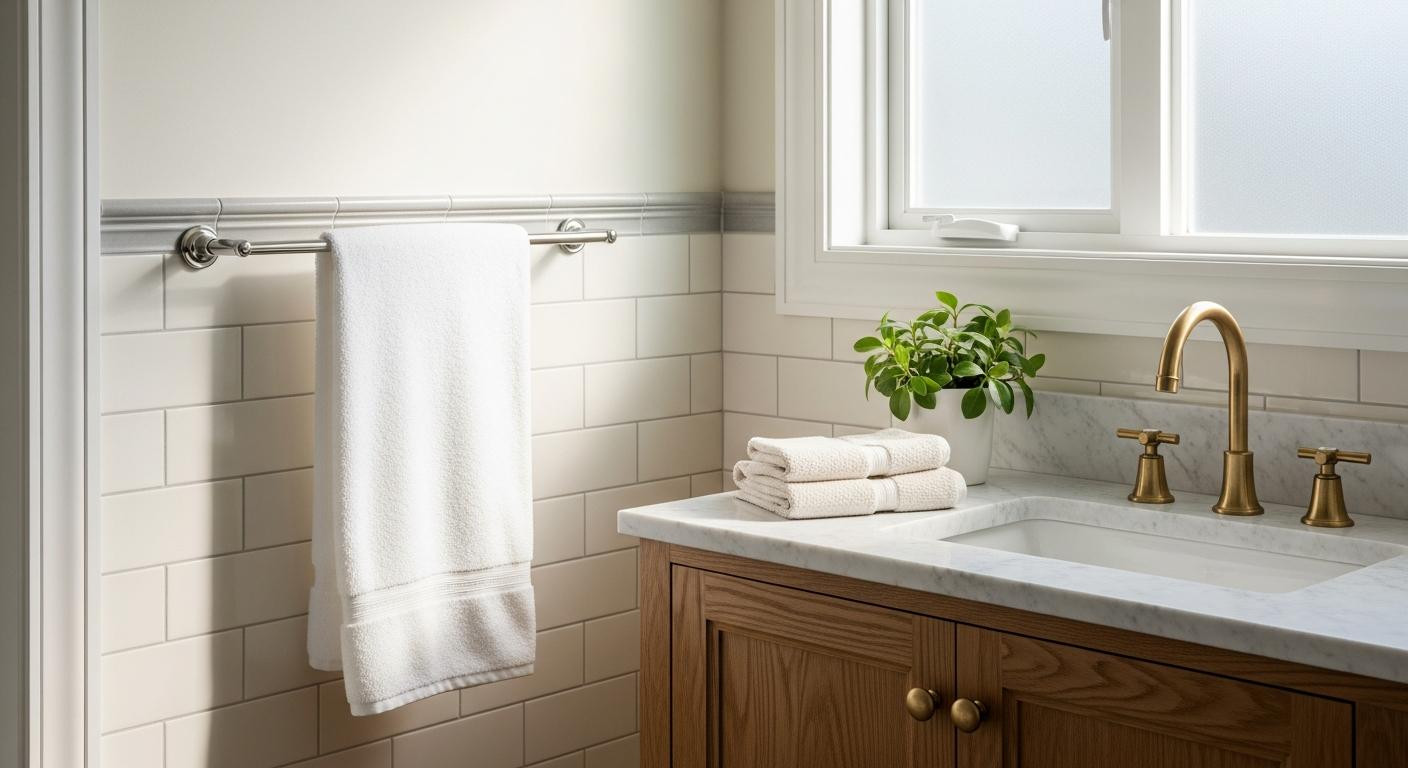
Your bathroom towel bar sits at 36 inches because that’s where the builder’s template marked it in 2018, or where the previous tenant eyeballed it with a level on a Wednesday afternoon. You bend slightly every morning to grab the hand towel, a motion you’ve repeated 400 times without questioning why your shoulder dips forward. The National Kitchen and Bath Association specifies 48 inches from floor to center bar for standard adult use. That 12-inch gap makes your 65-square-foot bathroom feel compressed, like the ceiling dropped six inches when someone miscalculated.
Walk into a hotel bathroom and your hand meets the towel at natural arm height. Walk into your rental and you’re reaching down toward the baseboard trim. The difference isn’t the towel quality or the lighting, it’s the installer who used a 36-inch measurement meant for children’s bathrooms and called it universal.
Why 36 inches creates the daily strain you ignore
A 36-inch towel bar forces anyone between 5’6″ and 6’2″ to bend at the waist or extend arms downward at an angle that tightens the lower back over months. Your natural arm swing when standing upright lands between 42 and 50 inches, depending on torso length. Reaching below that midline 14 times a week adds up to subtle chronic strain.
And it’s not just your spine. The towel edge drags across the vanity when you pull it free because standard vanities measure 32 to 34 inches high. A 36-inch bar leaves only two inches of clearance, turning every towel grab into a minor furniture collision. Professional ergonomics consultants recommend the 48-inch standard specifically to align with standing reach zones that don’t require spinal flexion.
The morning sequence becomes automatic: shower steam still clinging to the mirror, wet hands reaching down instead of out, the cotton terry catching on the faucet handle. You’ve adapted to bad installation without realizing the bar should meet you, not the other way around.
The spatial trick 48 inches creates in cramped bathrooms
Lower towel bars pull your visual anchor downward. When the highest frequently-used element sits at 36 inches, your eye settles there, making 8-foot ceilings feel like 7 feet. The 48-inch placement lifts the visual midpoint, creating vertical stretch that makes narrow bathrooms feel properly proportioned instead of pressed flat.
But here’s the contrast that matters: it’s not about making the room feel bigger, it’s about making it feel calibrated. A 36-inch bar reads as afterthought hardware. A 48-inch bar reads as intentional architecture, especially when paired with the eucalyptus-first bathroom approach where every element earns its height.
Standard vanities create a horizontal line at 32 to 34 inches. A 36-inch towel bar sits only four inches above that plane, reading as visual clutter rather than distinct layers. The 48-inch placement establishes 14 to 16 inches of breathing room between elements, allowing each fixture to register separately instead of stacking into a single congested zone.
When to break the 48-inch rule without regret
Kids under 4’6″ need towel bars at 36 inches to reach independently without step stools dragged across tile. The solution isn’t permanent low mounting, it’s Command hooks rated for 5 pounds at temporary heights during ages 3 through 9. As children grow two to three inches annually, the 48-inch bar becomes functional by age 10, while adhesive hooks peel off without drywall scars.
And wheelchair users require bars between 42 and 48 inches per ADA forward-reach standards, measured from floor to bar center. In shared bathrooms, install the primary bar at 44 inches, a compromise that works for both standing and seated users without requiring dual installations. This splits the difference between ergonomic ideal and accessibility requirement, landing in the zone where most hands meet fabric without strain.
The fix that costs less than dinner for two
Professional repositioning runs $75 to $134 per bar, including removal, patching four screw holes, and new mounting. DIY costs drop to $20 if you reuse the existing bar and buy only wall anchors, spackle, and primer from Home Depot. The patch job takes 90 minutes: fill the old holes Tuesday evening, sand smooth Wednesday morning, prime and paint that afternoon.
But renters can’t drill new holes without risking deposits. That’s where vertical towel hooks mounted above the existing 36-inch bar create a functional 48-inch height without removing the low bar. 3M Command hooks hold wet towels weighing 1.8 pounds without surface damage. The low bar becomes hand-towel-only territory, similar to rental bathroom tricks that work around permanent fixtures.
Freestanding ladder-style towel racks offer another exit: 60 to 72 inches tall, leaned against the wall, no mounting required. They provide multiple height options and move with you on lease-end day.
Your questions about towel bar height answered
What if I’m shorter than 5’4″?
The 48-inch standard still works for adults 5’0″ to 5’4″ because it aligns with natural arm extension when standing upright. Measure from your shoulder to your fingertips, typically 24 to 26 inches. Your hand meets the bar without bending or reaching overhead. Discomfort starts when bars mount above 52 inches, requiring upward reach that strains shoulders for shorter users, breaking the same rule the 57-inch art hanging rule addresses for wall decor.
Should hand towel rings match the bar height?
Hand towel rings typically install 48 to 52 inches high, positioned 8 to 12 inches to the right or left of the sink rather than directly above. This keeps the hand towel within reach while wet hands are still over the basin, preventing water drips across three feet of floor between sink and wall-mounted bar. The height match creates visual continuity without functional redundancy.
Does this apply to heated towel racks?
Heated towel racks follow the same 48-inch guideline, measured to the center horizontal rail. Electric models plugged into GFCI outlets can mount anywhere within six feet of the outlet without hardwiring concerns, making height adjustment easier than traditional bars requiring precise stud locations. Once you fix the height, Amazon towels that make rental bathrooms feel like hotels complete the sensory upgrade.
Tuesday morning at 7:48, the towel hangs where your hand meets it without thought. No bend, no reach, no muscle memory compensating for someone else’s lazy measurement. Steam rises past white cotton at 48 inches, clearing before the fabric cools, because proper height leaves room for air to move.