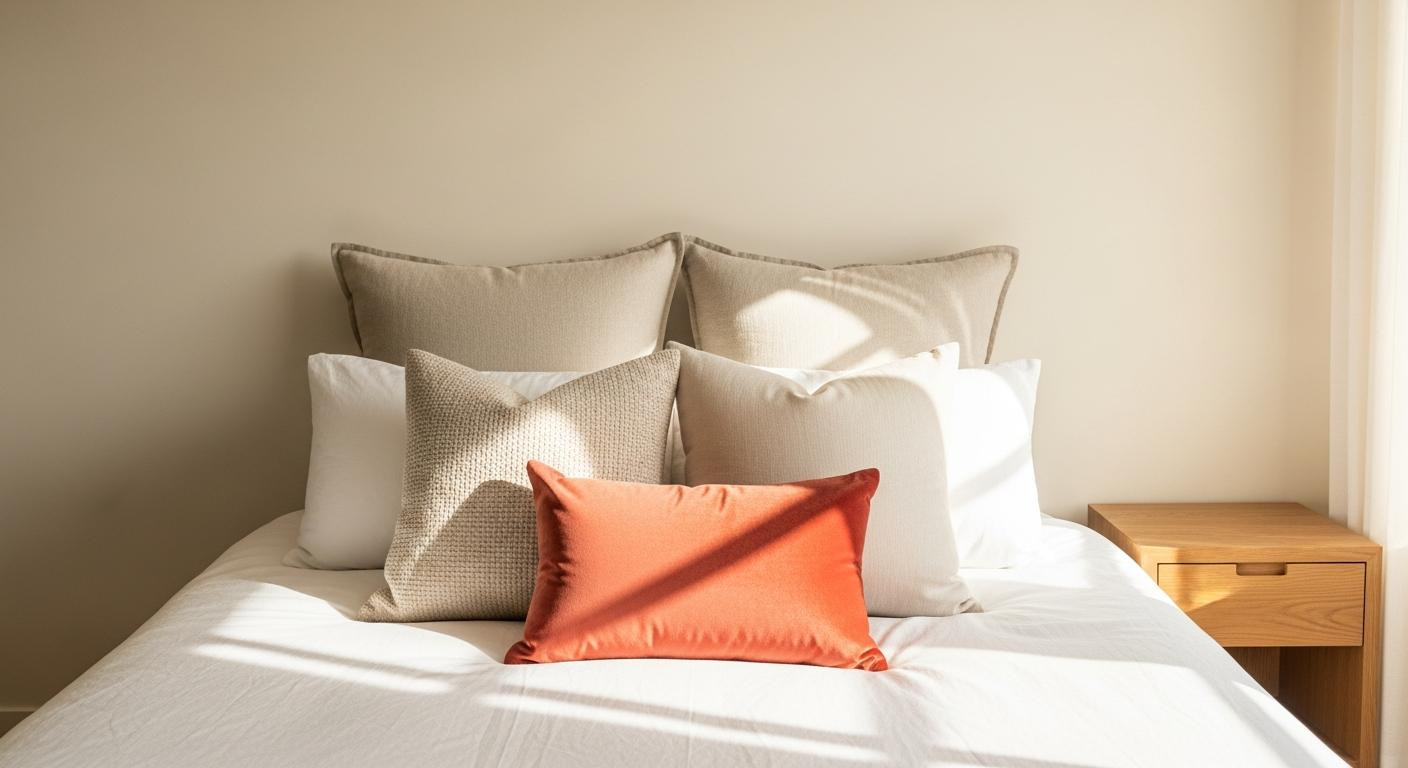
Your bed sits flat against the wall at 7:42am Tuesday, two pillows punched into submission, reading temporary despite rent costing $1,650 monthly. At the Ritz-Carlton last October, you counted five pillows stacked in descending sizes, each texture catching afternoon light differently. The setup looked effortless but followed rules you couldn’t decode until now.
Hotels pay staging consultants to perfect these arrangements. The actual formula costs $95 to $140 at Target, IKEA, and Amazon, takes 22 minutes to build, and works on any queen bed in any 250-square-foot bedroom. Here’s the exact system.
The 5-pillow sizing sequence hotels actually use
Hotels follow a back-to-front sizing pattern: two 26-inch Euro shams against the headboard, two 20-22-inch decorative pillows mid-layer, one 18-20-inch accent or 12×20-inch lumbar front. And it’s not random decoration. The decreasing sizes create depth perception, your eye reading dimension instead of clutter.
Design experts featured in Architectural Digest confirm hotels decrease pillow sizes by 4-6 inches per layer to anchor a 60-inch-wide queen headboard instead of letting it float. That’s the balance that makes this setup work. The textured layers absorb morning light rather than reflecting it flat, the way two sleeping pillows do.
But size alone doesn’t explain why hotel beds photograph better than yours. Texture progression matters more than most people realize.
Why texture builds hotel richness without pattern chaos
Hotels choose matte textures for back layers because they diffuse light instead of bouncing it harsh. A woven linen pillow has visible slubs that create micro-shadows, the surface reading warmer than smooth cotton at identical thread counts. Bouclé adds dimensional loops that shift as you walk past the bed.
And then one sheen layer changes everything. The fourth-layer velvet or satin-like pillow introduces controlled reflection. Hotels position sheen pillows where bedside lamps hit at 9pm, the fabric glowing amber instead of cold.
This only works when surrounded by matte textures. Two sheen pillows read Christmas catalog, not boutique hotel. Professional organizers with certification note that one pattern pillow maximum keeps the stack from feeling busy, especially when paired with solid textured bases.
The exact $100 budget stack versus the $280 designer version
Two IKEA bouclé 20-inch pillows at $19.99 each form the back layer for $40 total. One Amazon Basics tone-on-tone geometry 20-inch pillow adds subtle pattern for $15.99. One Target velvet metallic 18-inch in coral or rust costs $22. An optional Amazon lumbar 12×20-inch completes the front for $16.99.
Total: $94.98 before tax. This combination uses rental-friendly neutrals with one warm accent, the formula working in north-facing bedrooms where color saturation matters less than texture depth.
But here’s where designer versions actually improve. West Elm’s bouclé 24-inch pillows at $89 each use thicker fills that hold shape after six months of daily rearranging. Pottery Barn’s soft geometry 22-inch pillow at $59 has cotton-linen blends that resist pilling.
The upgrade trades longevity for upfront cost but follows identical texture formulas. Lighting designers with residential portfolios note that budget pillows flatten faster, requiring annual replacement versus 18-month cycles for designer options.
What breaks the formula faster than cheap pillows
Mismatched sizes destroy hotel effects instantly. A 26-inch back pillow next to an 18-inch mid-layer creates 8-inch jumps the eye reads as error, not intention. Hotels never exceed 6-inch size decreases per layer, which helps balance all the white without visual chaos.
And pillow overstuffing makes stacks topple by 9am, understuffing reads deflated by afternoon. The IKEA bouclé arrives slightly underfilled, improving after one fluff cycle. All-pattern stacks without solid texture anchors feel busy, not layered.
The formula requires two solid textures minimum, pattern and sheen as accents only, lumbar as optional shape variation when the bed feels too horizontal. That said, even perfect sizing fails if you ignore bed width.
Your questions about the 5-pillow hotel formula answered
Do I remove sleeping pillows before adding the formula?
Hotels stack decorative pillows in front of sleeping pillows, the five-layer formula sitting forward on the bed. You sleep with your regular pillows, toss the decorative stack onto a bench or chair nightly. This takes 30 seconds before bed, 45 seconds to rebuild mornings.
Storing decorative pillows inside a storage ottoman or under-bed box when not photographing the room works for renters managing limited space. Admittedly, it’s easier said than done in apartments under 300 square feet.
Can this work on full or king beds?
Full beds at 54 inches wide use 22-24-inch back pillows instead of 26-inch to avoid overhang. King beds at 76 inches need three back pillows instead of two to fill the wider headboard. The mid-layer and accent sizing remains identical across all bed sizes.
Professional staging consultants confirm that three 26-inch pillows on a king create 78 inches of width, causing slight overhang that reads sloppy in photos.
How long do budget pillows maintain shape?
IKEA bouclé and Target textured pillows hold structure for 8-12 months with weekly fluffing. Velvet sheen pillows fade after 15-20 washes. Replace back-layer pillows annually, accent layers every 18 months.
Total annual refresh cost: $45-60. This is one of those budget upgrades that quietly improves how a space feels without requiring professional help.
Morning light hits the coral velvet at 8:17am, the texture glowing against taupe bouclé that absorbs the rest. Your hand rests on the lumbar pillow, the 12×20-inch rectangle anchoring the stack without bulk. The bed photographs like the Ritz but costs what you’d spend on takeout.