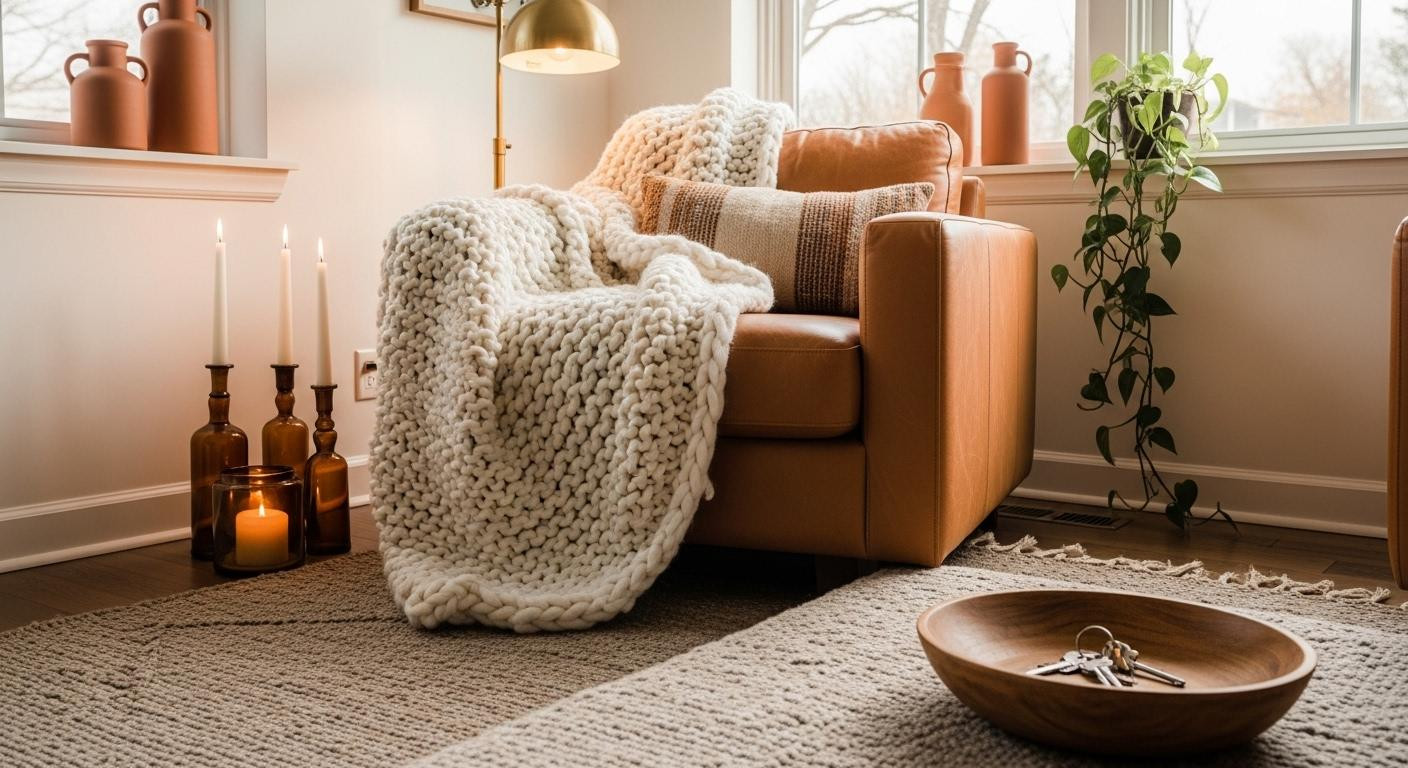
You have decluttered three times this winter. The throw pillows are gone. That textured rug you loved sits rolled in the closet. Your 380 square foot living room feels emptier, colder, somehow smaller than before. Every minimalism blog promised this strategy would expand your space. Instead, you are sitting in a white box that feels like a waiting room. Here is what those blogs never mentioned: designers creating the most-saved small-space sanctuaries in 2026 use the opposite approach. They layer textures, scatter soft light sources, and embrace warm tonal palettes. The transformation costs under $300 and takes one weekend.
The small-space minimalism myth designers want dead
The belief that small spaces need minimalism to feel larger started with good intentions. Scandinavian design principles emphasized clean lines and open surfaces. Marie Kondo’s 2014 book reinforced decluttering as the path to spatial peace. Pinterest algorithms favored stark white rooms with three items per shelf. By 2020, minimalism became the default advice for anyone living in under 500 square feet.
Here is the problem: visual minimalism creates psychological coldness that actually shrinks perceived space. According to design professionals featured in House Beautiful, refined layering using natural materials and warm lighting is replacing trend-heavy sparse styling as the strongest direction for winter homes. Your empty room feels smaller because there is nothing to anchor your eye or create depth. The solution is not less. It is intentional more.
The 4-layer maximalist formula that creates winter glow
This formula works in rentals, studios, and apartments from 300 to 700 square feet. Each layer is non-permanent and portable. Total investment: $250 to $800 depending on your budget tier. Implementation time: 2 to 4 hours with no tools required.
Layer 1: texture foundation with rugs and throws
Start with your floor and furniture. A 5×7 base rug in warm cream or soft taupe anchors the room. Layer a smaller 3×5 textured rug over one corner to zone your seating area. According to professional organizers with certification, rug layering adds comfort and visual interest that makes small living rooms feel intentionally collected rather than staged.
Add chunky knit throws to every seating surface. Drape one over your sofa arm. Fold another across your chair back. Budget options from Target Threshold cost $25 to $50. Mid-range West Elm throws run $70 to $120. The texture of natural materials creates warmth that smooth surfaces cannot match.
Layer 2: scattered soft light replaces overhead harshness
Turn off your overhead LED. Overhead lighting at 4000K flattens small rooms and emphasizes every empty corner. Replace it with three to five scattered light sources at 2700K. One table lamp on your side table. Three varied glass candlesticks on your coffee table. Two pillar candles on your bookshelf.
IKEA GLIMMA tealights cost $4 for 100. Target Brightroom glass holders run $15 to $30 per set. Project 62 table lamps start at $30. This scattered approach creates visual depth by casting multiple soft shadows. According to lighting designers with residential portfolios, layered lighting at warm temperatures transforms spatial perception more than any furniture arrangement.
Layer 3: tonal color depth instead of white walls
White walls reflect light but provide no visual anchor. Warm neutrals absorb and soften light in ways that actually expand perceived space through tonal depth. Benjamin Moore Swiss Coffee has a light reflectance value of 82.2, offering warmth without darkness. Sherwin-Williams Accessible Beige at LRV 47 adds grounding depth to accent walls.
You do not need to paint if you rent. Use tonal layering through textiles instead. Cream base rug, soft taupe overlay, ivory throw, warm beige pillows. This gradient approach creates the put-together feeling that design studios recommend for small spaces without requiring landlord approval.
The shopping strategy: budget breakdown for every tier
Budget tier ($250 to $400): IKEA STOENSE rug 5×7 for $100. Target Threshold overlay 3×5 for $40. IKEA LAMPAN lamp for $30. Target Threshold throw for $30. IKEA GLIMMA candles for $4. Benjamin Moore paint sample for $15. One pothos plant for $10. Wooden bowl for $15. Total: approximately $244 before tax.
Mid-range tier ($400 to $600): Wayfair Safavieh rug for $150. West Elm throw and lamp for $200. CB2 candleholders for $50. Accessories for $85. Paint sample for $15. Total: approximately $500.
Splurge tier ($600 to $800): West Elm Kasbah rug for $300. Pottery Barn throw for $150. West Elm lamp for $100. Premium candles for $20. Tonal paint and curated accessories for $130. Total: approximately $700. This achieves Restoration Hardware aesthetic at accessible prices.
Layer 4: lived-in accessories prevent catalog coldness
The final layer separates sanctuary from showroom. Small wooden bowls hold remotes or jewelry. Ceramic vessels in varying heights sit on shelves. One pothos or snake plant fills the corner your minimalist phase left bare. These items cost $10 to $40 each at Target Hearth and Hand or $30 to $80 at West Elm.
According to design professionals, layering with intention differs from filling with clutter. Each piece serves dual function: beauty and purpose. The wooden bowl catches your keys. The ceramic vessel holds pens. The plant purifies air. Your space starts feeling collected rather than styled. This lived-in approach works in studios and one-bedrooms equally.
Total implementation time: 2 to 4 hours from start to finish. Unroll your base rug in 10 minutes. Layer the overlay in 5. Drape throws in 15. Place candles and lamp in 30. Style accessories in 20. Your entire transformation happens in one Saturday afternoon without tools or landlord permission.
Your questions about small-space winter glow answered
Will adding more layers make my 400 square foot apartment feel cluttered?
Strategic layering differs from random accumulation. Each piece serves dual function and follows tonal cohesion. You are varying textures within the same warm neutral color family. This prevents visual chaos. Professional organizers confirm that rug layering zones spaces through intentional placement rather than random addition. The key is editing what you already own before layering what you need.
Can renters implement this formula without damaging walls?
Every layer is non-permanent and portable. Rugs sit on floors. Throws drape on furniture. Candles rest on surfaces. Lamps plug into existing outlets. No wall mounting required. No adhesives needed. Your entire investment travels with you to your next apartment. This approach respects lease restrictions while delivering luxury feeling.
What if my budget only allows the $250 tier?
The IKEA and Target route delivers 80 percent of visual impact. Prioritize one textured rug for $80 to $150. Add two chunky throws for $50 to $80 total. Buy a candle variety pack for $15 to $30. Invest in one warm-toned lamp for $40 to $60. Total: approximately $240. Upgrade ceramic vessels and wooden bowls later through thrift stores. The texture foundation and lighting layers create the most dramatic transformation.
You walk into your living room at 7pm on a January evening. Candlelight catches the layered rug edges where cream meets taupe. Your hand finds the chunky throw draped over the sofa arm. Soft lamp glow pools on the wooden bowl holding your keys. The room does not feel bigger. It feels warm, intentional, collected. It feels like the sanctuary you needed all winter. This is what designers mean by living well in small spaces.