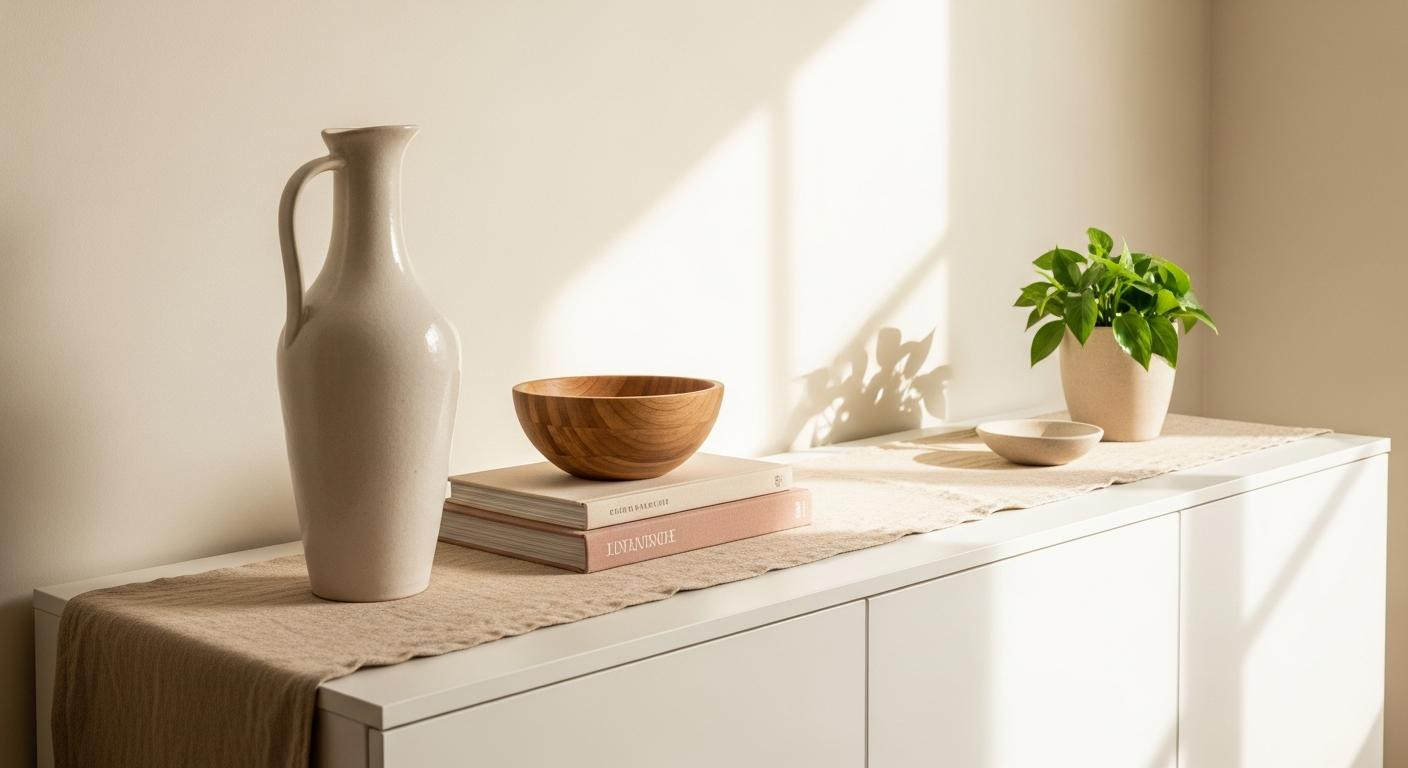
Your sideboard holds nine objects Tuesday afternoon when you step back to assess what’s not working. Two picture frames lean against the wall, a bowl sits in the center, candles flank the edges, a plant trails over the side. The surface looks neither empty nor styled, just occupied.
Designers don’t arrange sideboards object by object. They think in three horizontal zones that divide the surface into distinct visual roles: a tall anchor zone, a mid-level transition zone, and a low grounding zone. Miss one zone and the entire composition reads as unfinished, regardless of how much you’ve placed there.
The tall zone anchors everything between 20 and 30 inches
Your sideboard needs one element that reaches between 20 and 30 inches above the surface to create a vertical boundary where your eye stops traveling. Without this anchor, the entire arrangement feels temporary, like objects waiting to be put away.
Designers place this tall element off-center, typically one-third of the way from either edge, because centered height reads as formal symmetry that stiffens the composition. The tall zone works when it contrasts with the surface texture: a woven basket on glossy wood, a ceramic vase on reclaimed pine, a framed mirror on painted MDF.
This zone fails when the object is too thin, under 6 inches wide, because it reads as decorative accent rather than visual anchor. The width matters as much as the height. And when you position tall objects on both ends of the sideboard, they trap the eye instead of guiding it across the surface.
The mid zone fills transition space at 10 to 18 inches
The space between your tall anchor and the surface needs transitional height that connects vertical to horizontal. According to ASID-certified interior designers, this range should fall between 10 and 18 inches to create proper visual layering.
But one mid-zone object reads as lonely. Two objects at identical heights read as bookends. The successful mid-zone uses different shapes at similar heights: a 14-inch bowl beside a 16-inch stack of books, a 12-inch plant next to an 18-inch box.
The objects shouldn’t match in finish or material. Smooth ceramic beside rough wood, glossy glass beside matte metal. That contrast is what makes each piece register separately instead of blurring into a single mass.
Why 6 inches of empty surface between objects prevents clutter
Your mid-zone objects need minimum 6 inches of empty surface between them or they merge into a single visual mass. Designers measure this gap from outside edges, not centers.
Objects closer than 6 inches create clutter. Objects more than 18 inches apart create two separate arrangements instead of one cohesive zone. The gap should show the surface material underneath, which grounds the objects in place rather than making them float.
The low zone grounds everything at 4 to 8 inches
Objects under 4 inches disappear visually unless they sit at the front edge where downward sight lines catch them. Professional organizers with certification confirm that the 4-to-8-inch range works for objects that spread horizontally: a tray holding smaller items, a stack of coffee table books, a wide shallow bowl.
These pieces work because width compensates for minimal height. A single 5-inch object in the middle of the sideboard reads as forgotten clutter, not intentional styling. The low zone succeeds when it extends toward the front edge, creating depth from back to front instead of just left to right.
Your low zone needs surface texture that contrasts with both the sideboard finish and the objects above it. A smooth lacquer tray on a glossy sideboard vanishes. A woven basket on raw wood creates separation that your eye can actually register.
Empty space between zones matters more than the objects
Your sideboard zones fail when objects crowd each other, even if you’ve hit all the right heights. Designers leave minimum 8 inches of bare surface visible between zone groupings because empty space defines where one zone ends and another begins.
This breathing room keeps three zones from collapsing into one cluttered mass. The space should show the sideboard’s actual surface, not be filled with smaller objects that blur boundaries. It’s similar to the spatial breathing room that makes furniture arrangements work in larger room layouts.
And when you step back and can’t identify where zones separate, you’ve lost the system that makes styling look professional instead of accidental. That’s the difference between a composed surface and a dumping ground.
Your questions about the sideboard styling trick answered
Can I use this system on a console table or dresser top?
The three-zone system works on any horizontal surface between 40 and 72 inches wide. Narrower surfaces under 40 inches need only two zones because three zones crowd the space.
Wider surfaces over 72 inches can support two sets of three zones, positioned at opposite ends with empty space in the center. The height zones remain consistent regardless of furniture type: tall 20-30 inches, mid 10-18 inches, low 4-8 inches.
What if my sideboard sits under a window?
Window placement limits your tall zone to objects that don’t block natural light or sightlines. Lighting designers with residential portfolios note that this is where overhead lighting turns your space institutional, so the tall zone needs to shift.
Designers move the tall zone to one end, placing it beside the window rather than underneath. The mid and low zones continue across the center section, but the composition becomes asymmetrical by necessity. This actually creates more visual interest than centered arrangements, similar to why designers stopped creating perfect symmetry in other contexts.
Do zones work with existing objects I can’t remove?
Audit what’s already there for height and assign each piece to a zone. You’ll likely find everything clusters in one or two zones, leaving the third empty.
Add only what fills the missing zone. Designers work with inherited objects by editing ruthlessly: remove mid-zone items until only two remain, eliminate low-zone pieces that lack width, replace short tall-zone objects with something that hits 24-plus inches. The zone system works as a diagnostic tool that shows you exactly what’s missing or excessive, much like how empty corners become intentional negative space when properly defined.
Your sideboard reads differently Thursday evening after you’ve moved the lamp 14 inches left and removed the picture frames. Light hits the tall ceramic vase at an angle now, casting shadow across the wooden bowl in the mid zone. The empty surface between zones feels intentional.