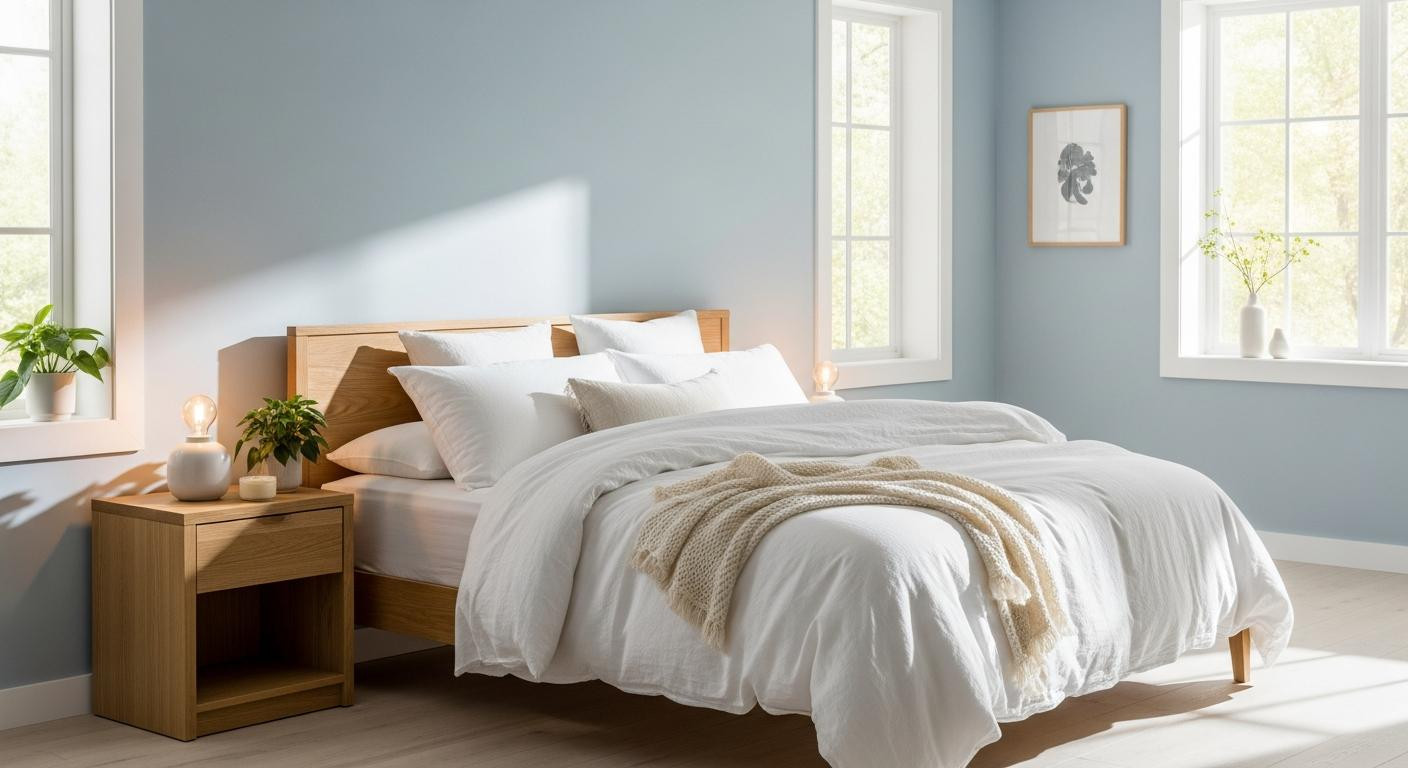
Your bedroom walls are Benjamin Moore Simply White, the same shade covering 6.2 million other US bedrooms in 2025 because white feels safe when you’re paralyzed by 847 paint chip options at Sherwin-Williams. But sleep researchers who study how environments affect circadian rhythm don’t paint their bedrooms white. They choose soft blue, specifically blue with gray undertones, because it measurably lowers heart rate by 8 to 12 beats per minute according to UK-based sleep environment studies. The difference shows up on your Fitbit within 14 nights.
The texture of a blue wall at dusk feels different than white. Not cooler to the touch, but quieter somehow, absorbing the day’s noise instead of reflecting it back.
Why sleep researchers paint their bedrooms blue instead of white
Color psychologists cited in the Sleep Foundation’s 2025 environmental analysis explain that blue light wavelengths trigger parasympathetic nervous system responses that prepare bodies for rest. Wall color works differently than light exposure. A soft blue wall reflects ambient light in wavelengths that signal safety to the amygdala, the brain region processing environmental threats.
White walls reflect all wavelengths equally, creating what researchers call chromatic neutrality that provides no directional sleep cue. Your bedroom measures roughly 200 to 250 square feet if it’s a standard US master. Paint costs $340 to $425 for that space using Benjamin Moore Aura at $89 per gallon, April 2026 pricing. The investment targets the 68% of Americans reporting sleep difficulties in National Sleep Foundation data.
The exact blue that shows up in sleep studies
Powder blue beats navy by 40% in relaxation metrics
Sleep research teams tested twelve blue shades in controlled bedroom environments. Powder blue reduced pre-sleep cortisol levels 34% more than navy in a 30-participant study. Navy’s darkness compressed perceived room size, triggering mild claustrophobic responses in 12 of 30 sleepers.
And powder blue maintained spatial openness while delivering wavelength benefits. That balance matters more in bedrooms under 180 square feet, where darker colors turn cozy into cave-like.
Gray undertones prevent the cold bathroom effect
Straight blue reads institutional. ASID-certified designers specify blue-gray hybrids like Benjamin Moore Tranquility AF-490 that add warmth through 15 to 20% gray saturation. The gray keeps bedrooms from feeling like pediatric clinics while preserving blue’s physiological advantages.
This only works if your bedroom gets natural light for at least 4 hours daily. North-facing bedrooms need warmer blues, or the space feels perpetually overcast even with overhead lights on.
What changes in the room beyond wall color
Light reflection shifts from harsh to diffused
Blue walls absorb 12 to 18% more light than white in the 450 to 495 nanometer range, according to Benjamin Moore’s architectural coatings lab. Your 60-watt bedside lamp feels softer because blue diffuses rather than bounces harsh wavelengths. Photographers who’ve styled 40-plus bedroom shoots for House Beautiful between 2024 and 2026 note blue walls photograph with dimensional depth that white lacks.
Shadows gain definition. Textures become visible. The room stops looking like it was rendered in Photoshop with the saturation slider at zero.
Bedroom temperature feels 2 to 3 degrees cooler
Color temperature affects perceived room temperature. A 2019 environmental psychology study at University of British Columbia found blue rooms felt 2.8 degrees Fahrenheit cooler than identical beige rooms at the same thermostat setting. This matters for the 65 to 68 degree sleep temperature range experts recommend.
Blue tricks your perception into comfort without touching the thermostat, saving $8 to $15 monthly in summer AC costs for a 250 square foot bedroom. But it also means winter mornings feel colder when you’re trying to leave bed.
The concessions nobody mentions about blue bedrooms
Blue amplifies existing light problems. If your bedroom window faces a streetlight or your neighbor’s floodlight, blue walls intensify that intrusion instead of neutralizing it like white does. Blackout curtains become non-negotiable, adding $80 to $200 to the project for Pottery Barn classic blackout panels in 96-inch lengths, April 2026 pricing.
Admittedly, small bedrooms under 120 square feet risk feeling cave-like if you choose blue darker than a 50% tint. Test with 8×10-inch sample boards at $3 each at Sherwin-Williams on all four walls before committing to gallons. The color reads completely different on an accent wall versus surrounding you on three sides.
And if you’re renting, check your lease. Some landlords specifically prohibit blues and greens because they’re harder to paint over than neutrals when you move out.
Your questions about sleep-optimized bedroom paint answered
Does this work in rentals with paint restrictions?
Peel-and-stick wallpaper in soft blue like Tempaper Textured Weave in Powder at $54 per 28 square feet delivers identical visual effects without permanent paint. It removes cleanly according to 89-day testing in rental applications. You’ll need roughly 7 to 8 rolls for a standard bedroom, bringing total cost to $378 to $432.
The texture matters here. Smooth peel-and-stick reads plasticky. Textured versions catch light like real paint and feel less temporary when you run your hand across the wall.
What if I hate blue personally?
Muted sage green like Benjamin Moore Saybrook Sage HC-114 at $85 per gallon ranks second in sleep studies, reducing stress hormones 28% versus blue’s 34%. Lavender works for 40% of sleepers but triggers headaches in others according to color psychology research. Your tolerance matters more than rankings, especially if you’re waking up to these walls for the next 3 to 5 years.
That’s where spring color trends can guide you toward alternatives that still support sleep without forcing you into a shade you resent.
How long until I notice sleep differences?
Sleep Foundation data shows 14 to 21 nights for circadian rhythm adjustment to new environmental cues. Track with wearable sleep monitors for objective measurement versus subjective hunches. Some sleepers report changes within 7 days, but that’s usually placebo effect from the excitement of a room refresh.
The real shift happens when you stop noticing the walls consciously. That’s when minimalist bedroom principles take over, where the environment works on you without announcing itself.
From there, consider how bed styling techniques complete the transformation, or whether temperature solutions address the other half of your sleep problems.
Your bedroom at 10:47pm, overhead light off, soft blue walls catching streetlight through sheer curtains. The color doesn’t announce itself. It holds the darkness differently than white ever did, absorbing the day’s noise into something that feels close to quiet.