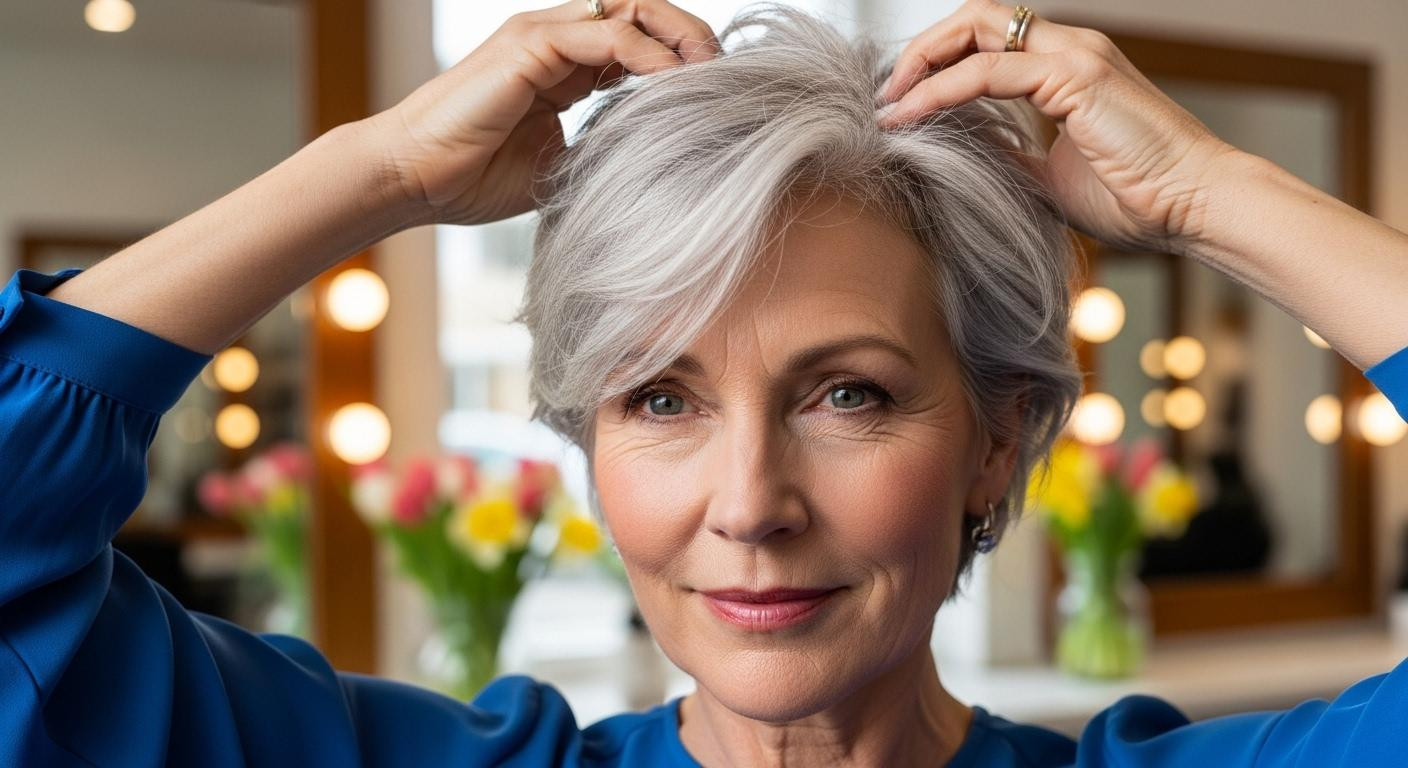
The salon colorist slides a $285 invoice across the counter for your fourth gray-blending appointment this year. Your phone displays 47 saved pixie cuts showcasing luminous silver strands. Two paths diverge: continue the $2,400 annual salon dependency or embrace natural gray through strategic texture.
Celebrity colorists reveal why 2025’s most modern choice rejects industry concealment protocols. These cuts work with gray hair’s unique 30% coarser structure rather than fighting natural biology.
The $2,400 annual gray-concealment industry salon math hides
Traditional salon gray-blending sessions cost $150-$600 per visit every 6-8 weeks. Premium transformations reach $7,000 for complete overhauls requiring multiple appointments. Add purple toner touch-ups at $85 every 4 weeks plus quarterly damage repair treatments at $120.
Annual totals range from $1,200 to $4,800 just for color maintenance. Factor in specialized shampoos, conditioners, and glosses the salon prescribes. The hidden revenue loop compounds when harsh developers damage hair requiring additional repair services.
Why traditional highlighting costs compound after 50
Gray hair’s coarser cuticle structure resists traditional dyes differently than pigmented strands. Salons compensate with stronger chemical formulations and more frequent applications. Each session creates microscopic damage requiring expensive protein treatments.
Professional colorists with decades of experience confirm the industry built gray concealment into a subscription model. The chemistry literally penalizes aging through increased processing time and product consumption.
Gray hair texture requires different chemistry salons rarely disclose
Depigmented strands measure 30% thicker in diameter with reduced moisture retention capacity. This coarser texture makes gray hair naturally resistant to uniform dye penetration. Salons rarely explain why your sessions take longer or cost more than younger clients.
The result: accelerated damage cycles requiring additional services. Your natural biology becomes their recurring revenue stream rather than something to celebrate and enhance.
These 5 pixie cuts work with gray texture instead of against it
Modern pixie variations celebrate gray’s unique reflective properties while minimizing maintenance costs. Each cut leverages coarse texture for natural hold and dimension. Crown elevation techniques add 40% more volume without chemical volumizers.
Tight curly pixie with crown elevation
Type 3 curls combined with salt-and-pepper gray create natural dimension no chemical process can replicate. The rounded silhouette uses coarse texture to maintain shape without daily styling products. Maintenance requires 8-week trims at $60 versus 6-week color sessions at $285.
Point-cutting at crown level lifts naturally wiry gray strands into sculptured texture. The geometric precision signals intentional style rather than neglect.
Textured shaggy pixie with point-cut layers
Point-cutting creates 2mm-3mm varied lengths that catch light differently across gray’s natural color variation. Most heads show 40-60% silver distribution mixed with remaining pigmented strands. The intentional irregularity celebrates transition phases rather than concealing them.
This cut works especially well during the 6-month grow-out period when natural roots meet previously colored ends. Specialized styling tools enhance texture without heat damage.
Soft wavy pixie with browline-skimming fringe
Gentle wave patterns achieved through 1-inch barrel techniques enhance gray’s natural reflective qualities. The brow-grazing length frames mature faces while requiring zero root touch-ups. Gray’s coarser structure holds waves longer than chemically processed hair.
Professional stylists note how silver strands reflect light differently than pigmented hair. This natural luminosity becomes the cut’s focal point rather than something to camouflage.
Product investment: $15 monthly versus $80 monthly purple shampoo regimens
Salon-prescribed gray maintenance systems cost $105 monthly on average. Purple shampoo at $32, violet conditioner at $28, plus weekly gloss treatments at $45 create dependency cycles totaling $1,260 annually. These products treat gray as a color problem requiring constant correction.
Natural embrace approaches focus on texture and moisture instead. Quality texture cream costs $18 quarterly while bond repair masks run $22 every three months. Annual investment: $160 versus $1,260 for chemical suppression systems.
Trichologists specializing in hair structure confirm gray needs hydration and protein rather than color correction. The purple shampoo industrial complex treats natural aging as pathology requiring treatment rather than texture requiring care.
The cultural shift salons resist: gray as 2025’s status symbol
Social media documentation shows 2.5 million #silversisters posts celebrating natural transitions. Celebrity embrace includes Sharon Stone, Jamie Lee Curtis, and Andie MacDowell choosing authentic silver over chemical maintenance. Yet salon trade publications still position gray as damage requiring repair.
Generational data reveals Millennials entering perimenopause choose natural silver 65% more than Gen X did at comparable ages. The economic recession taught this generation to question expensive beauty subscriptions that fight natural processes.
Professional colorists with decades of experience observe the philosophical shift. Fighting gray became expensive theater while embracing it with strategic cuts became revolutionary. Age-specific styling approaches prove natural transitions can be stunning.
Your questions about embracing gray hair with a pixie answered
Will gray hair make me look older than highlighted hair?
Research demonstrates intentional gray with modern cuts reads as confident sophistication rather than neglect. The cut quality matters more than color coverage. Outdated styles with obvious grow-out roots signal maintenance failure while strategic pixies celebrate natural texture.
How do I manage gray hair’s coarser texture daily?
Gray’s 30% coarser structure responds better to moisture-based styling products than alcohol-based formulations salons typically recommend. Leave-in conditioners and texture creams work with the natural wiriness rather than fighting it through chemical smoothing.
What’s the transition timeline from colored to natural gray pixie?
Most professional stylists recommend cutting colored ends every 6 weeks while growing natural gray from roots. Full transition requires 4-6 months with short styles versus years with long hair. Strategic cutting minimizes awkward grow-out phases.
Morning light at 10:47am catches silver strands sculptured into intentional geometry. No appointment anxiety or root touch-up calendar. Just precision celebrating what biology creates naturally with $2,400 annually redirected from concealment toward experiences gray wisdom values.