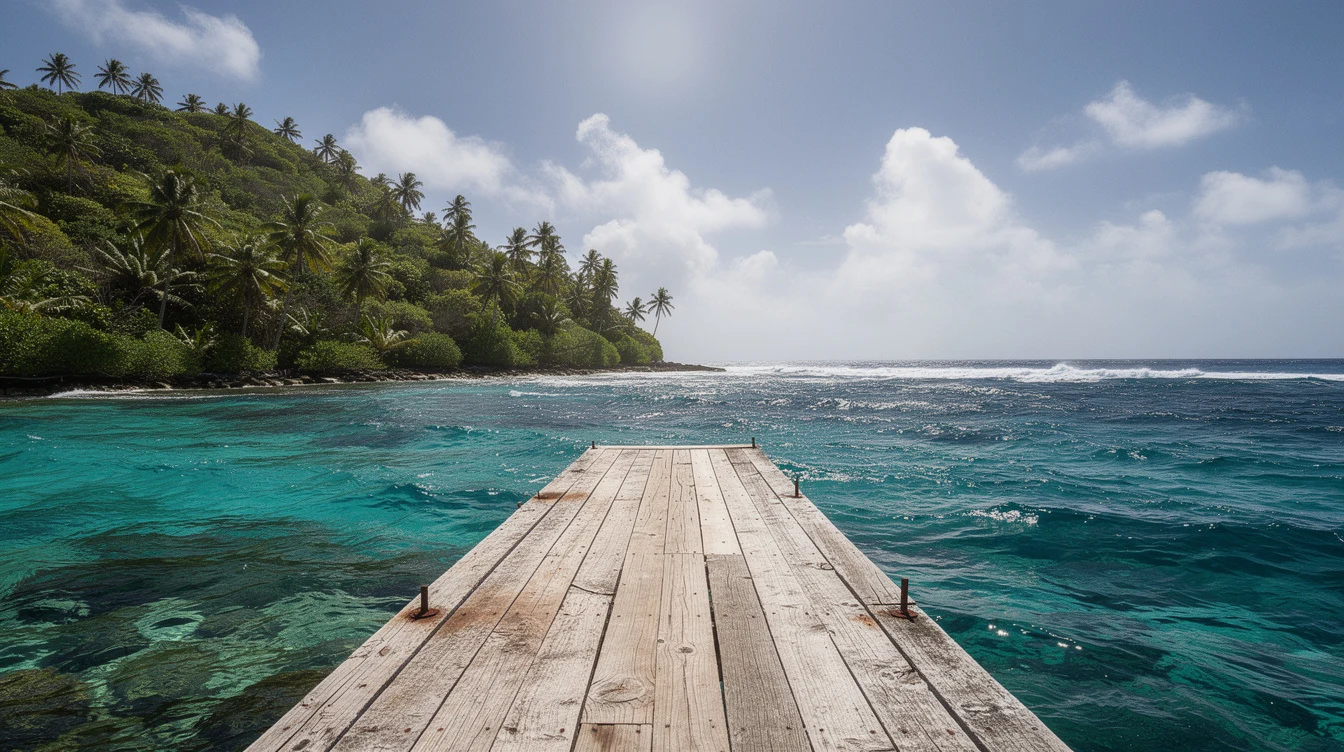
Providencia caps its own tourism at the dock. That is the whole story, and it is why the island still works the way it does.
The island that chose to stay small
You fly to San Andrés first, then catch a local flight or boat. There is no other way in. And because there is no other way in, the numbers stay low.
The buildings stay low too. No high-rises, no cruise terminal, no duty-free mall.
San Andrés went the other direction. It built the resorts, drew the package tours, and now handles the volume Providencia deliberately avoids. The contrast is sharp, and it is the first thing you notice.
But the second thing is the language. English Creole still runs through daily life here, a living thread from the island’s Anglo-Caribbean past. San Andrés diluted that.
Providencia kept it, partly because the tourists never arrived in force, partly because the locals never let them.
What the limited access actually buys you
The water is clear, the reefs are intact, and the pace is slow by design, not by accident. Cayo Cangrejo sits offshore with snorkeling you can reach by boat. The Puente de los Enamorados connects Santa Catalina to the main island, and it is a walk, not an attraction.
There is resistance here to oil exploration and to the kind of development that rewrites a place overnight. That stance has a cost. Infrastructure is modest.
The range of hotels and restaurants is narrow. And the nightlife is thin, because the island is not pretending to be a party destination.
What you get instead is a village rhythm in a Caribbean setting. The catch matters. The reef matters.
The Creole spoken in the street matters. These are not marketing angles. They are the actual fabric of the place, still in use because mass tourism never broke through.
Which Providencia is which
Colombia has two, and the confusion is real. The Caribbean island is the one with beaches and coral. The other is a landlocked town in Nariño department, 2,200 meters up in the Andes, home to about 11,000-12,000 people, cool and rural and not touristic at all.
Almost everything online, the photos of turquoise water and cay trips, is the island. The Andean town barely registers. If you are planning a trip, check the flight path.
San Andrés means the island. Pasto or Ipiales means the mountain town.
Can you get there without flying through San Andrés?
No. That is the point. The island sits closer to Nicaragua than to mainland Colombia, and politically it is Colombian territory.
But logistically it is an appendage of San Andrés. You land there first, then transfer.
The local flight or boat is the filter. It adds time, adds cost, and weeds out the casual visitor. That friction is intentional.
It is the mechanism that keeps the island from becoming what San Andrés became.
Is it worth the extra effort?
That depends on what you are after. If you want all-inclusive convenience, wide restaurant choice, and a scene, San Andrés is the better fit. It is louder, easier, and more developed.
But if you want the Caribbean with the volume turned down, with reefs that have not been loved to death, and with a culture that has not been smoothed into generic resort service, Providencia is the trade. The access is harder. The payoff is quieter.
And by the time the last boat leaves for San Andrés, the dock is empty, and the island goes back to running on its own clock.