Fitting a bunk bed with the right mattress is a safety decision before it is a comfort decision. The My Green Mattress guidance on organic bunk bed mattresses lays out a small number of hard rules: the mattress must be made from organic materials, it must be firm enough to provide support, it must be the right size for the frame, and it must stay within a low profile. The guidance notes that these mattresses have a thickness of 8 inches or less, and that the mattress should be at least 5 inches shorter than the top of the rails. Those two numbers decide most of the purchase before you ever compare brands. It also covers who this decision is easy for and who should walk away from a bunk setup entirely.
If you want the wider picture before deciding, start with our best organic mattresses.
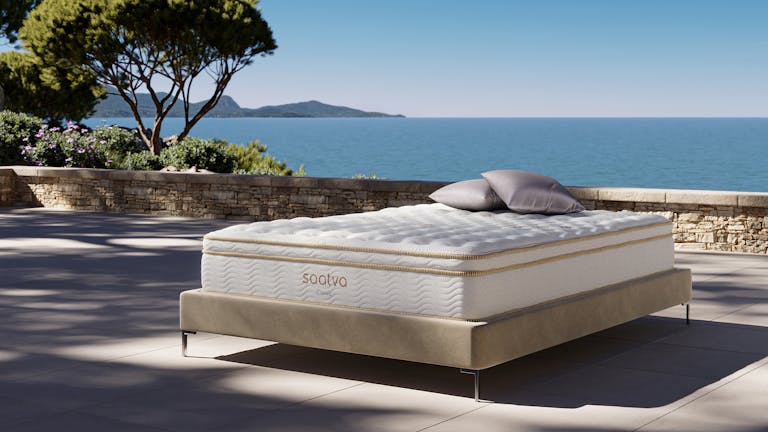
Our pick
Saatva Classicfor the adult or teen bed in the room, not the top bunk
- 365-night home trial
- Free white-glove delivery and old-mattress removal
- Lifetime warranty
- Listed as compatible with a bunkie board, with a 11.5 inch or 14.5 inch height choice
What does the official guidance say a bunk bed mattress must be?
The official guidance says a bunk bed mattress must be organic, firm enough to support the sleeper, correctly sized for the frame, and no thicker than 8 inches. It also says the mattress must sit at least 5 inches below the top of the bunk rails, a Consumer Product Safety Commission rule. Those four conditions are the entire filter: if a mattress fails any one of them, it does not belong on a bunk bed, regardless of how good its materials are.
The guidance adds that an organic mattress provides a healthy night’s sleep and, because it is made from sustainable materials, supports a company committed to eco-friendly practices. That is a values argument rather than a performance claim, and it is worth separating the two when you read a brand page. The measurable part of the decision is thickness, clearance, size, and firmness.
Why does the 8 inch thickness limit matter so much?
The 8 inch limit matters because bunk bed frames are built around clearance, not comfort. A mattress that exceeds 8 inches eats into the gap between the sleeping surface and the top rail, and the Consumer Product Safety Commission rule requires at least 5 inches of clearance below the rail top. A thick mattress on a top bunk can push a child close to or above the rail line, which is exactly what the clearance rule exists to prevent.
When you shop, measure before you buy. Take the frame’s interior depth, subtract the required 5 inches of clearance, and treat the result as your maximum mattress height. If the frame cannot accommodate a mattress within that number while still meeting the 8 inch guidance, the frame and the mattress are mismatched and one of them has to change.
What firmness does the guidance recommend for a bunk bed?
The guidance says to choose a mattress firm enough to provide support, but not so firm that it is uncomfortable. That is deliberately a range rather than a number, and the guidance does not assign a firmness rating in points. The practical reading is that a bunk bed mattress should resist sagging under the sleeper’s weight, because a soft surface on a raised, narrow frame gives less stable support than the same surface on a floor bed.
For a child, firmness also interacts with the mattress staying flat and in place on a slatted or solid bunk base. If you are buying for a teen or adult who will use the lower bunk nightly, comfort matters more and you can weigh the two halves of the guidance differently. Check the brand’s stated firmness description on its own page and confirm it against the sleeper’s weight and sleep position before ordering.
What mattress types does the guidance describe for bunk beds?
The guidance describes two relevant constructions. A hybrid mattress is made with a combination of foam over innersprings, and some organic hybrid mattresses use cotton or wool comfort layers over an innerspring system. It also describes a low-profile mattress with a supportive pocketed coil spring system, pressure relieving comfort layers, and a quilted cover as a good option for bunk beds. Neither description is a recommendation of one type over the other.
What the guidance establishes is that organic bunk bed mattresses can be built as hybrids or as low-profile pocketed coil designs, and that the comfort layers can be cotton or wool. Beyond that, construction details, certifications, and layer counts vary by brand. Verify them on the manufacturer’s own specification page.
What should you check on the brand page before buying?
Before you add anything to a cart, confirm four things on the official product page: the exact mattress height in inches, the available sizes and whether your bunk frame’s size is listed, the stated firmness, and the materials and certifications the brand claims. The guidance tells you what to require; the brand page tells you whether a specific product meets it. If the height is not stated as a number, treat that as a missing fact rather than an assumption.
Also check the trial, return, and warranty terms, since a bunk bed mattress is harder to exchange than a floor mattress once it is installed on an upper frame. Those terms are brand specific and are not covered by the organic bunk bed guidance. Read them on the seller’s page, and check whether delivery includes setup, because a mattress delivered to a bunk room is a different logistics question than one delivered to a master bedroom.
See the Saatva Classic price in your size →
How do the key numbers compare in one place?
The table below collects every figure the guidance states for organic bunk bed mattresses, plus the Saatva Classic figures listed on its official page. Where the guidance gives no number, the table says so rather than filling the gap. Use it as a checklist against any product you are considering.
| Item | Organic bunk bed guidance | Saatva Classic (official page) |
|---|---|---|
| Maximum thickness | 8 inches or less | 11.5 inches or 14.5 inches height options |
| Rail clearance rule | At least 5 inches below rail top (Consumer Product Safety Commission) | Not stated |
| Firmness | Firm enough to support, not uncomfortably firm | Plush Soft 3/10, Luxury Firm 5-7/10, Firm 8/10 |
| Base compatibility | Low-profile pocketed coil or hybrid described | Foundation, box spring, or bunkie board listed |
| Trial | Not covered by guidance | 365-night home trial |
| Warranty | Not covered by guidance | Lifetime warranty for the original purchaser |
| Delivery | Not covered by guidance | Free white-glove delivery and setup, old mattress removal available |
The mismatch in the first row is the point of the table. The Saatva Classic is listed at 11.5 or 14.5 inches, which exceeds the 8 inch bunk bed limit in the guidance, and its own page lists bunkie board compatibility as a base option rather than a bunk clearance claim. Read the clearance rule against the actual height before assuming any mattress fits a top bunk.
Who should buy an organic bunk bed mattress?
You should buy an organic bunk bed mattress if you are furnishing a shared children’s room, a guest room with a bunk frame, or a small apartment where vertical sleeping is the only layout that works, and you want materials you can verify as organic. The decision turns on four checks: organic materials, a thickness of 8 inches or less, at least 5 inches of clearance below the top of the rails, and a firmness that supports without becoming uncomfortable. If your frame passes the clearance math and your sleeper needs a low-profile, supportive surface, this category is straightforward and the guidance gives you a clear filter.
You should also buy in this category if environmental commitments matter to your household, since the guidance states that sustainable materials support a company committed to eco-friendly practices. If any of the four checks fails, the correct move is to change the frame or change the mattress, not to accept a near miss on clearance.
Who should NOT buy an organic bunk bed mattress?
Skip this category if you are shopping for a standard floor bed, a master bedroom mattress, or a sleeper who needs more than 8 inches of comfort layers. The 8 inch limit and the 5 inch rail clearance rule exist for raised frames, and applying them to a floor bed means giving up height and cushioning for no safety benefit. A floor bed has no rail line to clear, so the constraint that defines this category simply does not apply to you.
Also walk away from a bunk setup if the frame’s interior depth cannot deliver 5 inches of clearance with any mattress that also meets the 8 inch guidance. In that case the frame and the mattress category are incompatible, and the honest fix is a different frame rather than a thinner compromise. The same applies if the sleeper is an adult who will use the bunk nightly and needs a plush, deep comfort layer: a low-profile organic bunk mattress is the wrong tool for that job, and a full-height mattress on a floor frame will serve better.
How does the Saatva Classic fit into this decision?
The Saatva Classic is the alternative for the bed in the room that is not the top bunk. Its official page lists a 365-night home trial, a lifetime warranty for the original purchaser, and free white-glove delivery and setup with old mattress removal available. It is offered in three comfort levels, Plush Soft at 3/10, Luxury Firm at 5-7/10, and Firm at 8/10, and in two heights, 11.5 inches and 14.5 inches. It is listed as compatible with a foundation, a box spring, or a bunkie board.
That height range is the reason it belongs on the lower bunk or a floor frame rather than the top bunk: at 11.5 or 14.5 inches it exceeds the 8 inch thickness limit in the organic bunk bed guidance. The bunkie board listing is a base compatibility note, not a clearance claim. Read it that way and the two products stop competing: the guidance governs the raised frame, and the Saatva Classic governs the bed where clearance is not the binding constraint.
World Sleep Almanac score: 7.8/10. The score is an editorial rating built on five criteria: price at equal size, trial and return terms, warranty length, materials and construction, and public customer reviews. For this category the guidance itself supplies no trial, warranty, or price figures, so those criteria are scored against what the Saatva Classic page states alongside the guidance’s own material and clearance rules. The method behind the score is a fixed editorial rubric applied the same way on every page.
Verdict: an organic bunk bed mattress is the right buy for a raised frame that passes the clearance math, and the wrong buy for any floor bed. The guidance gives you four checks and two hard numbers, 8 inches of thickness and 5 inches of rail clearance, and those numbers settle the question before brand comparison begins. For the lower bunk or the adult bed in the same room, the Saatva Classic carries a 365-night trial and a lifetime warranty.
Our pick
Saatva Classicthe lower bunk and floor bed choice in this room
- 365-night home trial
- Free white-glove delivery and old-mattress removal
- Lifetime warranty
- Plush Soft, Luxury Firm, and Firm comfort levels
A useful companion to this page: our My Green mattress organic Wool review.
Frequently asked questions
Does the 8 inch rule apply to the bottom bunk too?
The guidance sets a single thickness figure of 8 inches or less for bunk bed mattresses and pairs it with the 5 inch rail clearance rule from the Consumer Product Safety Commission. The clearance rule is what protects a sleeper on an upper frame, so it binds hardest on the top bunk. Apply the 8 inch figure to both bunks for consistency, and treat the clearance math as the deciding check on the upper frame.
Can a hybrid mattress work on a bunk bed?
Yes, if it stays within the height and clearance limits. The guidance describes a hybrid as foam over innersprings, and notes that some organic hybrid mattresses use cotton or wool comfort layers over an innerspring system. The construction type is not the filter; the thickness, size, clearance, and firmness are. A hybrid that measures 8 inches or less and clears the rail line by at least 5 inches satisfies the guidance on construction and on dimensions.
What is a pocketed coil mattress and why is it mentioned for bunks?
The guidance describes a low-profile mattress with a supportive pocketed coil spring system, pressure relieving comfort layers, and a quilted cover as a good option for bunk beds. Pocketed coils are the spring system inside that description, and the low profile is what keeps the mattress inside the 8 inch limit. The guidance presents this as one acceptable option alongside hybrids, not as a requirement.
How do I know if my frame has enough clearance?
Measure the interior depth of the bunk frame from the base to the top of the rails, then subtract 5 inches. The result is your maximum mattress height. If that number is 8 inches or lower, any mattress you consider must fit inside it. If the frame cannot deliver 5 inches of clearance while the mattress also meets the 8 inch guidance, the frame and mattress category do not match and one of them has to change.
Should I check trial and warranty terms for a bunk mattress?
Yes. The organic bunk bed guidance does not cover trial, return, or warranty terms, so those live on each brand’s own page. They matter more on a bunk than on a floor bed, because a mattress installed on an upper frame is harder to exchange. Read the terms before ordering, and check whether delivery includes setup, since a bunk room raises a different logistics question than a master bedroom.
Reviewed by the World Sleep Almanac editorial team. Updated 2026.