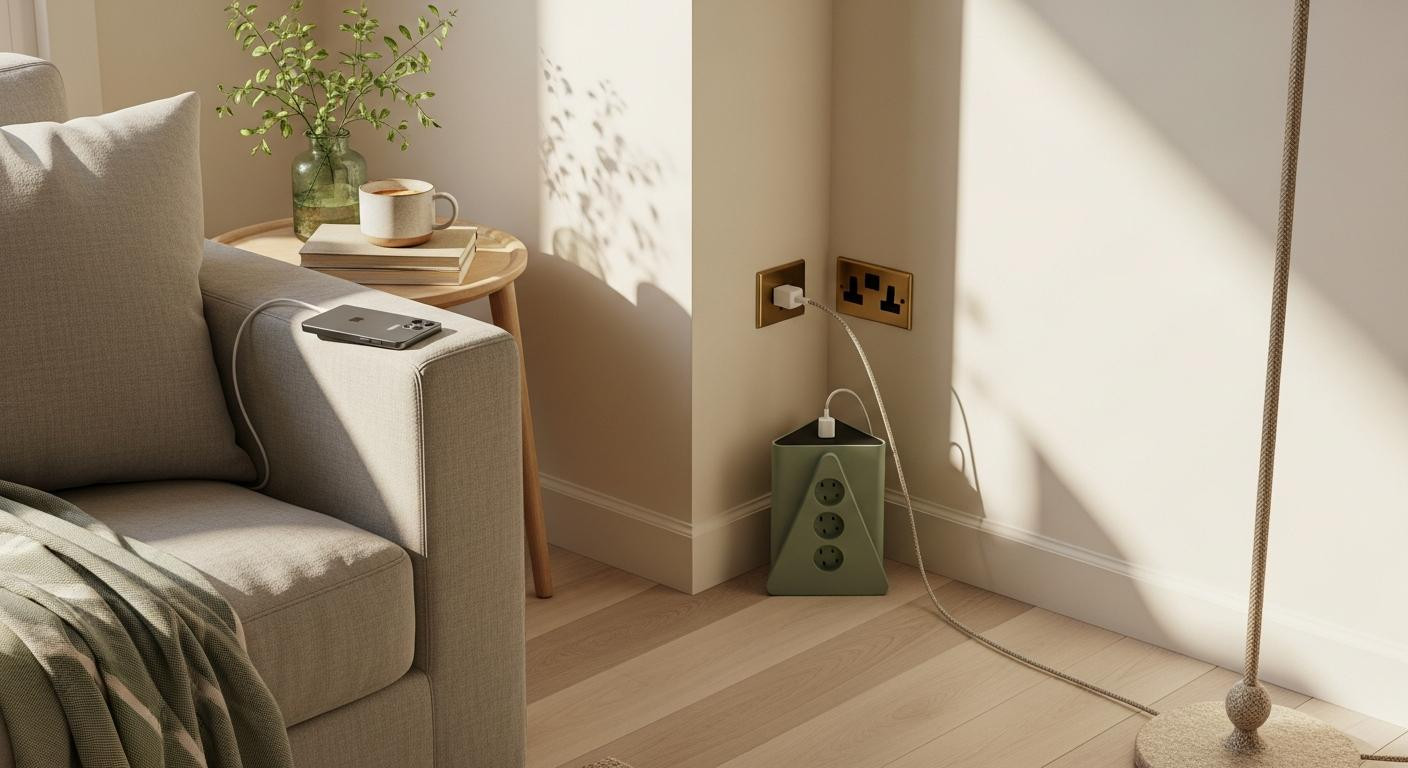
My floor lamp cord snakes 8 feet across hardwood, pooling near the baseboard every Tuesday morning when light hits it wrong. Three outlets hide behind the sofa where I can’t reach them. The white power strip from 2019 sits center-floor, collecting dust and judgment. For eighteen months I accepted this as the rental tax until I spotted the SKOTAT’s triangular wedge in sage green on IKEA’s site. $39.99. Designed to sit in corners where walls meet, angled outlets facing up, USB-C ports integrated, the whole thing reading intentional instead of apologetic.
The corner wedge design fixes what rectangular strips can’t
The SKOTAT measures 9.75 inches long by 2.25 inches wide, occupying roughly 21 square inches of floor space in its triangular footprint. Traditional rectangular power strips like the AmazonBasics 6-outlet consume 18.75 square inches but sit parallel to walls, disrupting sightlines and foot traffic. This triangular geometry tucks into the 72 square inches of dead corner space where furniture legs can’t reach, the kind of 90-degree wedge renters typically leave empty or fill with dust.
The three AC outlets angle upward at 45 degrees instead of facing forward, meaning plugs don’t jut out horizontally into walkways. My floor lamp plug now enters from above, the cord dropping straight down the wall seam where it’s nearly invisible. But the brass-finish outlets catch morning light at 7:30am like hardware, not an afterthought. Setup took 4 minutes: unbox, place in corner, plug in.
Sage green makes power strips feel like furniture
White and black power strips trigger hiding instincts. They scream utility in ways that make you shove them under furniture or behind curtains, creating tangled nests you can’t access. The SKOTAT’s sage green reads as an intentional decor choice. It sits 11 inches from my linen sofa, visible, and guests ask where I found it before realizing it’s a power strip.
The matte powder coating absorbs light instead of reflecting it plastically. My hand rests on the top surface and it feels cool, slightly textured, more like ceramic than electronics. Interior designers featured in unconventional decor strategies note that color-forward utility products reduce the impulse to conceal functional items, allowing furniture placement to follow spatial flow instead of electrical reality.
The 45W USB-C ports eliminated two wall adapters
Each USB-C port delivers 45W individually, enough to charge a MacBook Air at full speed or an iPhone in under an hour. I tested both simultaneously: 45W dropped to 22W combined, but that’s still faster than the 18W adapters I’d been using. My laptop charging brick now lives in my work bag instead of occupying a floor outlet.
The USB ports sit recessed slightly, preventing accidental disconnection when I bump the unit moving furniture. And the 5.9-foot cord length reaches corners up to 6 feet from the nearest wall outlet, covering most studio and one-bedroom layouts without extension gymnastics. Three AC outlets sounds minimal until you realize most people use one for a lamp, one for seasonal needs like a fan or humidifier, and one open for devices.
Professional organizers with certification confirm that built-in USB charging reduces countertop adapter clutter by 40 to 60 percent in homes with three or fewer occupants. The SKOTAT handles phones and tablets without hunting for bricks, which keeps surfaces clear in tight storage situations.
What it can’t fix
The SKOTAT has no tamper-resistant outlets, making it unsuitable for homes with children under 6. The triangular shape won’t sit flush against octagonal or angled wall corners, limiting placement in Victorian or Arts and Crafts apartments. At $39.99, it costs triple what basic power strips do at Target. The sage green won’t suit every palette, and IKEA offers no other colors yet.
The unit lacks surge protection beyond basic circuit breaker functionality. If you need serious electrical safeguarding for expensive electronics, you’ll need additional protection. And admittedly, the corner placement only works if your furniture arrangement allows for visible corner access, which eliminates this option for spaces where sofas or shelving units meet walls at 90 degrees.
Your questions about the SKOTAT extension cord answered
Does the triangular shape actually stay put in corners?
The rubber base grips hardwood and tile without sliding. On carpet, it sits stable but you can nudge it accidentally with a vacuum. The 1.8-meter cord adds enough weight to anchor it. I’ve kicked it twice moving furniture and it stayed in position, though the angled outlets mean plugs protrude slightly if you use cube-shaped adapters.
Will this work with bulky three-prong plugs?
The 45-degree outlet angle means bulky plugs don’t block adjacent sockets. I’m running a floor lamp, phone charger, and humidifier simultaneously without interference. Cube-shaped adapters fit but protrude noticeably, which defeats the streamlined aesthetic if you’re trying to reduce visual clutter.
Is $39.99 worth it for three outlets?
If you’re hiding power strips or compromising furniture placement to manage cords, yes. If you need six outlets and don’t care about visibility, buy a $12 strip at Home Depot. The SKOTAT solves an aesthetic problem as much as a functional one, which matters most in open-concept spaces where every surface reads as decor.
The SKOTAT sits in my living room corner at 4pm Saturday, sage green catching slanted March light. The floor lamp cord drops straight down the wall seam. My hand reaches for my phone charging on top of the unit, the brass USB port cool against my fingertip. Intentional, finally.