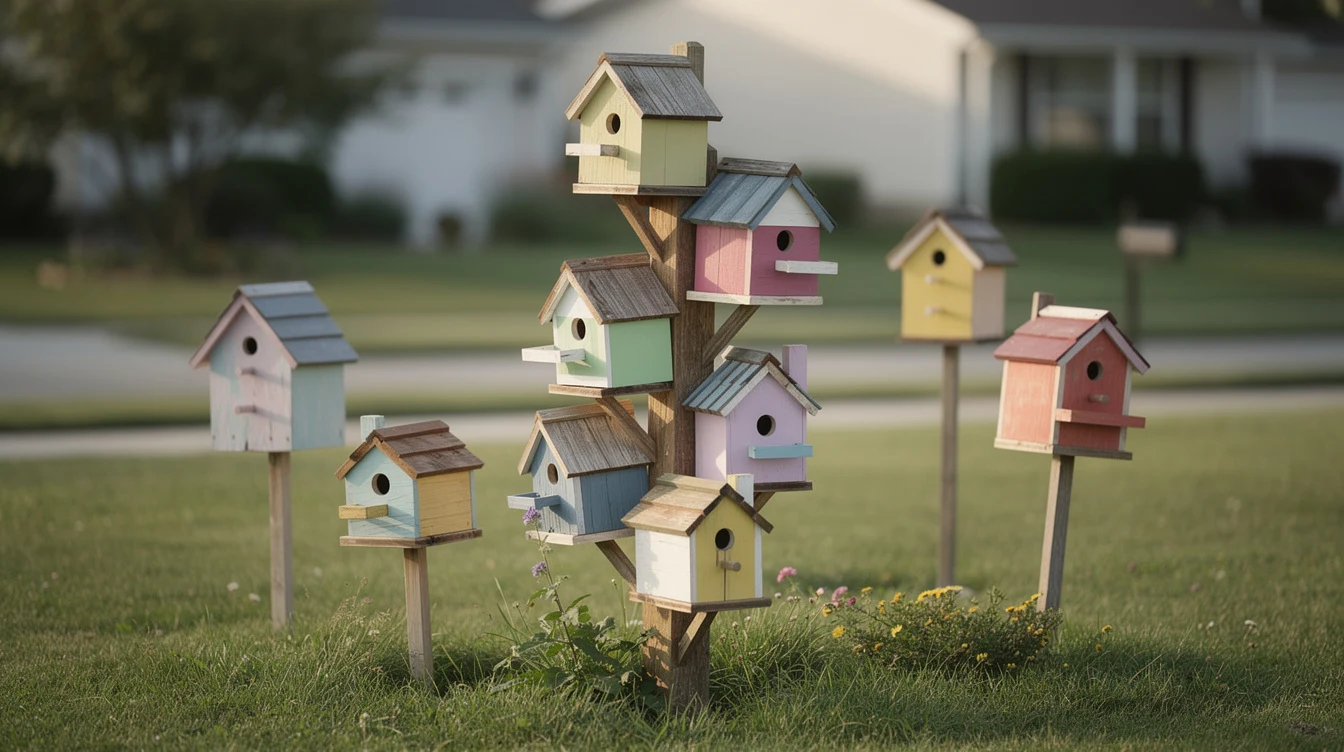
My front corner was a brown patch of shame. Three summers of drought, one failed sprinkler, and enough weed killer to kill a golf course. Neighbors stopped making eye contact.
I ripped it out in a weekend. No turf, no mulch carpet, just a plan: build a birdhouse village so ridiculous that cars actually slow down. It worked.
UPS drivers now ask for photos.
I Let the Grass Die and Found Something Better
My front corner was a brown patch of shame. Three summers of drought, one failed sprinkler, and enough weed killer to kill a golf course. Neighbors stopped making eye contact.
I ripped it out in a weekend. No turf, no mulch carpet, just a plan: build a birdhouse village so ridiculous that cars actually slow down. It worked.
UPS drivers now ask for photos.
I Built a Totem Pole That Steals the Show
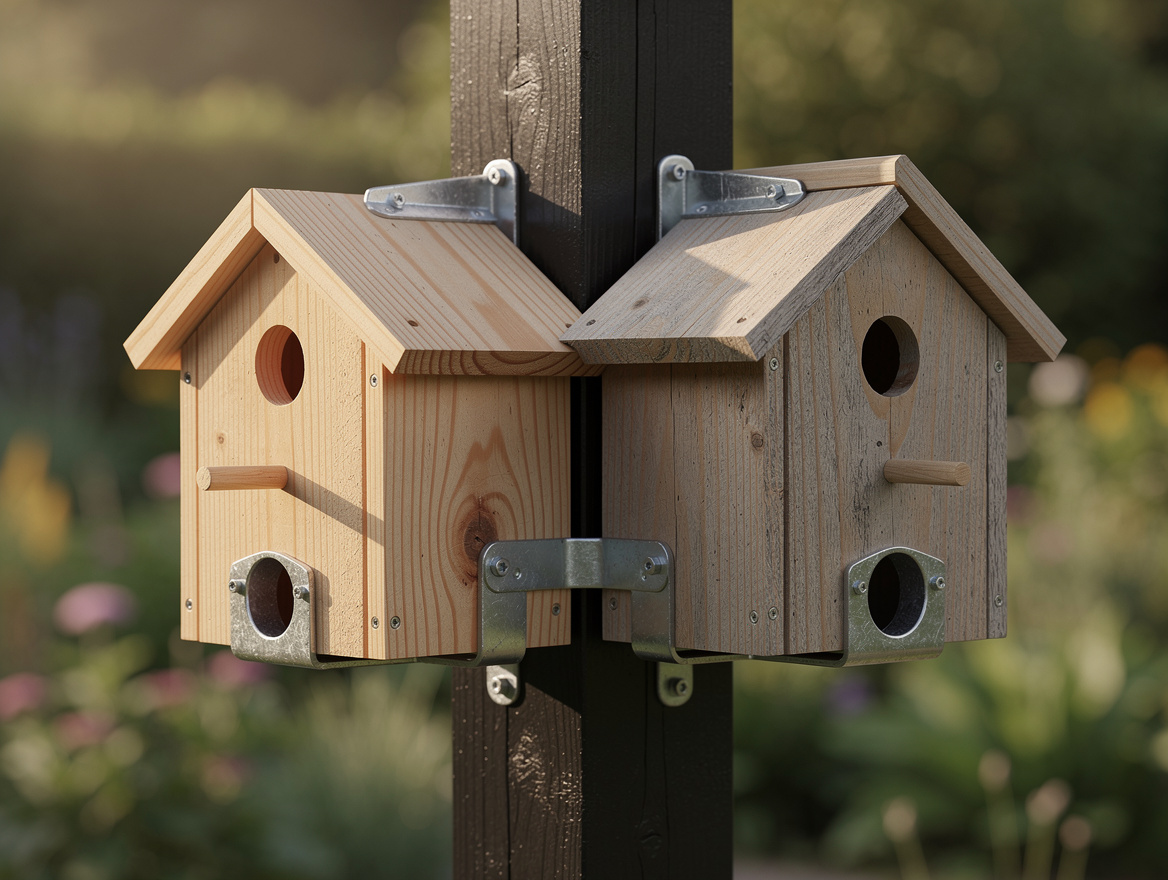
The hero piece is a 4×4 treated lumber post from Home Depot, set 60 cm deep in quick-set concrete. I mounted five houses staggered vertically on galvanized steel brackets from Lowe’s, about $8 each.
Lowest house sits at 1.4 m, highest at 2.2 m. That vertical stack reads as one sculptural thing from the street, not clutter. Total post hardware: roughly $45.
I painted the post matte black so the houses pop. One opinion: raw wood posts look like fence mistakes. Paint it or lose the drama.
I Turned a Fence Shelf Into Main Street
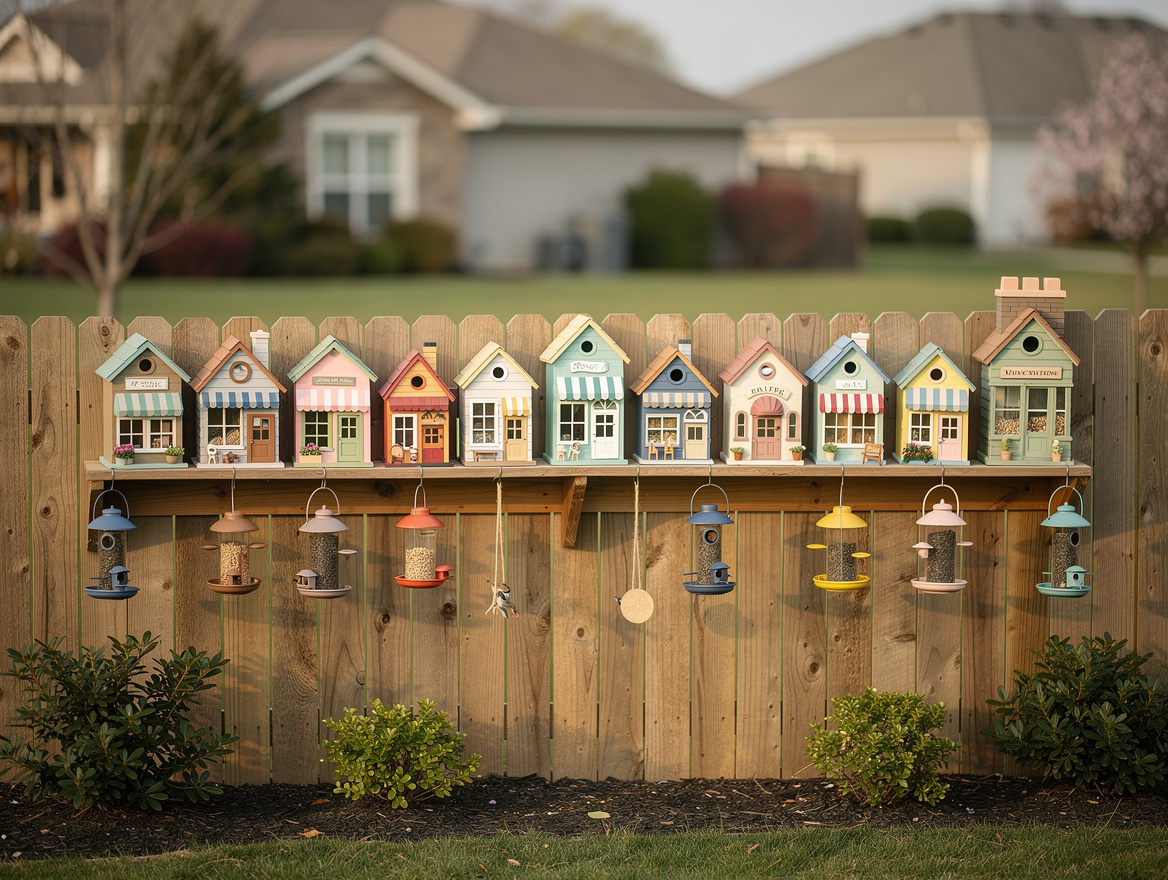
Behind the totem, I screwed a 2.4 m pressure-treated shelf board onto two short 4×4 posts at chest height, about 1.3 m. This is the village street.
I lined up eight small houses and three feeders like storefronts. Each got a dumb name: the Seed Bakery, the Suet Pub, the Finch Wine Bar. The names don’t matter.
What matters is the rhythm: house, feeder, house, house, feeder. Your eye reads it as intentional.
The shelf and posts ran about $35 at Home Depot. I sealed everything with Cabot Australian Timber Oil, one quart for $18.
I Mixed Materials So Nothing Looked Matchy
Matchy birdhouses look like a catalog exploded. I went deliberately chaotic.
Three cedar houses from Wayfair, around $22 each, for the natural weathering. One chunky resin gnome house from Amazon at $34, because someone needs to be weird. One modern cedar box with a 38 mm entrance hole, actual bluebird spec, from a specialty maker on Etsy at $41.
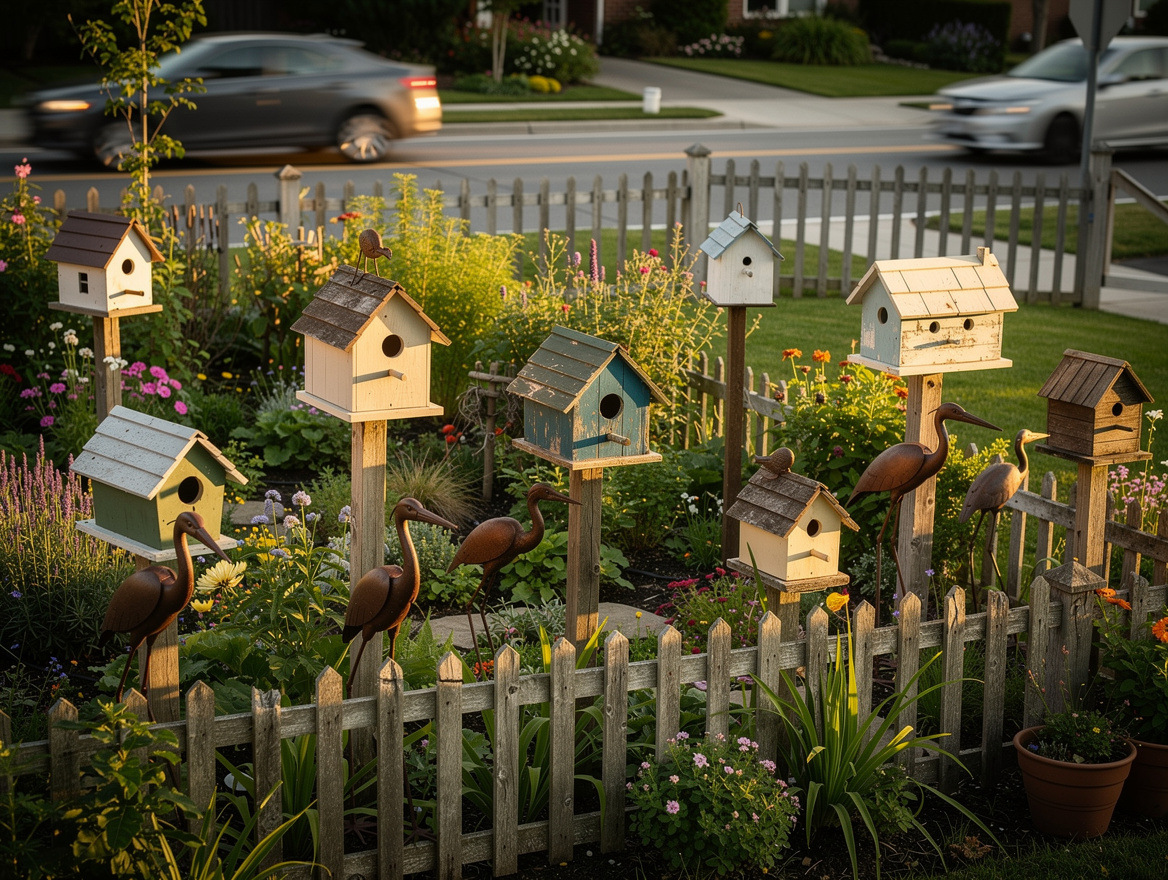
Two powder-coated metal heron silhouettes from a garden store, $29 each, stabbed into the ground at angles. They catch morning light and cast shadows that move. That’s the art-installation trick that makes people brake.
I Sized Houses for Real Birds, Not Just Cuteness
Decorative houses are fine, but I wanted some actual nesting. Mixed village, mixed function.
My small shop-front houses: 11 cm x 11 cm floor, 18 cm high, 32 mm hole. Good for chickadees and wrens. The medium bluebird house: 14 cm x 14 cm floor, 22 cm high, 38 mm hole, front panel hinged for fall cleaning.
One large feature house at 18 cm x 18 cm floor, 30 cm high, with faux 25 mm side windows for that apartment-building look.
I faced all entrances east-northeast, away from our prevailing southwest winds. Typical mount height for active boxes: 1.8 m to 3 m. My decorative low stuff is just eye candy; the real nesting happens higher and quieter.
I Added Feeders That Pull the Eye Through
Feeders break up the house rhythm and bring live birds into the composition. Motion is what stops cars, not static objects.
I hung one tube feeder with nyjer seed from a shepherd’s hook, $12 at Walmart. One suet cage from Ace Hardware, $7. One platform feeder I built from scrap cedar, basically a shallow box on legs, for doves and jays to land heavy.
The tube feeder spins in wind. The suet cage gets woodpecker traffic. The platform feeder is a mess, but mess means life.
A dead-clean village reads as fake. Let it get bird-busy and slightly chaotic.
I Spent Less Than a Patio Set and Got More Conversation
My total landed around $340. That’s six houses, three feeders, one totem post, one shelf, two metal silhouettes, hardware, sealer, concrete. The typical range for this scale runs $250 to $800 depending on how many houses you buy versus build and how fancy you get on materials.
A basic resin village from Amazon could hit $150. All-cedar custom work could push $700. I split the difference.
Built two houses from a SparkJump-style DIY kit, $19 for a three-pack of unfinished pine blanks. Painted them myself with Behr exterior acrylic samples, $5 each at Home Depot.
The DIY ones look slightly wrong in a good way. Handmade imperfection reads as charm. Machine perfection reads as corporate lawn decoration.
If I had to pick one move, I’d start with the totem post. One vertical stack at eye level changes everything. The shelf and the rest can grow later.
One strong focal point beats a scattered yard of cute.
Mia Carter writes about small-space living and budget home makeovers. She has restyled three rentals and tests most ideas in her own 45 sqm flat.