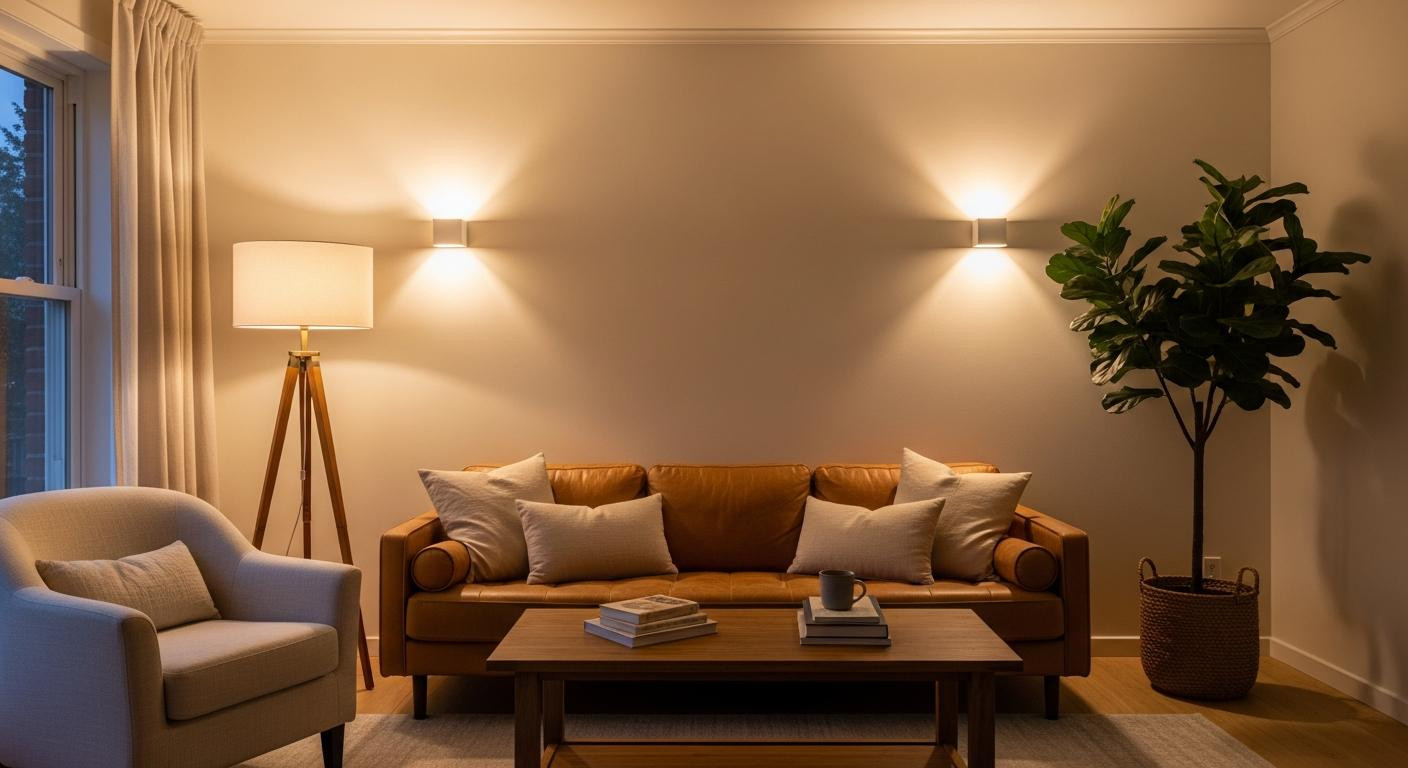
Your living room gets darker at 7pm Tuesday when the overhead fixture casts flat light across 225 square feet of beige walls and shadowed corners. The single bulb blazes at 100% or stays off—no middle ground, no warmth, no pockets of intimacy where you actually want to sit. Renters complain about “boob lights” creating clinical brightness that makes furnished rooms feel cheap. The problem isn’t your fixture. It’s the two missing layers your room never had: task lighting for reading corners and accent lighting for depth. Fix all three for $75 in under an hour without touching a wire.
Your room feels flat because it only has one light source
Ambient lighting—the overhead fixture—does one job: general illumination. It makes the room bright enough to vacuum but creates no visual hierarchy, no shadows, no reason for your eye to rest anywhere specific. By 8pm, when you want to relax, the same overhead brightness that helped you clean now feels like a waiting room.
Lighting designers with residential portfolios call this single-layer syndrome. The room reads two-dimensional because every surface receives identical light intensity. Your sofa, coffee table, and walls exist in the same visual plane. Task and accent layers break this flatness by creating contrast: bright spots for activity, dim zones for rest, shadows that add depth.
Without them, your living room photographs well but feels wrong. And that’s exactly why spaces with expensive furniture still look blah after sunset.
The three layers that make rooms feel alive
Ambient: the base layer you already have
Your ceiling fixture provides ambient light—the foundation. It keeps you from tripping over furniture at night. In a 225-square-foot room, one overhead fixture casting 800 to 1200 lumens covers the basics. The mistake is stopping here.
According to ASID-certified interior designers, dimmable ambient sources let you control intensity. At 100%, it’s cleaning light. At 40%, it becomes background glow that supports the other two layers. But most renters can’t install dimmer switches, which is where the next layer becomes critical.
Task: light where you actually sit
Task lighting targets activities: reading beside the sofa, working at a desk, folding laundry on the ottoman. A $39.93 floor lamp from Walmart with a warm 2700K bulb creates a 3-foot pool of functional brightness without illuminating the entire room. The Mainstays 62.2-inch LED model curves over seating areas, directing light exactly where you need it.
This is the layer renters skip because they assume lamps are optional decor. They’re not—they’re essential infrastructure for making a room usable after dark. Floor lamps plug into existing outlets and move with you, which makes them the easiest fix for rental lighting problems.
Accent: the jewelry layer that adds drama
Accent lighting highlights specific objects or architecture: artwork, plants, textured walls. Wireless sconces or clip-on fixtures create visual punctuation without helping you see—they help the room feel intentional. A sconce behind a fiddle-leaf fig casts shadows up the wall, adding 6 inches of perceived height.
Design experts featured in Architectural Digest recommend 5 to 15 lumens per square foot for accent layers. That’s enough to create drama without competing with task or ambient sources. This layer is the difference between “furnished” and “designed.”
The $75 fix that adds all three layers without wiring
Wireless LED sconces from brands like C Cattleya cost $75.19 at Home Depot and stick to walls via rechargeable battery operation. The 32-inch 2-light model offers dimmable color-changing LEDs controlled by remote. Place two flanking your sofa at 60 inches from the floor for ambient fill light in corners where overhead fixtures create shadows.
But if you’re budget-constrained, skip sconces and invest in one quality floor lamp instead. The Walmart Mainstays model at $39.93 positions an adjustable LED head directly over seating areas, replacing the need for expensive arc lamps that cost $500 at Pottery Barn. Pair it with a 60-watt-equivalent LED bulb in soft white for under $5 total.
From there, add clip-on accent fixtures if you have $20 remaining. Home Depot’s clamp lights attach to bookshelves or console tables, aiming upward at walls or downward at plants. Use 40-watt bulbs to avoid overpowering the effect. Two clips behind a media console create uplighting that makes the wall glow, adding perceived depth to flat spaces.
That’s where dimmer switches for $25 become the final upgrade once you’ve established the three-layer foundation.
Why this works when single overheads fail
Single overhead fixtures distribute light evenly, which sounds good until you realize even distribution creates no contrast, no focal points, no visual rest. Your eye scans a room lit identically from ceiling to floor and finds nothing interesting. Professional organizers with certification confirm that layered lighting creates rhythm: bright task zones pull focus, dim ambient areas recede, accent spots add surprise.
Rooms feel bigger because shadows define edges instead of flatness erasing them. The emotional shift happens within 20 minutes of turning off your overhead and using only lamps and sconces—the space transforms from functional to intentional. And unlike furniture rearrangement tricks, lighting changes don’t require moving heavy objects.
What makes this setup work is specificity. You’re not adding random lamps. You’re placing task light at 14 inches from the sofa’s left arm, exactly where your dominant hand rests when reading. You’re positioning wireless sconces to fill the 4-foot gap between your overhead fixture’s reach and the floor.
How layers interact with existing room features
If you’ve already applied strategies like placing mirrors opposite windows, layered lighting amplifies those effects. Mirrors reflect task and accent sources, making them appear more distributed across the room. A single floor lamp becomes two visual sources when mirrored.
The same principle applies to decluttered coffee tables. Table lamps work best on consoles or side tables with minimal visual competition. Clear those surfaces first, then add task lighting as the focal feature rather than another object fighting for attention.
Your questions about 3 lighting layers every living room is missing and how to fix it for $75 answered
Can I layer lighting in a rental without my landlord caring?
Wireless sconces use adhesive strips or rechargeable batteries—zero electrical work required. Battery-powered units from Target start at $40 and mount like picture frames. Floor and table lamps plug into existing outlets. If your lease prohibits wall damage, skip sconces and double down on floor lamps—two $39 lamps still create task and ambient layers for $78 total.
What if my living room already has built-in recessed lights?
Recessed cans provide ambient coverage but rarely offer task focus. Add lamps anyway. The point of layering is mixing light heights—ceiling fixtures alone leave middle and lower zones dark. A floor lamp at 5 feet and a table lamp at 2 feet fill the gap between your 8-foot ceiling cans and your sofa.
Do I really need all three layers or can I skip accent lighting?
Skip accent if you’re budget-constrained. Ambient plus task solves 80% of the “flat room” problem without needing to spend on decorative fixtures. Accent lighting is the final 20% that makes rooms photograph well and feel expensive. Start with two layers, add accent when you find clip lights on sale at Home Depot for under $20.
By 8:30pm Wednesday, your living room glows in three distinct zones: wireless sconces casting soft amber behind the sofa, a floor lamp pooling warm light over your book, a clip fixture making the fiddle-leaf fig’s shadow climb the wall. The overhead stays off. The room finally feels like yours.