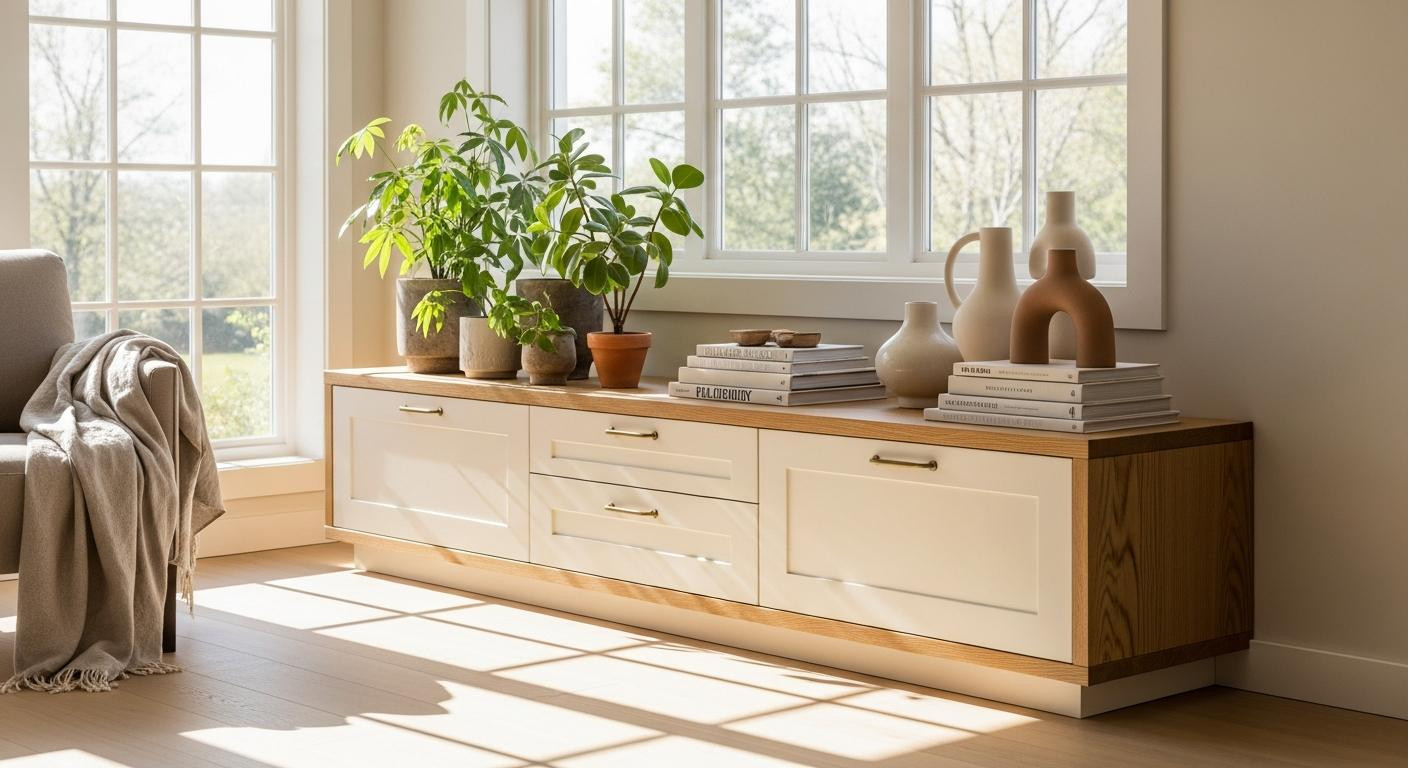
Your living room’s BESTÅ unit cost $138 on a March Saturday when you needed fast TV storage for the 65-inch screen arriving Tuesday. By April, the floating white box photographed exactly like what it was: particle board anchored 6 inches off the floor, screaming temporary in a room that needed permanence. The gap underneath collected dust. The top edge hit your sight line at an awkward height where nothing felt grounded. Custom built-ins quoted $3,200 and required contractors you didn’t have. But three specific measurements transform BESTÅ into architecture: 3.5-inch base depth, 0.75-inch trim thickness, 4-inch leg height. Miss any one dimension and guests spot IKEA within 30 seconds of sitting on your sofa.
Why BESTÅ reads cheap (and it’s not the material)
The floating effect creates visual lightness that signals temporary furniture, not permanent architecture. Particle board core isn’t visible when properly finished, but exposed edges and uniform surfaces lack shadow depth. Built-ins feel permanent because they interact with walls and floors through trim, creating dimensional relationships that ground a space.
According to ASID-certified interior designers featured in recent residential portfolios, the human eye registers depth through shadow lines at baseboards and crown molding. From a sofa 8 feet away at a 15-degree viewing angle, those shadows separate millwork from furniture. Custom built-ins cost 6 times more but use 80% of the same techniques you can replicate for under $400.
The three measurements that create built-in depth
Base layer: 3.5 inches hides the hover
Adding a 3.5-inch base platform grounds the unit in a way that feels intentional, not improvised. This specific depth matches standard baseboard profiles in most US homes built after 1990. Pine boards from Home Depot run $42 for enough material to support a 94-inch wide configuration.
The measurement creates shadow lines identical to actual built-in cabinetry. And the base must extend 0.5 inches beyond the BESTÅ frame on all sides for proper shadow casting. That overhang catches light at angles that photograph like custom millwork, especially when paired with warm wood tones.
Trim frame: 0.75-inch thickness adds $200 perception
This exact thickness mimics face-frame cabinet construction without making the room feel too busy. Not 0.5 inches, which reads flat. Not 1 inch, which creates awkward proportions against 15-inch deep cabinets. The trim covers particle board edges and creates dimensional relief that separates amateur installations from professional results.
Pine trim strips with miter-cut corners, wood glue, and finishing nails transform the profile. But what really sells the illusion is brass knob placement: 2.5 inches from the vertical edge, centered on door height. Similar measurement precision makes modular IKEA systems read as custom work when you respect architectural proportions.
Material warmth separates IKEA from millwork
Butcher block tops read as intentional design
The $80 IKEA countertop sits on top of BESTÅ, adding organic texture that changes throughout the day. Laminate tops photograph flat no matter the lighting. Wood grain catches morning sun differently than evening lamps, creating visual interest that mimics custom cabinetry’s natural material choices.
The overhang matters: 1 inch at the front, flush on sides. That projection creates a functional ledge for remotes and coasters while maintaining clean side profiles. At the same time, it adds weight to the composition without extending so far it looks like a shelf.
Hardware warmth versus hardware bling
Antique brass finishes provide warmth without looking costume-y in a way brushed nickel can’t match. Design experts with residential portfolios confirm that $3 knobs from standard retailers deliver the same patina variation as aged hardware on vintage built-ins. Matte black reads trendy but not timeless for built-ins meant to last five years minimum.
Knobs positioned at natural hand-reach height, 36 inches from the floor for lower cabinets, feel more grounded than centered placement. That balance principle applies across rooms when you’re creating symmetry that doesn’t feel forced.
Where the illusion breaks (and how to save it)
Cable management holes must be drilled before assembly: 4-inch diameter, rear top corner. Units wider than 94 inches need center support legs or they sag visibly by month three. Professional AV installers note that toggle bolts, not drywall anchors, become critical above 58 inches width when wall-mounting configurations.
The biggest tell is leaving a gap between the unit and ceiling. Built-ins either hit the ceiling or stop 12 inches below with intentional styling above. That 6-8 inch gap common in rentals screams furniture, not architecture. Admittedly, if your ceilings exceed 9 feet, this hack needs crown molding or accepts its furniture status.
Your questions about IKEA BESTÅ TV unit hack that looks like built-in cabinetry answered
Can renters drill into BESTÅ without voiding damage deposits?
Drilling into the BESTÅ itself doesn’t affect rental agreements in most US states. Pre-drilling holes for trim attachment keeps particle board from splitting while wood glue provides primary hold. The base platform can be removed at move-out, leaving the original BESTÅ intact underneath with minor spackle requirements for nail holes.
Does the trim hack work with BESTÅ’s glass doors?
Glass doors require different trim approach because the frame must sit flush with the glass edge. Skip side trim on glass door units, focus on top and base treatments instead. Lighting designers working on residential projects recommend this adaptation for mixed door styles that maintain visual continuity.
What’s the minimum wall width for this to look intentional?
88 inches minimum allows two 47-inch frames with trim. Maximum realistic span hits 120 inches before center support becomes visible and breaks the built-in illusion. Corner installations require 24-inch return walls minimum or the configuration reads unfinished. Similar spatial planning applies when balancing warm materials across adjacent rooms for cohesive flow.
Tuesday evening at 6:47pm when amber light hits the oak butcher block top and catches the brass knobs at angles that photograph like vintage hardware. Your partner walks through the door, drops keys on the counter, glances at the media wall, and doesn’t see IKEA. Just a living room that feels finished.