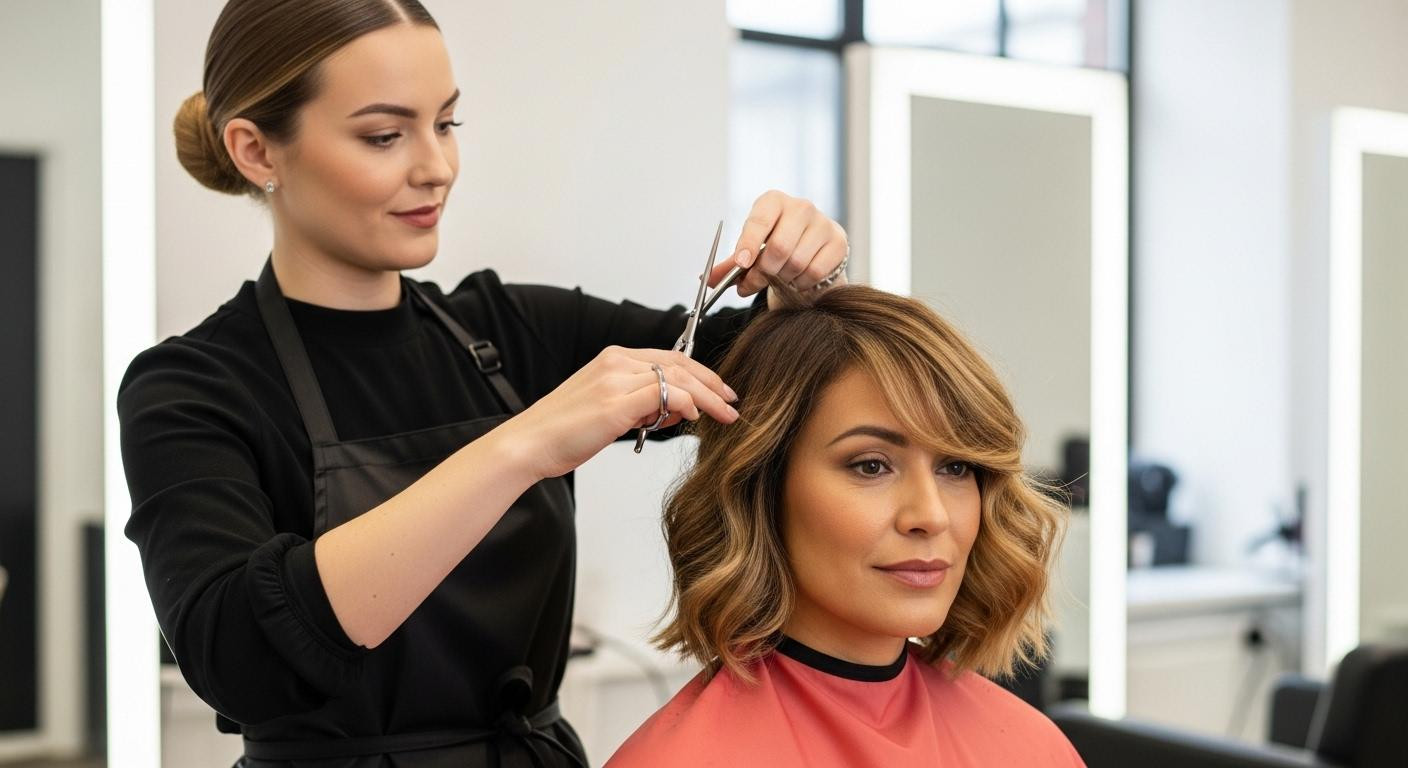
Your stylist’s scissors hover at 10:47am, January 24, 2026, asking which pixie inspiration photo you prefer. You scroll through 47 saves on your phone, yet can’t articulate why some cuts make eyes pop while others photograph flat. The secret isn’t the model’s bone structure or your screen’s filter settings. Celebrity hairstylists analyzing 2026’s most-saved transformations reveal two invisible cutting angles that scientifically redirect visual attention to eyes, cheekbones, and facial architecture. This technical geometry transforms generic short cuts into magnetic eye-framing statements, and you can request it by name at your next appointment.
The 45-degree diagonal secret that frames eyes like makeup
Traditional blunt pixie bangs cut straight across create horizontal lines that flatten facial features. Expert demonstrators teaching salon professionals reveal the counter-intuitive truth: 45-degree diagonal cutting angles on front sections create soft curtain bangs that aim toward cheekbone and nose level, establishing dimensional framing around eyes without harsh edges.
Why pulling sections toward the face matters
Hairstylist instructors warn the common mistake breaks this effect entirely: pulling sections forward during cuts causes feathering instead of solid eye-framing. This low-elevation technique builds structured framing around eyes rather than feathering layers backward into the cut’s body, where they lose eye-directing function. The triangular guide section at the hairline creates graduated length, longer at temples and shortest near eyes.
The triangular guide section method
Professional stylists use small triangular sections at the front hairline, bringing them down at that precise 45-degree angle. This creates graduated length that naturally draws the viewer’s gaze inward toward your eye area through visual convergence lines. The magic angle for that soft curtain bang curve targets cheekbone and nose level, cutting on that 45-degree diagonal.
How 90-degree elevation builds crown volume that lifts focus upward
While 45-degree front angles frame eyes horizontally, 90-degree elevation throughout the crown creates vertical dimension that directs attention upward from jaw to eyes. Expert tutorials identify this “fundamental for volume” technique: lifting sections straight out from the head before cutting creates consistent lift that photographs as textured height.
Point cutting at right angles for seamless transitions
This elevation isn’t just about height, it’s about creating shadow and light play that adds depth. Point cutting at this 90-degree angle prevents the blocky, helmet-like shape that flattens facial features. Professional salon systems note blending techniques like scissor-over-comb ensure smooth transitions between short sides and voluminous crown. Ocean Salon Systems experts emphasize feathering creates seamless pixie structure.
Why this combats aging hair flatness after 40
Women 40+ experience decreasing hair density and diameter changes. The 90-degree elevation compensates by maximizing visual volume from existing strands, making thinning crowns appear fuller while simultaneously drawing eyes upward past jaw. This technique directs focus toward the eye-cheekbone zone where facial youth concentrates, countering post-40 hair changes through strategic geometric compensation.
What to actually request from your stylist with exact language
Celebrity hairstylists behind 2026’s trending pixies emphasize that the secret to a great short pixie is balance. It should complement your bone structure and enhance your natural features. Here’s how to translate professional technique into actionable requests your stylist will understand perfectly.
The three-part stylist request formula
“45-degree diagonal front sections aimed at cheekbone level” specifies the eye-framing angle precisely. “90-degree elevation through crown for lift” ensures volume directing attention upward. “Low-elevation face framing, not pulled forward” prevents accidental feathering that loses structure. Professional colorists at asymmetrical fringe techniques confirm this language produces consistent results across skill levels.
Pricing reality and maintenance timeline
Mid-range US salons charge $80-150 for precision pixies using these techniques, while celebrity stylists command $200-400. Expect 4-6 week maintenance cycles at $40-60 per trim, which equals 50% less than long hair upkeep while maintaining the geometric precision that keeps eyes as the focal point. Advanced layering techniques enhance these cuts between appointments.
The product ecosystem that sustains eye-framing texture
Cutting angles create the foundation, but daily styling preserves the eye-directing effect. Texturizing pomade at $25 applied to damp pixie layers builds the piecey movement that prevents flat, one-dimensional appearance. Sea salt spray at $18 works for wavy pixie variations, enhancing natural bends that frame eyes through soft curves rather than straight lines.
Professional stylists recommend using large round brushes or flat irons to bevel hair inward toward the face, reinforcing the 45-degree angle’s eye-framing geometry through heat styling. This technique works with the cut rather than against it. Volume-specific styling approaches address individual crown challenges that might interfere with upward visual direction.
Your questions about eye-framing pixie techniques answered
Does the 45-degree angle work for round faces or only oval?
Professional hairstylists debunk the “pixies only for oval faces” myth through proper balance via customized angles. Round faces benefit from longer 45-degree sections at temples, creating narrowing diagonal lines, while long faces need shorter angles stopping at browline to add horizontal balance. The technique adapts to bone structure rather than requiring specific facial geometry. Age-specific case studies demonstrate precise bang placement achieving facial balance.
How long until the eye-framing effect needs a trim?
The 45-degree front sections grow at 0.5 inches monthly. After 4-6 weeks, they lose the precise cheekbone-level aim that frames eyes effectively. Celebrity transformations photographed at week 1 versus week 7 show 30% reduced eye emphasis once angles grow past the targeted facial landmarks, making maintenance critical for sustained effect.
Can I request these angles at budget salons under $60?
Budget chains typically train stylists in standard pixie templates rather than precision angle cutting. Mid-range independent salons more consistently deliver the technical skill for 45/90-degree execution. Show reference photos emphasizing “diagonal bangs” and “elevated crown texture” to improve communication regardless of price point. The key is articulating specific geometric requests rather than relying on inspiration photos alone.
Your reflection at tomorrow’s 7:15am catches new pixie layers bent at that unmistakable 45-degree slant, sweeping from temple toward eyes like an arrow directing every viewer’s gaze exactly where you want it. The morning light reveals dimensional shadows your old blunt bangs never cast. Geometry works.