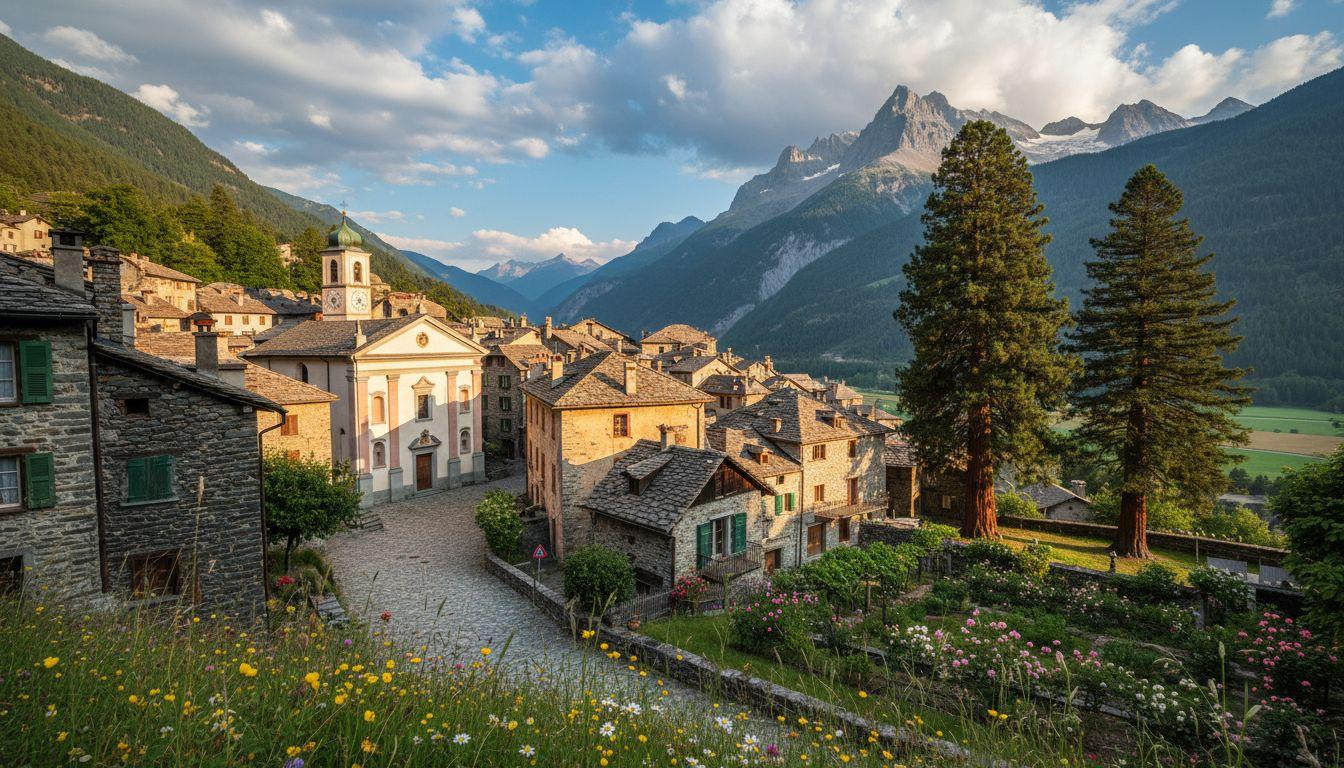
Morning light catches golden stone facades as Switzerland’s most quietly beautiful village awakens. Soglio sits on a natural terrace 3,600 feet above sea level, where 320 residents guard eight centuries of mountain heritage. Below, glacier-fed turquoise streams flow through Val Bregaglia toward Italy, while above, Pizzo Badile’s sharp peak cuts into alpine sky.
This baroque mountain village feels like stepping into Segantini’s paintings. The artist called Soglio “the gateway to paradise” in 1886, and his viewpoint remains unchanged today.
Where medieval palaces meet glacier streams
Seven von Salis family palaces cluster around cobblestone streets, their golden walls and red tile roofs unchanged since the 14th century. The Church of San Lorenzo anchors the village center, its baroque facade rebuilt in 1760 after fire consumed the original Romanesque structure. Stone houses press against narrow lanes, creating intimate courtyards where mountain silence settles.
Palazzo Salis operates as Switzerland’s most historic hotel, welcoming guests since 1876. Its baroque gardens harbor two giant sequoias, planted in the 1880s when Mediterranean influences reached this Alpine crossroads.
The turquoise surprise flowing below
Glacier melt creates streams of startling blue-green water cutting through the valley floor. These waters catch light differently than typical mountain rivers, their mineral content creating colors more common to tropical lagoons than Swiss Alps.
Mediterranean botany at 3,600 feet
Chestnut forests surround Soglio, their cultivation dating to Roman times. Mediterranean plants thrive in the village’s microclimate, protected by surrounding peaks yet warmed by southern exposure. This unusual botanical mix creates garden magic rare in Alpine villages.
What Segantini saw unchanged
Giovanni Segantini painted here repeatedly from 1886-1894, capturing light that still illuminates stone walls each morning. His famous quote about Soglio being paradise’s threshold rings true when afternoon sun breaks through western ridges. Pizzo Badile (10,853 feet) dominates eastern views, its vertical granite face catching alpenglow at sunset.
The village profile appears identical to Segantini’s canvases. No modern construction interrupts medieval sight lines. Church bells still mark village rhythms as they did 150 years ago.
The artist’s unchanged perspective
A plaque marks Segantini’s favorite sketching spot in Palazzo Salis gardens. From this terrace, the same golden-hour light touches stone facades exactly as captured in his 1887 “Alpine Landscape with Soglio.” Walking paths connect viewpoints where he positioned his easel.
Eight centuries preserved intact
Soglio’s first historical mention dates to 1219, recorded in Graubünden State Archives. Continuous settlement created architectural layers spanning medieval foundations to baroque renovations without gaps. Local families maintain palaces as working buildings rather than museums, preserving living heritage.
Living in mountain time
Village rhythms follow mountain light rather than urban schedules. Mornings bring bread aromas from the single bakery and soft murmur from glacier streams below. Afternoon walks lead to Cascata di San Giacomo waterfall, 25 minutes through chestnut groves. Evening meals feature Capuns (Swiss chard parcels) and Pizzoccheri (buckwheat pasta), regional specialties reflecting Italian influences.
Nights settle into complete silence broken only by stream flow and distant Alpine bird calls. Wood smoke scents winter air when temperatures drop below freezing.
Seasonal transformations mark village life
Spring arrives with chestnut blossoms carpeting forest floors. Summer hiking weather reaches comfortable 77°F highs perfect for walking mountain trails. Autumn paints valley forests in gold and crimson colors rivaling New England displays.
Winter brings contemplative quiet
December through February transforms Soglio into meditation retreat. Snow covers surrounding peaks while village terraces remain accessible. Only 80-100 daily visitors replace summer’s 300-400 crowds, creating intimate Alpine experiences impossible in ski resorts.
Why authenticity survives tourism
Tourism provides income for 45% of residents without overwhelming village character. Agriculture, crafts, and remote work maintain economic diversity. Three languages blend in daily conversation: Romansh, Italian, and German, reflecting cultural crossroads heritage rather than tourist accommodation.
Local artisans continue traditional woodcarving and textile weaving. Soglio Cosmetics produces natural skincare using local botanicals, workshops available by appointment even in winter months.
Your questions about Soglio answered
How do I reach this mountain village affordably?
Train travel from Zurich Airport costs approximately $58 (CHF 52) reaching Stampa station in 2 hours 25 minutes. PostBus 441 connects Stampa to Soglio for $5.50 (CHF 5) in 20 minutes. Swiss Travel Pass covers train portions with 50% bus discounts. Total journey time: 3 hours 15 minutes including connections.
What distinguishes Soglio from famous Swiss mountain destinations?
Mid-range accommodations average $275-385 nightly versus $495-715 in Zermatt or $605-880 in St. Moritz. December brings only 80-100 daily visitors compared to Zermatt’s 4,500-5,500. Soglio preserves contemplative heritage tourism while ski resorts focus on adventure sports and luxury amenities.
When does winter offer the most magical experience?
December through February provides complete tranquility with 75% fewer visitors than summer peaks. Restaurant service continues at Palazzo Salis and Stüa Granda, traditional dishes available throughout winter. Church of San Lorenzo welcomes visitors 10 AM-4 PM daily, Christmas Eve services open to all guests.
Afternoon light strikes Pizzo Badile’s granite face as village shadows lengthen across ancient cobblestones. Eight centuries of mountain life continue undisturbed, preserved not by museums but by residents who understand paradise requires protection rather than promotion.