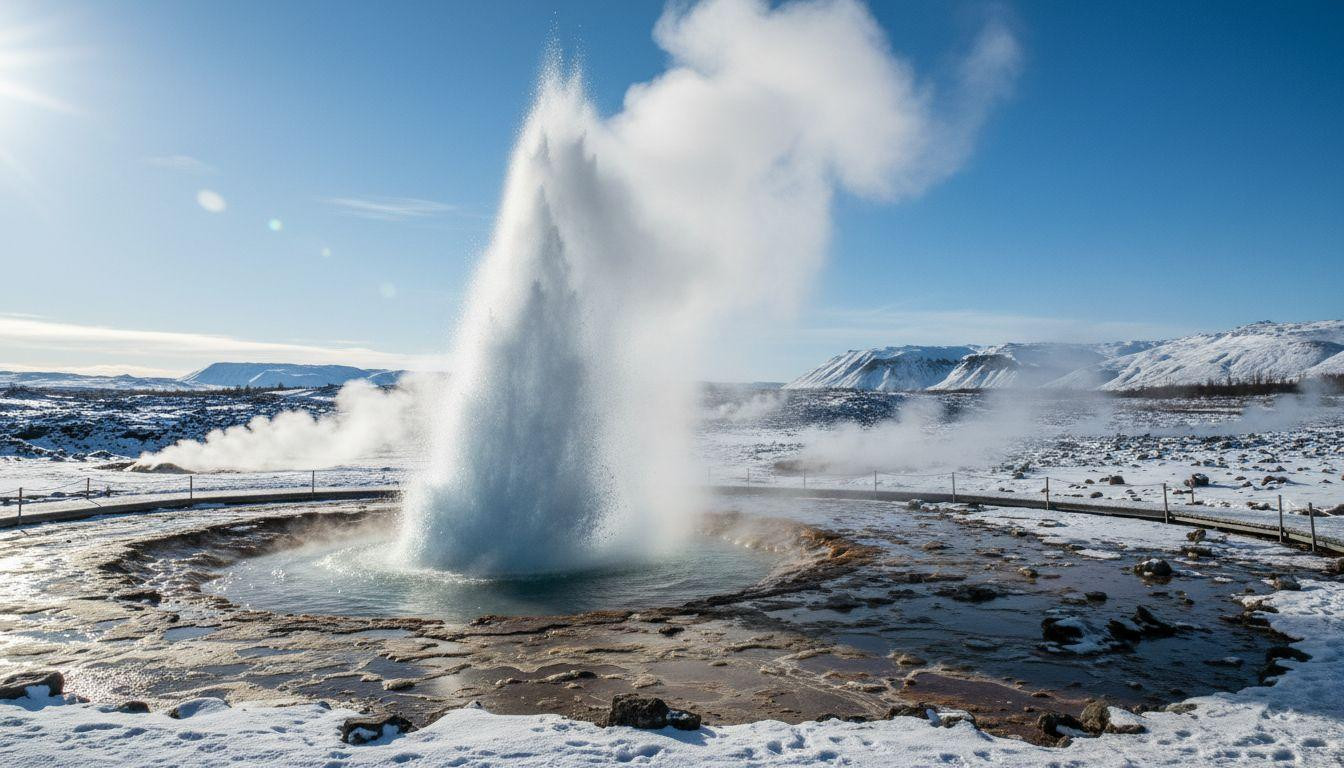
Forget Iceland’s Golden Circle where summer tour buses arrive every 8 minutes and 1.2 million visitors trample fragile moss that takes decades to regrow. January 2026 transforms this overcrowded geothermal loop into what Iceland felt like before the tourism boom: silent rift valleys, steaming geysers echoing across empty lava fields, and northern lights dancing above Gullfoss waterfall.
The Golden Circle you’ve been told to skip exists only May through September. Winter reveals the authentic Iceland that locals experience year-round.
Why summer’s Golden Circle became unbearable
Over 80% of Iceland’s 2.3 million annual visitors tackle the Golden Circle during peak season. July 2025 brought 302,000 airport arrivals compared to January’s 159,000. The math is brutal: 5,000-8,000 daily visitors concentrated at three fragile sites.
Fragile moss carpets require decades to recover from a single footprint. Off-road driving fines reach $800 because desperate authorities deploy drone surveillance. Iceland’s government proposed 2026 access fees at high-impact sites like Geysir to combat landscape damage.
Apps like “Safetravel” now redirect tourists to lesser-known spots. The irony: technology solves what seasonal timing prevents naturally. Winter already disperses crowds without digital intervention.
Winter’s Golden Circle: the before version
Snow transforms harsh black lava into ethereal white contrasts. Steam from Geysir’s geothermal area creates dramatic plumes against 23°F to 37°F air. Strokkur geyser erupts every 8 minutes, shooting water 82-115 feet high with no crowds blocking your view.
Landscape transformation in January
Gullfoss waterfall partially freezes into ice sculptures. Rainbow formations appear when low sun hits the spray from the 105-foot double cascade. Four to six hours of daylight create perpetual golden hour photography conditions.
Þingvellir National Park’s tectonic rift echoes with wind instead of voices. The 2cm annual plate separation becomes visible in ice formations along the Silfra fissure.
Practical advantages over peak season
Reykjavík accommodation drops from $400 to $200-250 per night. Rental cars cost the same $80-150 daily but without traffic on the 149-mile loop. Restaurant meals remain $25-40, but tables are immediately available.
Zero entry fees currently exist (2026 proposals remain pending). The same routes that cost $240 for summer bus tours become self-drive adventures through serene snowscapes.
The winter experience: what you actually do
Dawn at Þingvellir arrives around 11am in mid-January. Silky moss textures remain visible under light snow. The UNESCO World Heritage site where Iceland’s parliament met from 930-1798 sits empty of geology tour groups.
Geysir geothermal area (9-10am arrival)
Sulfur scent sharpens in cold air. Seltún’s overlooked bubbling mud pots display cream and pink colors against snow. Boardwalks remain ice-free from geothermal heat, allowing close approaches to active vents.
Underground rye bread baking continues year-round. Earthen pots emerge perfectly steamed after 24 hours buried in hot springs, available at visitor centers for $15.
Northern lights potential after 4pm
Winter darkness enables aurora viewing at any Golden Circle stop. Summer’s midnight sun makes this impossible. Reykjavík’s thermal pools provide perfect aurora-watching bases between sites.
Practical winter realities
4×4 rentals become mandatory for icy Route 36 conditions. Crampons cost $20 at Reykjavík outdoor shops for Gullfoss viewing platform safety. Layers handle -5°F to 37°F temperature swings throughout the day.
Nothing major closes: all three primary sites remain accessible year-round. Restaurant hours shorten (most close by 6pm in nearby towns), but visitor centers maintain services. The $800 off-road fines apply year-round through continued drone surveillance.
Winter’s frozen ground actually protects fragile moss better than summer trampling. Volcanic landscapes under snow create unique photographic opportunities unavailable during peak season.
Your questions about Iceland’s Golden Circle answered
What’s the actual cost difference between winter and summer?
Accommodation drops 40% in Reykjavík during January-March. Rental cars maintain identical pricing, but gas costs remain steady at current rates. Restaurant prices stay consistent, but winter travelers avoid summer’s booking premiums and wait times.
How does winter Golden Circle compare to summer crowds?
January sees roughly 400-800 daily visitors across all three sites combined versus summer’s 5,000-8,000. Parking lots designed for tour bus capacity remain nearly empty. No apps required to find solitude.
Are the northern lights actually visible from Golden Circle sites?
Absolutely. Winter darkness from 4pm-11am provides 8-hour viewing windows. Clear winter nights offer optimal aurora conditions that summer’s midnight sun eliminates entirely. Gullfoss provides particularly dramatic foreground subjects.
Steam rises from Geysir against snow-covered lava fields. Your footsteps crunch in the silence between eruptions. The Golden Circle that tourism nearly destroyed returns to its elemental beauty when winter reclaims what summer crowds temporarily stole.