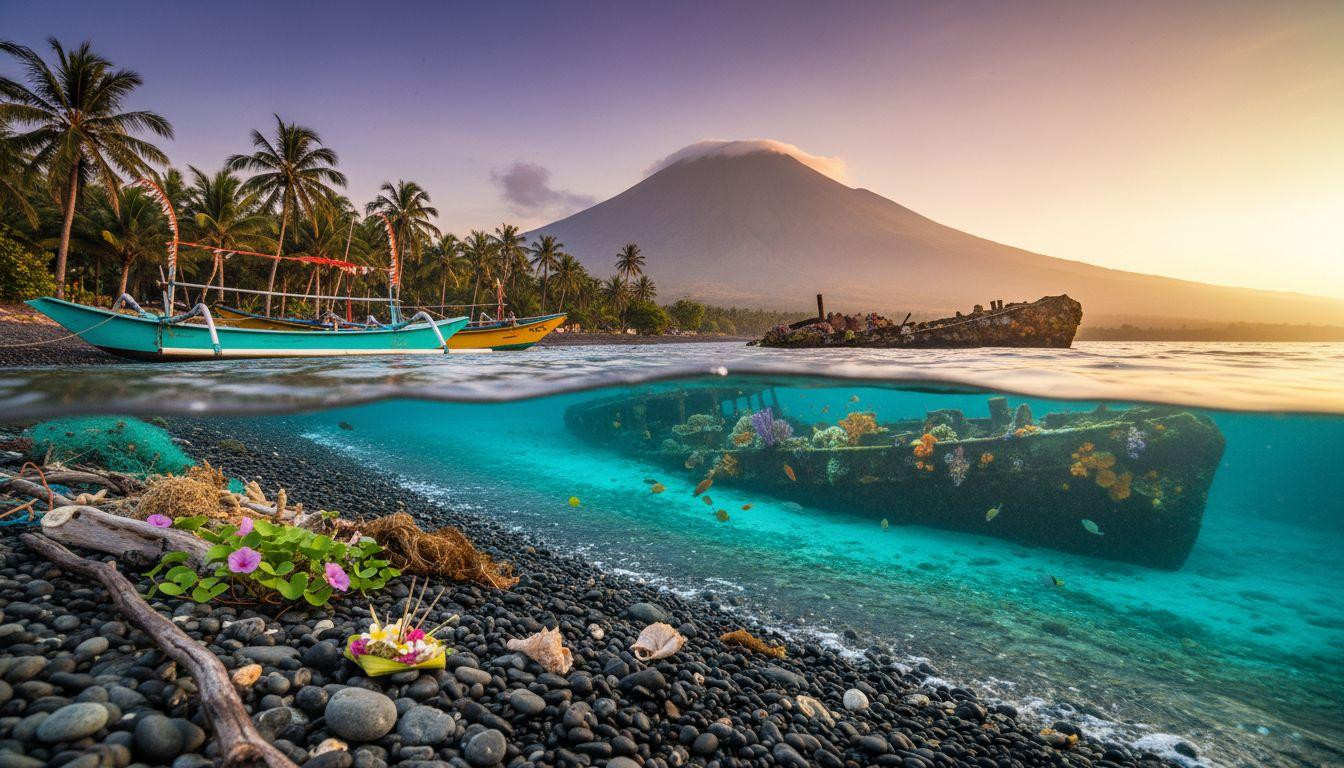
Forget Bali’s south coast where dive packages cost $180 and boats wait in crowded harbors. Tulamben holds the USAT Liberty shipwreck 150 feet from shore in crystal-clear water.
This fishing village of 2,500 residents delivers World War II history through your mask. No boats. No crowds at sunrise.
Why Bali’s south coast diving disappoints
Nusa Dua and Sanur trap divers in $110-180 packages. Resort operators control boat schedules and dive sites. You wait for groups, follow guides, surface on command.
Two-tank dives average $110 in Sanur versus $53-62 in Tulamben. Shore entry costs nothing. Boats charge $12-31 extra per trip.
The resort trap
South coast resorts bundle everything. No flexibility. No local culture. Siargao offers similar escape from mainstream Bali tourism with authentic island life.
Tulamben preserves fishing village rhythms. Village ladies carry your tanks down black pebbles for $1.25-3 tips.
Meet Tulamben’s shore-accessible shipwreck
The USAT Liberty sank January 11, 1942, torpedoed near Lombok Strait. The 1963 Mount Agung eruption pushed the wreck offshore into perfect diving position.
You swim 150 feet from Tulamben Beach parking to reach the bow. The 394-foot hull stretches between 16-98 feet deep. Open Water divers explore safely.
What makes the Liberty special
Coral coverage reaches 60 percent after 60 years underwater. Swim through portholes and engine rooms. Ribbon eels peek from crevices at dawn.
Blue water clarity rivals Fiji caves with 66-98 feet visibility May through October.
Price reality check
Single tank dives cost $28-37. Two-tank packages run $53-62. Discover Scuba programs start at $38 versus $77-110 on the south coast.
Accommodation ranges $19-31 for guesthouses to $94-188 for dive resorts. South coast mid-range hotels charge $125-250 nightly.
The authentic Tulamben experience
Fishing boats depart at 5am with traditional jukung outriggers. Markets open mornings in village center. Post-dive warungs serve nasi goreng for $1.87-3.12.
Mount Agung silhouette dominates sunrise dives. No Instagram crowds. Just you, history, and fish sounds underwater.
Beyond the Liberty wreck
Coral Garden sits 1,640 feet north with soft corals and clownfish. Drop Off wall plunges to 130 feet with pelagic action. Coron’s lagoons offer similar color shifts in Southeast Asian diving.
Nemo City specializes in macro photography. Nudibranch species include Spanish dancers and pygmy seahorses frequent sightings.
Local culture intact
Subak fishing traditions continue daily. No resort development sprawl. Tulamben Festival celebrates coral planting and jukung races each June.
Beach gear ladies represent family economic traditions. Tourism supports 10-20 local porters earning $1.25-3.12 per tank load.
Practical Tulamben access
Ngurah Rai Airport sits 62 miles away (2.5-3 hours). Private drivers charge $31-50. Gojek rides cost $31-44. Shared transport drops to $25 per person.
Best diving runs May through October with calm seas. Water temperature holds steady at 79-82°F year-round. Molokai’s volcanic coastline shares similar black beach diving in Pacific waters.
Village center to beach requires 5-minute walks. ATM sits 1,640 feet from shore. Minimart stocks basics 650 feet from dive sites.
Your questions about Tulamben answered
When do crowds arrive at Liberty wreck?
Day-trippers from south coast arrive 10am-2pm with 30-50 divers peak times. Sunrise dives (6-7am) see only 5-10 divers. January through March averages 20-50 daily total.
What makes Tulamben culturally different?
Authentic fishing village maintains Balinese-Hindu traditions. No resort mega-development. Local families operate warungs and guesthouses rather than international chains dominating south coast.
How does Tulamben compare to other Bali dive sites?
Tulamben offers 30-50% lower costs than south coast operators. Shore entry eliminates boat fees. Amed (12 miles south) charges similar rates but lacks major wreck attraction.
Black pebbles crunch underfoot as morning light touches turquoise water. The Liberty waits 150 feet offshore, coral-covered and patient as sunrise ignites Mount Agung’s peaks.