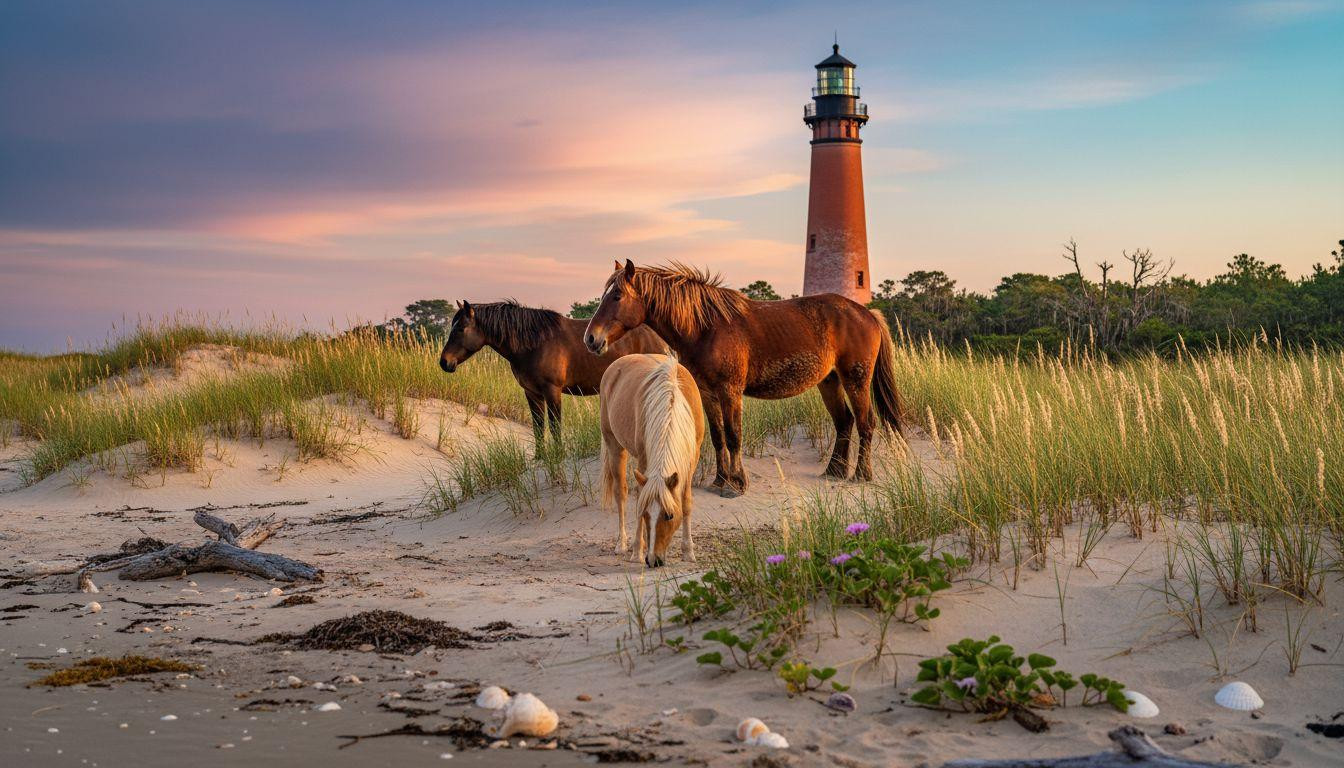
Nags Head’s paved boardwalks and commercialized beaches draw millions of visitors annually, transforming North Carolina’s barrier islands into crowded resort corridors. Just 11 miles north, Corolla preserves what the Outer Banks once offered: wild Spanish mustangs roaming free across 30 miles of unpaved Atlantic coastline where fog shrouds golden dunes at dawn.
This northernmost community in Currituck County remains authentically untamed. Where Highway 12’s pavement ends, adventure begins.
Why Nags Head lost its barrier island soul
Dare County recorded $2.1 billion in visitor spending during 2024, with Nags Head serving as the commercial hub. Peak season Airbnb rates average $602 per night, while Bodie Island Lighthouse attracted 30,779 climbers in its busiest year on record.
Development transformed natural barrier island character into paved tourism infrastructure. Beach access requires navigating crowded parking lots and commercial strips. The authentic Outer Banks experience disappeared beneath layers of shops, restaurants, and managed attractions designed for maximum visitor throughput.
Summer occupancy rates exceed 62%, creating traffic jams along Highway 12. Restaurant reservations become essential, and spontaneous beach exploration proves nearly impossible during peak months.
Meet Corolla where the road ends and horses run free
Landscape that development forgot
Beyond Corolla’s village center, paved roads surrender to sand tracks accessible only by four-wheel drive vehicles. Carova Beach stretches northward, where approximately 100 Spanish mustangs descended from 16th-century shipwrecks graze freely among sea oats and dunes.
The Currituck Beach Lighthouse stands 162 feet tall, its unpainted red brick exterior distinguishing it from other Outer Banks beacons. Climbing 220 steps rewards visitors with 360-degree panoramas over the Atlantic Ocean and Currituck Sound. Morning fog often shrouds the coastline, creating ethereal silhouettes of horses against golden sand.
Price reality check
Currituck County’s tourism spending reached $581 million in 2024, reflecting significantly lower visitor density than Dare County’s commercialized areas. Off-season oceanfront cottages rent for $150-250 per night, representing savings of 20-30% below national beach averages.
Wild horse safaris cost $50-70 per adult, while lighthouse admission requires just $12. Four-wheel drive beach permits cost $50 for unlimited seasonal access. Local seafood restaurants serve she-crab soup for $12 and fresh oysters for $18 per dozen.
The Corolla experience
Activities beyond paved tourism
Dawn horse safaris offer the most authentic barrier island encounters. Professional guides navigate sandy tracks to locate herds grazing in coastal marshes. Photography opportunities abound as morning fog lifts, revealing horses silhouetted against the rising sun.
The historic Whalehead Club, built between 1922-1925 as a hunting lodge for Philadelphia magnate Edward Collings Knight Jr., now operates as a museum within Historic Corolla Park’s 39 acres. Tours cost $7-12 and showcase Art Nouveau architecture alongside exhibits detailing the region’s elite hunting heritage.
Winter whale watching extends from December through April, when humpback whales migrate through Atlantic waters. Soundside kayaking provides serene exploration of placid marshlands where great blue herons and osprey nest.
Cultural authenticity
“Banker” culture traces to colonial shipwreck survivors who established fishing communities along these isolated shores. Local traditions emphasize maritime heritage rather than tourist entertainment. The Corolla Wild Horse Fund, established in 1996, protects the genetic integrity of Spanish mustang bloodlines.
Annual events maintain low-key character: Christmas Tree Lighting ceremonies occur without commercial fanfare, while summer Wild Horse Day celebrations focus on education rather than entertainment. Local craft traditions include maritime decoys and driftwood art created by residents whose families have lived here for generations.
Preserving paradise through isolation
Geographic barriers protect Corolla from overdevelopment. Highway 12 provides the only vehicular access, creating natural visitor limits during peak seasons. Environmental protections restrict construction north of the village, preserving 30 miles of undeveloped coastline.
The 500 permanent residents swell to approximately 10,000 during summer months, yet density remains dramatically lower than Nags Head’s commercialized beaches. Visitors often encounter more horses than people along northern beaches.
Recent TikTok trends featuring #CorollaHorses have generated over 10 million views, yet physical access limitations prevent social media from overwhelming the destination. Four-wheel drive requirements and permit systems maintain authentic barrier island character.
Your Questions About Corolla, North Carolina answered
What permits do I need for four-wheel drive beach access?
Beach driving permits cost $50 per vehicle for seasonal access to Carova Beach and northern areas. Permits are available online or at local outfitters. Standard four-wheel drive vehicles handle sand conditions, though deflating tires to 15-20 PSI improves traction. Morning hours offer optimal conditions before afternoon winds create challenging driving surfaces.
When do wild horses appear most frequently?
Spanish mustangs graze throughout daylight hours, with dawn and dusk providing optimal viewing opportunities. Cool weather months from October through March see increased activity as horses seek sheltered dune areas. Professional safari guides report 90% success rates for horse encounters, as the protected herd of approximately 100 animals maintains consistent territorial patterns.
How does Corolla compare to other Outer Banks destinations?
Corolla attracts roughly 200,000 annual visitors compared to millions visiting commercialized Outer Banks areas. Accommodation costs run 15-25% below regional averages during off-season periods. The unpaved northern beaches contrast sharply with developed southern areas, offering authentic barrier island experiences that disappeared elsewhere decades ago.
Fog lifts from Carova Beach as wild horses emerge from maritime forests, their hoofprints joining countless others in sand unmarked by development. Here, where pavement ends and wilderness begins, the Outer Banks remembers its untamed soul.