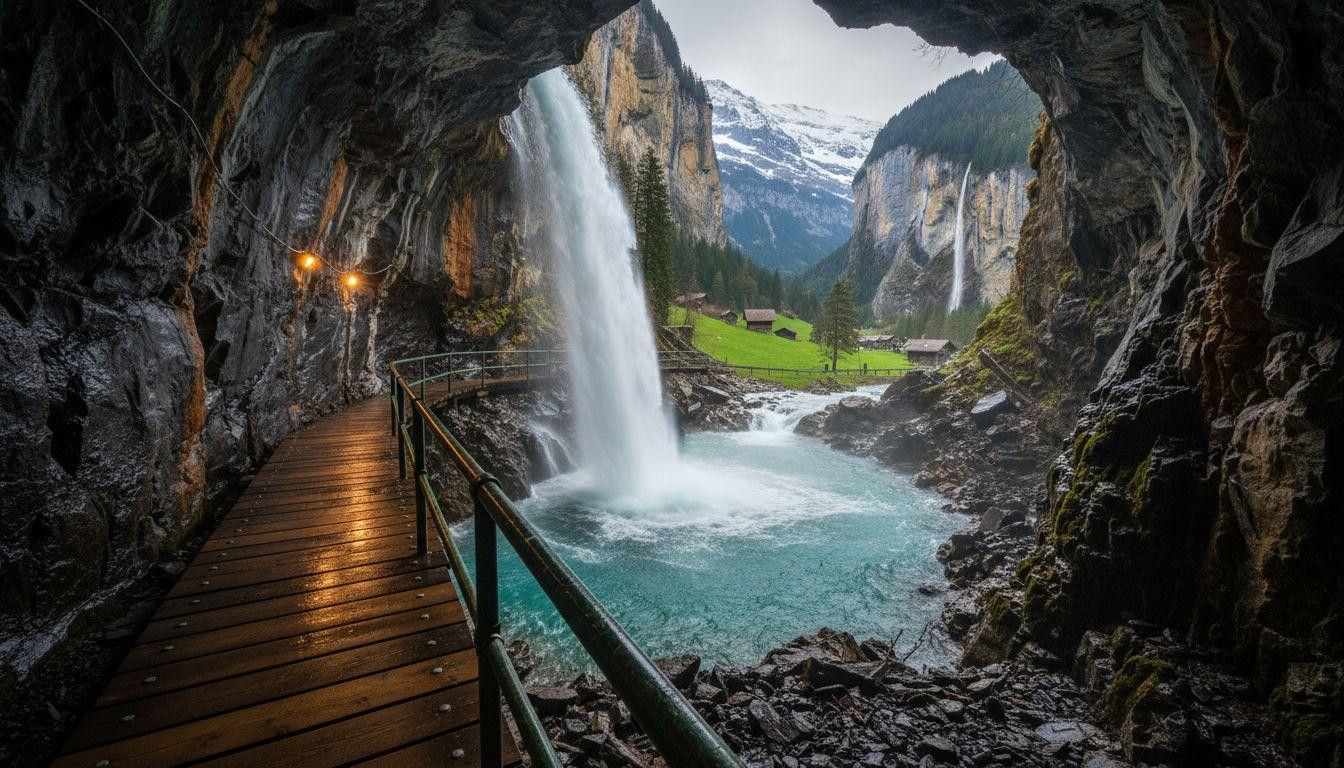
Jungfraujoch sells out weeks ahead at $260 per ticket. The train climbs 3,454 meters where altitude sickness hits half the visitors. You spend six hours round-trip from Interlaken for controlled viewing platforms and indoor exhibits. Fourteen miles away, an elevator bores into the Jungfrau mountain itself. You walk through ten glacier waterfalls carving black rock tunnels at 20,000 liters per second. Entry costs $18. No booking required.
Trümmelbach Falls drains the Eiger, Mönch, and Jungfrau glaciers through a single mountain gorge. Water thunders through carved passages you reach by funicular, then wooden platforms bolted to wet stone. The sound echoes off granite walls. Mist creates rainbows where natural light cracks through. This is what Jungfraujoch promises from observation decks: raw alpine power, unfiltered.
Why Jungfraujoch disappoints
The Top of Europe railway requires advance tickets during summer. Prices hit $260 for adults in 2026, more with connections from Zurich. The journey takes two hours each way from Interlaken. At 11,332 feet, thin air causes headaches, nausea, dizziness in roughly 50% of visitors according to alpine medicine studies.
You arrive at an indoor complex. The Ice Palace shows sculpted tunnels. The Sphinx Observatory offers views through thick glass. Tour groups move on schedules. The experience feels managed, sanitized. You paid for proximity to glaciers but stand behind barriers watching from climate-controlled rooms.
Return trains book solid by mid-afternoon. Miss your slot and you wait hours. The whole operation runs like an airport. Jungfraujoch handles 3.7 million visitors yearly. You feel every single one.
What Trümmelbach delivers instead
Europe’s only underground glacier waterfalls
Ten waterfalls cascade inside the mountain between Lauterbrunnen and Stechelberg. The same glaciers feeding Jungfraujoch drain here: 24 square kilometers of ice melt funneling through vertical shafts. Peak flow reaches 20,000 liters per second in June. The water carries 20,000 tons of rock debris yearly, grinding tunnels wider.
A 1916 funicular climbs 345 feet at 45 degrees through solid rock. It drops you between falls six and seven. Walk up via stairs to fall ten, or descend to fall one. Wooden walkways and metal platforms let you stand three feet from torrents. The spray soaks everything. You hear nothing but water against stone.
The cost comparison that matters
Trümmelbach charges 16 Swiss francs ($18) at the gate. No passes, no discounts, no advance booking. You show up, buy a ticket, ride the elevator. The whole visit takes 90 minutes. From Lauterbrunnen village, walk 30 minutes along the valley floor or take bus 141 for $4 round-trip.
Total from Zurich: $110 train to Lauterbrunnen (Swiss Travel Pass makes it free), $18 entry, $4 bus. You spend $132 and four hours. Jungfraujoch costs $260 entry alone, plus $90 for trains from Interlaken, plus six hours minimum. The math is $350 and a full day versus $132 and a half-day. For waterfalls you can touch instead of glaciers you view through windows.
Inside the mountain
What you actually see
The elevator opens onto wet rock. Turquoise water explodes from a crack above, hits a ledge, splits into three streams. The color comes from glacial flour, rock ground so fine it stays suspended. Each waterfall carves a different shape. Fall seven spirals down a corkscrew shaft. Fall four drops straight 60 feet into a pool that boils white.
Platforms shake when flow peaks. The sound measures around 100 decibels, similar to a chainsaw. You feel the vibration in your chest. Natural light filters through fissures, turning mist into shifting veils. Artificial floods add amber tones at the lower falls. The air stays cool, around 50°F even in August, and smells like wet stone.
When crowds thin out
The falls open early April through early November, following glacier melt season. Summer brings peak flow and peak visitors. Afternoon queues stretch 45 minutes in July and August when tour buses arrive. Rainy days pack the tunnels with people avoiding outdoor hikes, but the waterfalls run harder, louder, more dramatic.
Mornings before 10am stay quiet. Late afternoon after 4pm empties out. If you climb the stairs instead of waiting for the elevator, you skip the line entirely. The stairs are steep, wet, and unlit in sections. They take 20 minutes up. Most visitors ride, so the stairs stay empty. This Belgian town glows golden at 7pm when 400 locals reclaim their streets, and Trümmelbach offers the same shift: arrive when others leave.
The Lauterbrunnen advantage
Trümmelbach sits in a valley with 72 waterfalls total. Staubbach Falls drops 974 feet from a cliff face visible from town, free to view. Mürrenbach runs even taller but requires a hike. Most visitors photograph Staubbach and leave. Trümmelbach charges admission and hides inside rock, so it filters out casual tourists.
The village of Lauterbrunnen holds 800 residents. Hotels cost $110 to $180 per night, half the price of Grindelwald where Jungfraujoch trains depart. Restaurants serve rösti for $22, fondue for $28. The valley stays agricultural. Cows wear bells. Farms sell cheese at roadside stands. Forget Rothenburg where hotels cost $200 and Dinkelsbühl keeps medieval walls for $90: Lauterbrunnen operates on the same principle of authentic access without tourist markup.
Your questions about Trümmelbach Falls answered
Can you visit Trümmelbach and Jungfraujoch in one day?
Physically possible but exhausting. Jungfraujoch requires four to six hours from Lauterbrunnen. Trümmelbach needs two hours including travel from the village. If you take the first Jungfraujoch train at 6:30am and return by 1pm, you can reach Trümmelbach by 2pm before it closes at 5pm. Most people choose one or the other. Trümmelbach offers more direct glacier contact for 95% less money.
Why does water inside a mountain stay turquoise?
Glaciers grind bedrock into powder finer than flour. This glacial silt stays suspended in meltwater, scattering light. Blue wavelengths penetrate deepest, giving the turquoise color. The effect intensifies in tunnels where rock walls block other light sources. The same physics create the blue of glacier ice itself. Trümmelbach shows this phenomenon at eye level instead of from distant viewpoints.
How does Trümmelbach compare to other underground waterfalls?
Ruby Falls in Tennessee drops 145 feet inside Lookout Mountain but flows at 30 gallons per minute, a trickle compared to Trümmelbach’s 5,280 gallons per second at peak. This Argentine town spent 25 years underwater and surfaced white as bone, showing water’s carving power over time. Trümmelbach remains Europe’s largest subterranean waterfall system and the only one fed directly by active glaciers. The volume, the access, and the glacier source make it unique globally. This Olympic valley runs 104°F water through snow-buried forest and frozen falls offers thermal contrast; Trümmelbach delivers pure glacial force.
The last platform sits at fall one, where all ten torrents converge into a single channel. The combined flow hits a boulder the size of a car. The boulder hasn’t moved in decades. The water just keeps hitting it, carving deeper. You stand there wet from spray, ears ringing, watching a mountain dissolve in real time. Jungfraujoh shows you glaciers from a distance. Trümmelbach puts you inside their drainage system while it works.