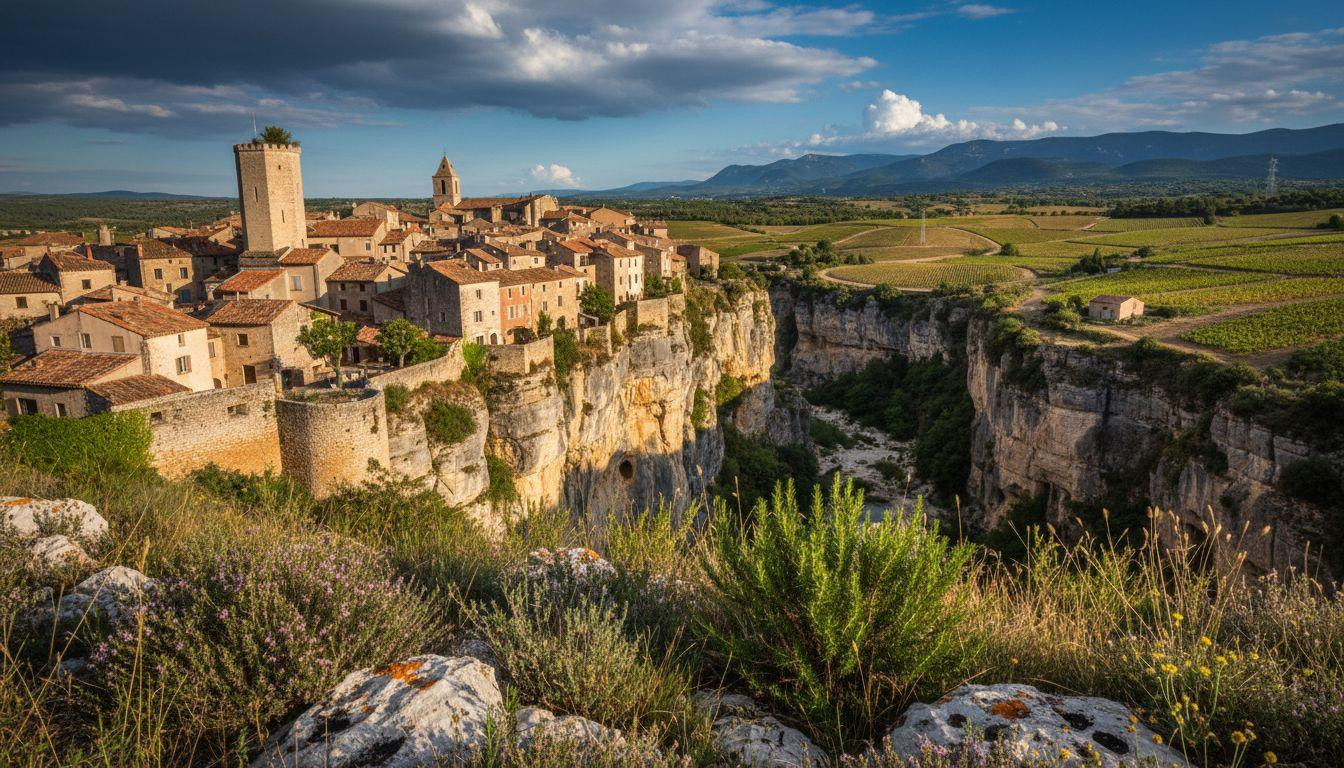
Carcassonne’s medieval citadel drowns in crowds of 4 million annual visitors who pay $13 entry fees to walk reconstructed 19th-century walls. Meanwhile, 56 miles northeast, the village of Minerve perches on limestone cliffs above the River Cesse with just 130 residents and free access to authentic 13th-century Cathar fortifications where 180 religious martyrs died in 1210.
Why Carcassonne disappoints history seekers
Eugène Viollet-le-Duc’s 1853-1911 restoration prioritized romantic aesthetics over historical accuracy. The fairy-tale conical roofs and perfect stonework you photograph today reflect 19th-century imagination, not medieval reality. UNESCO acknowledges the site’s “restored nature” in official documentation.
Crowd management grows worse each summer. Parking costs $9-11 daily in the main lot below the walls. Hotel rates reach $200-300 per night in July-August for standard rooms. Tourist infrastructure dominates the medieval experience with ice cream shops and costume rental booths lining ancient streets.
Meet Minerve where Cathar history lives in stone
The 1210 siege landscape
Minerve’s rocky peninsula above the Cesse and Brian gorges created a natural fortress that required no reconstruction. Simon de Montfort’s six-week siege employed four catapults including the massive “Malevoisine” (Bad Neighbor) that targeted the village’s water supply rather than its walls.
On July 22, 1210, after negotiated surrender, 180 Cathar Parfaits chose death over religious conversion. They burned at the stake outside the walls in a defining moment of the Albigensian Crusade. A simple stone stele overlooking the ravine commemorates their sacrifice with quiet dignity.
Cost reality check
Minerve bed-and-breakfasts average $110-150 per night versus Carcassonne’s $200-330 for equivalent comfort in peak season. Village access remains free year-round. Parking costs just $4-6 daily in July-August peaks compared to Carcassonne’s $9-11 mandatory fees.
Restaurant dinners run $30-40 with local Minervois wine versus Carcassonne’s $50-65 tourist menus. Discover quiet medieval villages across southern France’s wine country where authentic experiences cost 25-40% less than major tourist sites.
The Minerve experience
Walking the medieval core
Narrow stone lanes wind between houses built directly on curtain wall foundations. The covered street leading to the ancient well preserves its original vaulted passage. Rue des Martyrs follows the path Cathar prisoners walked to their execution site.
The Candela tower stands solitary above the village as the sole remnant of the medieval castle. Its cylindrical form rises against blue sky like a candle flame, giving Minerve its distinctive skyline that appears in no tourist brochures.
Minervois wine country
AOC wine tastings at nearby domaines cost $5-15 compared to Carcassonne’s $8-10 per glass tourist pricing. Domaines in La Caunette, Cesseras, and Aigne offer cellar-door bottles for $8-12 that sell for $35-50 in Carcassonne wine bars.
Garrigue landscapes surround the village with thyme, rosemary, and olive groves releasing intense aromatics in summer heat. Better than Florence where ZTL fines cost $110 and Lucca keeps Renaissance walls car-free for visitors seeking authentic medieval atmosphere without commercial overlay.
Practical information
Access from Narbonne train station takes 35-40 minutes by car through vine-covered hills. This medieval fortress requires wall reservations in 2026 where King’s Landing crowds fade but Minerve maintains open access with minimal visitor management.
April through June and September-October provide ideal weather with fewer crowds than August peaks. Winter visits offer profound silence broken only by wind in the gorges and distant ravens. Better than Venice where gondolas cost $90 and Bruges keeps medieval canals for $17 in destinations that prioritize preservation over profit.
Your questions about Minerve answered
How do I reach Minerve without a car?
High-speed trains connect Paris to Narbonne in 4.5-5.5 hours. From Narbonne station, taxi transfers to Minerve cost approximately $45-60 for the 22-mile journey. No regular bus service operates to the village, making private transport essential for car-free visitors.
What makes Minerve more authentic than Carcassonne?
Minerve’s houses, streets, and defensive walls retain original medieval masonry modified gradually over centuries. Carcassonne’s skyline represents 19th-century restoration work that prioritized visual drama over historical accuracy. The village maintains 0.1-0.15 tourist businesses per resident compared to Carcassonne’s 0.4-0.5 commercial density.
When should I avoid visiting Minerve?
Mid-week January-March sees restaurant closures and shortened domaine hours requiring advance planning. July-August weekend afternoons bring parking challenges and reduced personal space, though crowds remain manageable compared to major tourist sites. Rainy periods may restrict gorge access for safety.
Morning light touches honey-colored limestone walls as the Cesse flows silently underground through natural tunnels. Church bells echo across empty streets where history whispers rather than shouts, and 13th-century stones hold their secrets close.