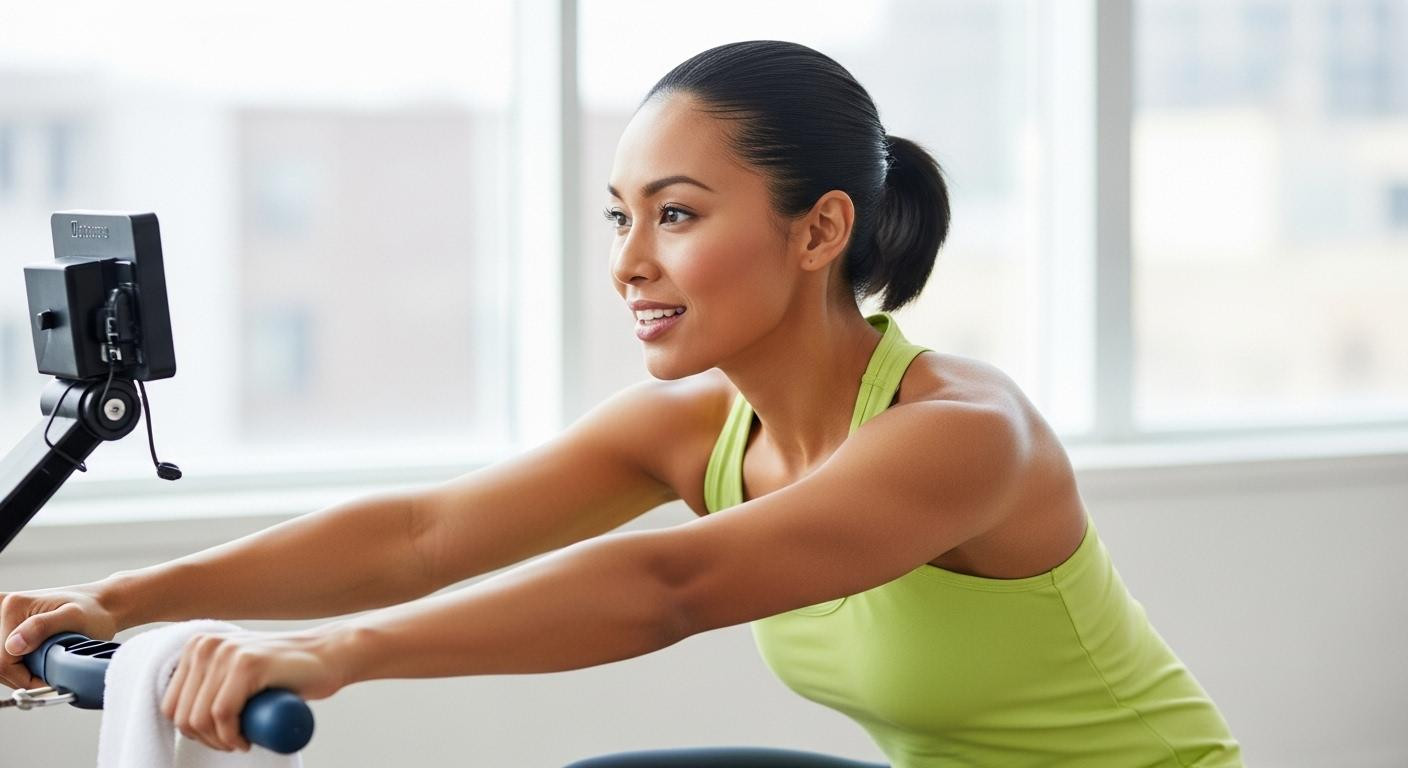
You step onto the treadmill at 7:15 AM. The display flashes green at 120 beats per minute. “Fat-burning zone optimal” appears on screen. You trust the machine’s promise for twenty focused minutes. Exercise physiologists studying metabolic conditioning reveal a harsh truth. That green zone misses your actual fat-burning peak by an average of 23 beats per minute. While machines claim scientific precision, your body burns significantly less fat than at higher intensities they never mention.
What cardio machines promise vs. what science proves
NordicTrack treadmills, Life Fitness ellipticals, and Concept2 rowers display identical graphics. The fat-burning zone spans 60-75% of age-predicted maximum heart rate. This “sweet spot” claims to burn the highest fat percentage during exercise.
The formula appears logical. Lower intensity uses fat preferentially over carbohydrates for fuel. Machines exploit this percentage to justify zone programming across all equipment.
The 85% efficiency illusion
Sports scientists studying exercise physiology confirm findings at 25% VO2 max. 85% of energy comes from fat at very low effort levels. This percentage creates the illusion of optimal fat burning.
The absolute burn reality
Total fat oxidation peaks at 65% VO2 max. This moderate-high intensity falls into most machines’ “cardio zone,” not “fat-burning zone.” You burn less absolute fat in the lower zone despite higher percentage contribution.
Clinical exercise testing reveals machine zones misalign with personalized weight loss goals. Research from major universities exposes fat-burning timing myths that complement zone misconceptions. Certified personal trainers with NASM credentials emphasize individual metabolic differences over generic formulas.
The FATmax revolution: Why your optimal zone doesn’t match the machine
Clinical exercise laboratories analyze metabolic responses during incremental testing. Machine learning studies identify individualized FATmax. This represents the heart rate where your body burns maximum absolute fat.
Results contradict universal zone programming. Generic age-sex zones show poor agreement with true optimal intensity levels. Testing reveals significant individual variation in fat oxidation patterns.
The 23 beat per minute mismatch
A 40-year-old woman’s machine suggests 108-135 beats per minute for optimal fat burning. Clinical testing often reveals her actual FATmax at 147 beats per minute. This places optimal intensity 12 beats into the machine’s “cardio zone.”
Lactate threshold as your fat-burning compass
Exercise physiologists recommend ventilatory threshold training for non-lab users. Breathing noticeably labors but conversation remains possible at this intensity. This correlates strongly with lactate threshold where fat oxidation peaks.
Sports scientists studying metabolic conditioning emphasize clinical testing for personalized routines. Ventilatory threshold breathing offers accessible self-calibration without expensive laboratory analysis. Low-impact alternatives that maximize calorie burn complement this individualized approach.
Equipment hierarchy: Which machines actually maximize fat loss
Cardio machines vary dramatically in calorie burn despite identical zone programming. Clinical trials reveal significant differences in total energy expenditure and muscle recruitment patterns.
Rowing’s 23% advantage
Rowing activates 86% of total musculature. This yields 23% greater fat loss versus cycling at matched perceived effort. The NordicTrack RW900 burns 840-1,200 calories per hour for a 155-pound user.
Full-body engagement achieves higher METs. Rowing reaches 12.5 METs compared to 11 METs for treadmill running. Machines engaging larger muscle groups produce superior metabolic demands.
Assault bikes dominate calorie burn
Air bikes achieve 950-1,300 calories per hour. This represents 13-20% higher burn than rowing at equivalent intensity. Unlimited air resistance scales with effort, enabling EPOC afterburn effects.
Exercise physiologists note afterburn extends fat burning 6+ hours post-workout. Studies comparing walking to high-intensity training reveal zone obsession misses broader metabolic impacts. Professional guidelines recommend 45-60 minute moderate sessions 3-5 times weekly.
2026’s AI solution: Personalized zones replace generic graphs
Third Space gyms launch $20 AI-powered recovery systems this January. Altitude chambers boost red and white blood cell counts. Hypoxic training enhances fat oxidation capacity beyond traditional zone limitations.
Vibroacoustic beds costing $160,000 aid professional teams’ recovery protocols. Democratization begins with accessible clinical FATmax testing. Exercise physiologists advocate cardiopulmonary testing to prescribe individualized intensity.
Until clinical testing becomes mainstream, ignore machine zones. Exercise at ventilatory threshold breathing intensity. This RPE 6-7 out of 10 approximates 65% VO2 max where absolute fat burn peaks. Metabolic profiling advances complement this personalized approach to training optimization.
Your questions about fat-burning zones on cardio machines answered
Can I trust wearables like Apple Watch for fat-burning zones?
Wearables use age-predicted formulas identical to machines. They track heart rate accurately but zone recommendations lack personalized FATmax calibration. Use devices to monitor intensity relative to ventilatory threshold breathing, not generic percentages.
Is rowing or assault bike better for fat loss at home?
Assault bikes burn 13-20% more calories than rowing machines at equivalent effort. Rowing activates 86% of muscles with lower joint stress. Choose assault bikes for maximum calorie burn, rowing for sustainable full-body conditioning.
Should beginners avoid zone 5 entirely?
Medical professionals warn zone 5 risks dizziness, elevated blood pressure, and arrhythmia for untrained individuals. Build aerobic base fitness in ventilatory threshold zones for 8-12 weeks before attempting high-intensity intervals safely.
The elliptical console flashes green at 118 beats per minute. You glance away, focusing on controlled breathing instead. Ventilatory threshold, not machine mythology, guides your intensity. Clinical testing will eventually confirm your personalized FATmax. Today, you trust exercise physiology over programmed pixels.