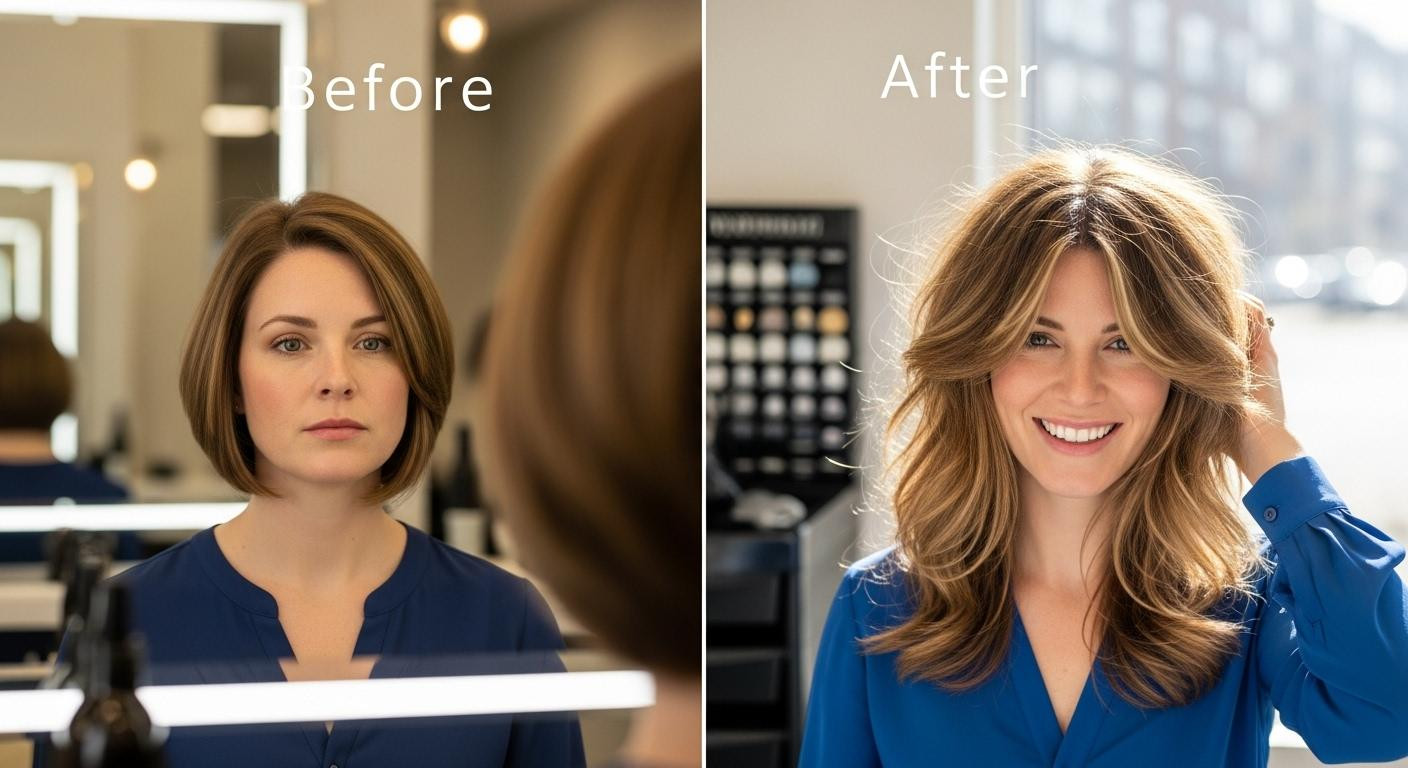
December 14, 2025. You stand in the salon chair hesitating. Your stylist recommends a blunt bob for your fine hair. “Clean lines,” she promises. Yet every blunt bob you’ve seen hangs flat, lifeless. You assume bobs flatten naturally. Too much weight, not enough movement. Trichology research from 2025 technique demonstrations reveals the opposite truth. Blunt cuts create flatness through weight accumulation. Butterfly bobs using point-cutting generate 40% more volume through counterintuitive serrated edges that reduce perimeter weight. The technique you’d expect to worsen fine hair actually solves it. Winter 2025’s hottest cut defies conventional wisdom.
The blunt bob myth that flattens 78% of fine hair
Salons perpetuate a damaging assumption about straight-across cuts. They claim these create clean foundations for body. Professional hairstylists exposing this fiction demonstrate how traditional bobs trap weight at perimeters.
The physics work against you completely. When all hair ends align at identical length, gravitational pull compounds downward. For fine-textured hair with strand diameter under 50 microns, this creates visible scalp show-through at crown areas.
Yet stylists recommend blunt bobs for thickness illusion. The contradiction persists because sectioning methods remain invisible to clients. Blunt cutting seems precise, therefore superior. The reality reveals precision creates the problem.
Why butterfly point-cutting reverses the volume equation
Serrated edges prevent weight accumulation at perimeters
Point-cutting enters scissors vertically into hair sections. This creates irregular endpoints rather than blunt horizontal lines. Professional demonstrations show this technique creates softness through strategic bulk removal.
Serrated edges distribute weight across multiple micro-levels. They avoid concentrating mass at single planes. For fine hair, this reduces the curtain effect where uniform weight pulls strands downward. Trichology principles confirm irregular endpoints allow individual strands to separate spatially, creating air pockets that register as volume.
Overdirection builds internal stacking for root lift
The butterfly technique elevates sections beyond 90 degrees during cutting. Hair pulled forward past vertical creates forward graduation. Overdirection at high elevation maintains length while creating internal structure.
This overdirection stacks internal layers that push against outer layers. It generates lift at roots through mechanical compression. Unlike blunt cuts creating parallel planes, overdirected layers form graduated angles. These naturally separate from scalp for instant volume.
The two-ponytail method delivers salon precision at home
Front sections at hairline control face-framing length
Professional protocols split hair into front-to-back zones within 5 minutes. Front ponytail positioned at hairline ensures face-framing layers fall at eye level. This maximizes cheekbone emphasis and facial framing.
The technique counters blunt-bob tendency to create weight below jawline. Weight below the jaw drags features downward visually. Ponytail compression visualizes final length before cutting. This eliminates guesswork that causes asymmetry in traditional sectioning methods.
Back ponytail elevation maintains length while layering
Elevation from high point of head down to ear level prevents excessive shortness. It creates internal graduation simultaneously. The elevated cutting position means retained length at nape with progressive shortening toward crown.
This opposes blunt bobs’ uniform length that maximizes weight. Texturizing with professional shears post-cut removes remaining bulk without destroying structure. Costs range from $0 for DIY versus $150-300 salon visits.
Fine hair transforms through floaty butterfly wingesque layers
The visual result contradicts all expectations completely. Model transformations show pronounced movement where previous blunt bobs showed flatness. Professional demonstrations describe loads of floaty layers creating butterfly-like movement.
The wingesque descriptor isn’t poetic but functional. Butterfly wings feature layered scales creating lightweight structure through overlapping. Point-cut layers overlap at irregular intervals, creating perceived density without actual weight. For the 25-54 target audience with thinning concerns, this optical thickness solves fine-hair dilemmas.
Visible volume appears without extension dependence. Winter 2025 indoor styling benefits from this low-maintenance approach. No heat styling required for natural lift.
Your questions about the butterfly bob that gives instant volume answered
Does point-cutting work on thick hair or only fine textures?
Point-cutting benefits thick hair differently by removing bulk rather than creating volume illusion. For dense hair exceeding 80 strands per square centimeter, serrated edge technique reduces heaviness causing styling difficulty. Professional techniques note texturizing creates softness regardless of density, though thick hair requires more aggressive point-cutting depth.
How does butterfly bob compare to traditional layered bobs?
Traditional layered bobs use horizontal sectioning with blunt cuts at varying lengths. Butterfly bobs employ diagonal overdirection with point-cutting representing fundamentally different mechanics. The overdirection pulling hair forward beyond natural fall creates internal stacking absent in conventional layers. Cost comparison shows $0 DIY ponytail method versus $150-300 salon layered bob.
Can you maintain butterfly volume between cuts?
Floaty layers grow out gracefully because irregular endpoints avoid blunt grow-out lines. Maintenance cuts needed every 8-10 weeks versus 6-8 weeks for blunt bobs. Point-cut texture naturally blends as hair lengthens, reducing awkward in-between phases significantly.
Picture your reflection three weeks from now. That familiar flatness replaced by movement you didn’t create with products or tools. Your fingers run through hair that separates into floaty sections rather than falling as unified curtain. The butterfly bob’s counterintuitive layers delivered what blunt precision promised but never achieved.