“`html
The parking lot at Hoh Rainforest fills by 9am on a February Tuesday. Forty-five miles south, the ranger station at Quinault sits empty at the same hour. Same moss. Same ancient trees. Different century of pace.
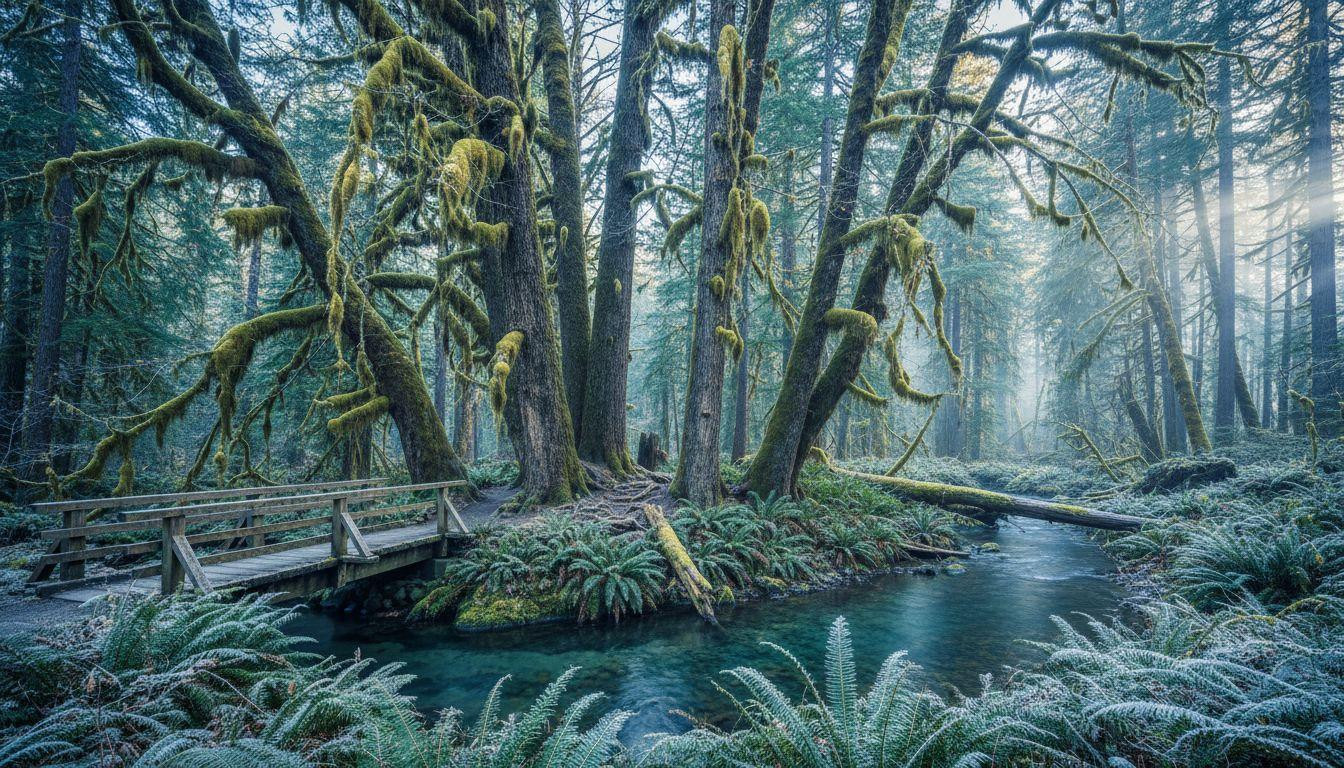
This half-mile loop through Maple Glade delivers what Hoh promised before Instagram found it. Bigleaf maples drip emerald moss over Willaby Creek. Frost lines the ferns north of the bridge. You walk alone.
Why Hoh became its own problem
Olympic National Park recorded 3.7 million visitors in 2024. Most drove straight to Hoh Rainforest. The Hall of Mosses trail, paved and wheelchair-accessible, became a family magnet. Tour buses arrived by 10am even in winter.
Social media amplified the crowds. The hashtag #HohRainforest collected 180,000 posts. Photographers lined up for the same moss-draped angle. Park rangers proposed shuttle service for summer 2026 to manage overflow parking.
Ropes now guide visitors along the 1-mile loop. You view the moss from a distance. The quiet that made these trees sacred disappeared under camera clicks and tour group chatter.
What Quinault keeps for itself
The Maple Glade loop starts 50 feet from the ranger station parking lot. Twenty spots, rarely full. The trail crosses a wooden bridge over Willaby Creek, then curves through old-growth forest untouched by crowds.
The landscape Hoh lost to fame
Four species of old-growth trees pack into this half-mile: bigleaf maple, Douglas fir, Sitka spruce, western hemlock. The maples form a cathedral ceiling. Moss hangs in curtains thick enough to hide your hand.
Willaby Creek runs turquoise over smooth stones. Benches sit at water’s edge. A short spur trail leads to a small waterfall where mist rises in morning light. You can touch the moss here. No ropes. No crowds pushing forward.
Winter transforms the scene. Frost coats the ferns in silver. Ice crystals catch on moss tips, turning emerald to pale green. The creek reflects bare branches like a mirror. This ephemeral beauty exists for maybe three hours after sunrise, then melts away.
What it costs compared to Hoh
Both trails require the same $30 Olympic National Park pass. But Quinault’s advantages stack up fast. The loop measures 0.5 miles against Hoh’s 1-plus miles. Elevation gain: 16 feet, essentially flat.
Lodging tells the real story. Kalaloch Lodge near Hoh charges $250-400 per night in winter. Lake Quinault Lodge, one mile from the trailhead, runs $100-200 for the same dates. Amanda Park cabins drop below $100 off-season.
Roosevelt elk browse the creek willows at dawn and dusk. At Hoh, you might spot them from a distance. Here, they walk within 30 feet of the trail. One visitor in August 2020 noted seeing a fox. No elk that day, but the possibility stays real.
Walking the loop at first light
Arrive at 7am. The ranger station opens at 8am, but the trail stays accessible. Morning mist rises from Willaby Creek. Frost glows silver-green on ferns north of the bridge. You hear only the creek and occasional bird calls.
What the morning feels like
The moss drips constantly. Not rain, just condensation from 140 inches of annual precipitation. Each step on the spongy trail releases an earthy scent mixed with fresh frost. Diffuse winter light filters through the canopy, creating silvery glows.
The waterfall spur appears 0.2 miles in. Mist catches the low sun. Ice forms on rocks at the base. This moment belongs to you. No voices. No camera clicks. Just the sound of water over stone.
Temperature hovers at 43°F in February. Comfortable in layers. The forest blocks wind. You can sit on a creek-side bench for 20 minutes without getting cold. Try that at Hoh’s exposed viewpoints.
Why winter wins here
Summer brings 75°F heat and higher creek flow. The water turns murky. Tourists discover Quinault as a Hoh alternative, though numbers stay low. Winter keeps the secret intact.
Frost amplifies moss texture. Ice crystals on emerald create a silver-green glow found nowhere else. Creek reflections turn glass-calm. The forest feels prehistoric, untouched, yours alone.
Hoh stays busy year-round. Quinault empties out November through March. The difference: 100-plus daily visitors at Hoh versus fewer than 10 at Maple Glade on a midweek winter day.
Planning your visit right
Drive US-101 south from Port Angeles for 2.5 hours. Turn onto North Shore Road at Amanda Park. The ranger station appears one mile in. Park for free. The loop starts across the bridge.
Dawn timing matters. Arrive between 6:30am and 8am for best light and guaranteed solitude. Frost melts by 10am. The magic window closes fast.
Combine Maple Glade with the Kestner Homestead loop, 1.3 miles through pioneer history. Add lunch at Lake Quinault Lodge. Total cost for the day: under $100 including the park pass and a salmon entrée.
Check road conditions at 360-565-3131. Winter storms close North Shore Road occasionally. South Shore Road offers an alternative route, though it adds 15 minutes. Cell service drops to zero past Amanda Park. Plan accordingly.
Bring layers, waterproof boots, and a thermos. No facilities at the trailhead. The ranger station has clean restrooms with running water when open. Otherwise, you’re on your own.
Your questions about Quinault’s winter rainforest answered
How does Quinault compare to other Olympic Peninsula trails?
Quinault offers the same old-growth experience as Hoh with 90% fewer visitors. The 0.5-mile loop takes 20-30 minutes at a relaxed pace. Hoh’s Hall of Mosses runs 1-plus miles and fills with tour groups even in February. For a similar experience closer to Seattle, this Vermont gorge hides a swaying bridge 30 feet above swimming pools, though it lacks the moss density.
What makes winter the best time for this trail?
Frost transforms the forest between December and February. Ice crystals coat moss tips, creating a silver-green glow. Creek reflections turn glass-calm. Temperatures stay mild at 43°F. Summer brings crowds and murky water. Fall offers leaf color but loses the frost magic. Spring means rain without the visual payoff. Winter delivers solitude plus ephemeral beauty.
Can beginners handle this trail in winter conditions?
The Maple Glade loop gains just 16 feet over 0.5 miles. The trail stays flat, though roots and mud require attention. Waterproof boots help. No technical skills needed. Families with young children complete it easily. Compare this to 6 Texas grottos where waterfalls stay 10 degrees cooler year-round, which demand scrambling. Quinault welcomes anyone who can walk a grocery store aisle.
Morning mist lifts around 8am. For ten minutes the whole forest turns gold. Then the light shifts and the moment passes. You either saw it or you didn’t. That’s the difference between showing up and sleeping in.
“`