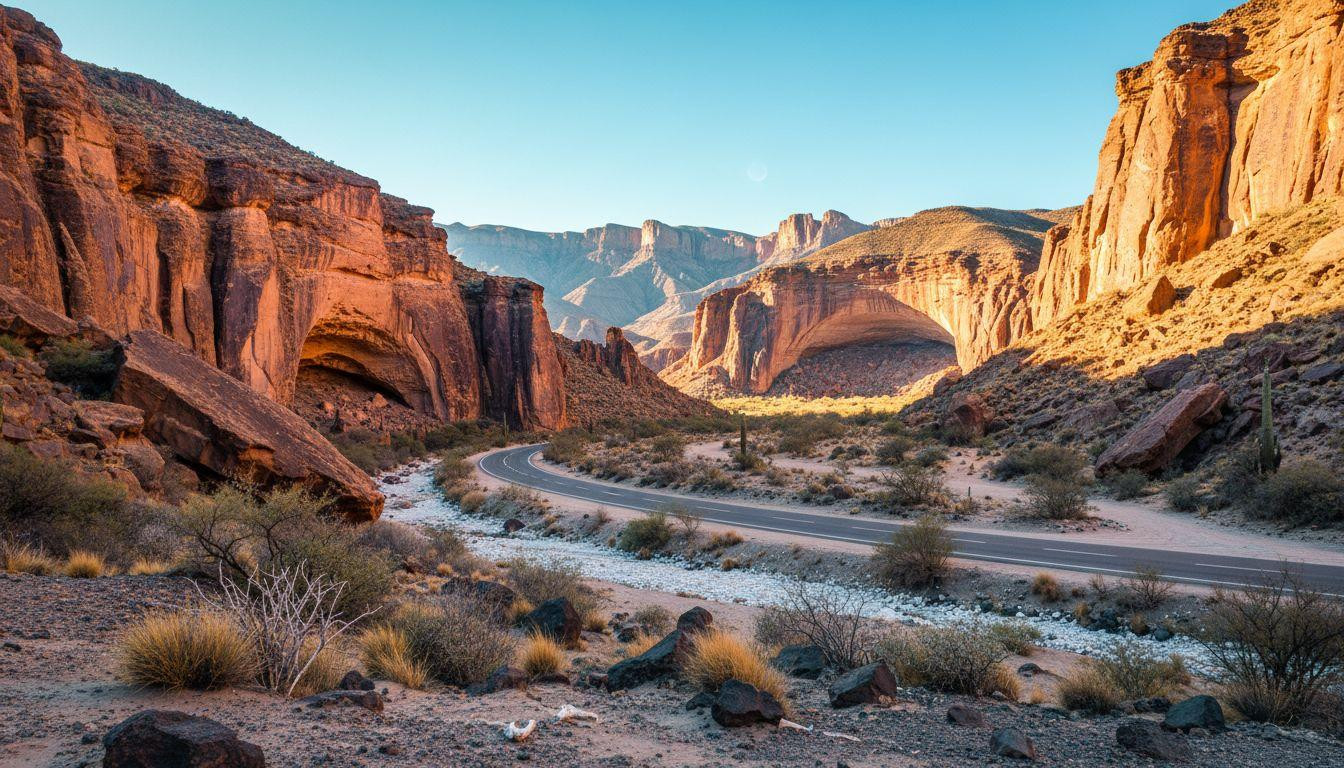
Antelope Canyon charges $85 to $225 per person for mandatory guided tours through slot canyons you explore for 20 minutes. Quebrada de Cafayate in northwest Argentina offers the same orange-red rock drama for free. Pull over whenever you want. Stay as long as you like. No crowds, no permits, no tour groups shuffling you along.
The 112-mile drive from Salta to Cafayate on Ruta 68 passes formations that rival Arizona’s most photographed landscapes. Devil’s Throat drops into a narrow canyon where iron-oxide walls glow the same burnt orange as Lower Antelope. The Amphitheater curves into a natural bowl 300 feet across. Valle Encantado’s spires rise from the desert floor like the hoodoos of Bryce Canyon.
You stop at roadside pullouts. No reservations required. No $15 Navajo Nation entry fees. The road stays open March through November when afternoon light hits the cliffs at the angle that makes cameras worthless and memories sharp.
What Antelope Canyon became
Upper Antelope Canyon books 186,000 tickets annually through tour operators who control all access. Lower Antelope adds another 150,000 visitors. Prime time slots from 9am to 3pm cost $105 to $149 per adult for 60 to 90 minutes inside. Photography tours with tripod access run $225 to $510.
You book months ahead. Pay a 20% deposit. Arrive at the exact time slot. Follow your group through the canyon. Take your photos between other people’s heads. Leave when the guide says time’s up.
Page, Arizona hotels charge $200 plus per night in season. The town exists for canyon tours. Gas stations, chain restaurants, tour company offices. The Navajo guides are professional and the formations are genuinely spectacular. But spontaneity died here around 2015 when Instagram made the light beams famous.
What Argentina’s quebrada offers instead
The landscape without barriers
Quebrada de las Conchas stretches 19 miles along Ruta 68. The formations start appearing 50 miles south of Salta. Devil’s Throat sits at kilometer 20. The Amphitheater at kilometer 25. Quebrada de las Flechas branches east toward Angastaco with arrow-shaped spires that gave the canyon its name.
Morning light hits the eastern walls around 8am. Afternoon sun warms the western faces from 3pm to sunset. No tour operator tells you which hour to arrive. Park on the shoulder. Walk to the overlook. Sit on the rocks. The only time limit is how long before you need to reach Cafayate for dinner.
The formations rise 300 to 500 feet. Wind carved them over 15 million years from the same sedimentary layers that built the Colorado Plateau. Iron oxide stains the sandstone. Manganese adds purple streaks. The geology textbook is identical. The tourist infrastructure is not.
The cost comparison that matters
Salta airport car rentals run $50 to $70 per day for economy vehicles. Gasoline for the 224-mile round trip costs $25 to $30. Two nights in Cafayate at a mid-range hostería: $80 to $120 total. Meals average $15 to $25 per person. Total two-day trip: $200 to $300 per person including lodging and food.
Antelope Canyon’s one-day experience: $87 to $149 tour plus $15 entry fee plus $200 to $300 Page hotel plus meals. Total: $350 to $550 per person for a few hours in the canyon versus two days exploring Argentina’s valleys at your own pace.
The Valles Calchaquíes region recorded 200,000 visitors in 2024 across 180 miles of canyons and wine country. Antelope’s two canyons alone see 336,000 people in a space you could walk across in 15 minutes. The math explains why one place feels like a theme park and the other still feels like a discovery.
The wine country nobody mentions
Vineyards at 9,800 feet
Cafayate sits at 5,518 feet elevation. The vineyards climb to 9,800 feet in nearby Colomé, making them among the highest wine-producing vines on Earth. Torrontés grapes grow sweeter here because UV intensity at altitude concentrates sugars. The white wine tastes like Sauvignon Blanc with apricot notes.
Bodega Puna sits half a mile from Cachi village. Tastings cost $20 to $30. The tasting room overlooks snow-covered peaks. Colomé includes a James Turrell sky observatory where the artist cut geometric openings in a concrete chamber. Light and shadow create optical illusions at sunset. Reservations required, $40 entry.
Piattelli and El Esteco offer tours through barrel rooms and vineyard walks. Most bodegas charge $25 to $40 for tastings that include 4 to 6 wines plus empanadas or cheese plates. The wine route adds a reason to linger that Arizona’s canyon country cannot match.
Villages that predate tourism
Cachi’s population holds at 5,000. Adobe houses line cobblestone streets. The central plaza has cafes where locals drink coffee at 7am before the first tourist bus arrives from Salta. A TripAdvisor reviewer from Buenos Aires wrote in July 2025 that Cachi remains “the most calm of all” compared to busier Salta and Jujuy villages.
The market sells paprika, ground chili, dried tomatoes, celery powder. Families have run the same shops since the 1950s. Seclantás, 12 miles south, specializes in handwoven ponchos. Angastaco produces goat cheese. These are working agricultural towns where tourism supplements rather than replaces the local economy.
Ruinas de Quilmes sits 30 miles from Cafayate. The pre-Columbian fortress housed 10,000 people from 800 AD until Spanish forces destroyed it in 1667. The stone foundations cover 75 acres on a hillside. Entry costs $5. You walk among the ruins alone most mornings.
The practical difference
Antelope Canyon requires advance booking, fixed time slots, mandatory guides, no tripods in standard tours, group sizes set by operators, and departure when your hour ends. Quebrada de Cafayate requires a rental car, a map, and the ability to pull over when something catches your eye.
One system maximizes revenue per visitor. The other assumes you can handle a self-guided experience. The formations photograph equally well in both places. The experience of being there differs completely.
Your questions about Quebrada de Cafayate answered
When should I visit to avoid crowds?
March through May and September through November offer dry weather, mild temperatures of 68°F to 77°F, and the lowest visitor counts. Avoid December through February when summer rains close roads. Peak season runs June through August during Argentina’s winter school holidays, but even then the roadside stops rarely feel crowded. Weekday mornings see the fewest vehicles.
Do I need a guide or can I drive myself?
The route requires no guide. Ruta 68 is paved and well-marked. GPS coordinates for Devil’s Throat: -25.9833° S, -65.7833° W. Cell service works intermittently. Download offline maps before leaving Salta. Most formations have small parking areas and walking paths. The drive from Salta takes 3 to 4 hours without stops, 5 to 6 hours if you explore each formation.
How does this compare to other South American destinations?
The Quebrada offers similar geology to Bolivia’s Valle de la Luna near La Paz but with better road access and wine culture. Chile’s Atacama Desert provides more dramatic scale but costs 40% more for accommodations and tours. Albarracín in Spain shares the colorful rock formations in a quieter setting, while Iran’s Takht-e Soleyman offers ancient desert landscapes with similar isolation. For direct canyon alternatives, Vermilion Cliffs in Arizona provides free access to wave rock formations. If you prefer self-guided coastal adventures, Nusa Penida near Bali delivers turquoise coves for similar costs.
The road curves through the Amphitheater around 4pm when western light turns the walls copper. No one rushes you. No group waits behind. The silence here sounds different than the silence between tour groups at Antelope. One is natural. The other is scheduled.