Amsterdam’s 20 million annual visitors create canal gridlock and museum queues stretching for hours. Rotterdam sits 47 miles south with the same Dutch culture at 25% lower prices. Europe’s architecture capital trades gabled houses for bold geometric innovation. This working port delivers authentic Netherlands experience without tourist performance.
Why Amsterdam disappoints architecture fans
Amsterdam’s historic center feels like a theme park. Canal boats bump into each other while tourists take selfies. Museum queues stretch 2+ hours at Van Gogh and Rijksmuseum during peak season.
Accommodation starts at $110-275/night for basic hotels. The Red Light District now serves as backdrop for tourist photos. Authentic local life retreated to outer suburbs decades ago.
Cruise ships dump 5,000+ visitors daily into the compact center. Bikes clash with pedestrians on narrow cobblestone streets. Like Venice’s gondola gridlock, Amsterdam’s canals prioritize tourism over livability.
Meet Rotterdam’s modernist revolution
Bold architectural landscape
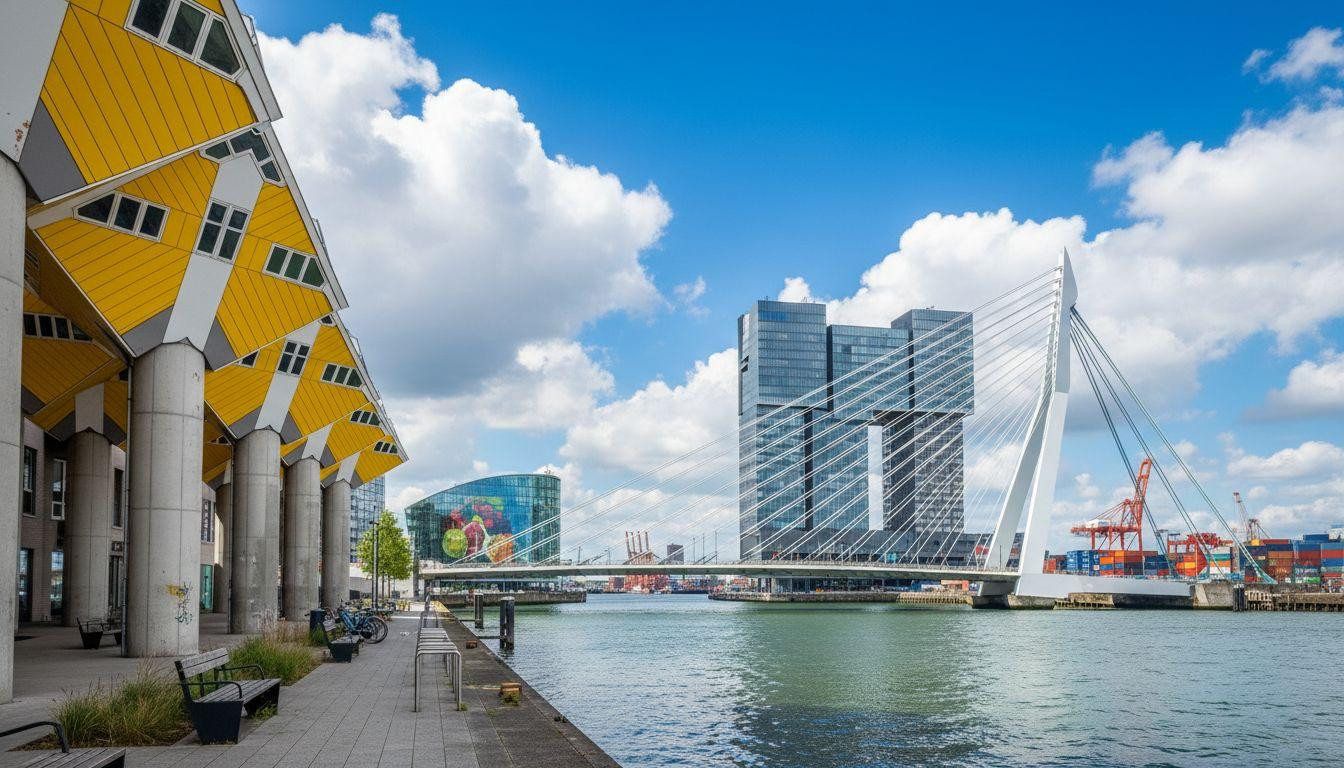
Cube Houses tilt 45 degrees like yellow geometric trees. Architect Piet Blom designed 39 tilted homes as an urban forest. Only two units open for public tours at the Kijk-Kubus Museum House.
Markthal spans 2,500 square feet with Europe’s largest ceiling mural. Giant fruits and vegetables arch over 100 multicultural food stalls. The building integrates market, apartments, and underground parking in one bold structure.
Erasmus Bridge stretches like a white harp across the Maas River. Locals call it “The Swan” for its graceful cable-stay design. Working port cities maintain authentic maritime character that tourist destinations lose.
Price comparison that matters
Rotterdam accommodation ranges $65-100 for hostels and $110-165 for mid-range hotels. Amsterdam’s equivalent costs $110-275 and $175-385 respectively. The difference funds extra travel days.
Harbor tours cost $17-22 compared to Amsterdam’s canal boats at $25-35. Cube House museum entry: $3.30. Climbing the Euromast tower: $17. Many architectural walks remain free.
Average meals cost $17-27 with herring stands at $5.50 and Markthal stalls at $11-17. Rotterdam’s multicultural port legacy created diverse food scenes without tourist markups.
The authentic Rotterdam experience
What to do differently
Walk through tilted Cube Houses where residents chose open-mindedness over conventional living. The museum house reveals how tilted walls affect daily life. Furniture must be custom-built for angled rooms.
Harbor boat tours reveal Europe’s largest port handling 450 million tons of cargo yearly. Container ships from 80+ countries dock daily. The industrial scale dwarfs Amsterdam’s decorative waterways.
Architecture walking tours connect Witte Huis (Europe’s first skyscraper from 1898) to Rem Koolhaas’s De Rotterdam vertical city. Medieval architecture contrasts dramatically with Rotterdam’s postwar modernism.
Food culture without tourist traps
Indonesian rijsttafel restaurants serve colonial-era rice tables at neighborhood prices. Fresh North Sea kibbeling (battered fish) comes from working trawlers, not tourist boats.
Markthal vendors represent 30+ nationalities reflecting the port’s international connections. Turkish döner, Surinamese roti, and traditional Dutch stamppot coexist authentically. Prices remain local because locals still shop here.
Coffee culture emphasizes quality over Instagram appeal. Neighborhood cafés serve working professionals, not selfie-seeking tourists. Coastal European cities maintain distinctive food traditions when tourism doesn’t overwhelm them.
Why Rotterdam works for architecture fans and expats
Rotterdam rebuilt from scratch after 1940 bombing destroyed 80% of the city center. Bold modernist architects created experimental designs impossible in preserved historic centers. The result feels like living in an architecture museum.
Direct Dutch communication style flourishes without tourist performance pressure. Locals engage authentically because their city wasn’t designed for visitors. Expats integrate more easily in working cities than tourist destinations.
April-June and September-October offer mild weather with minimal crowds. Hotel prices drop 20-30% during shoulder seasons while Amsterdam maintains peak pricing year-round. Photography conditions improve without tourist hordes blocking architectural details.
Your questions about Rotterdam’s advantages over Amsterdam answered
How much cheaper is Rotterdam really?
Accommodation costs 20-40% less than Amsterdam across all categories. Monthly expat living expenses average $2,145-2,420 in Rotterdam versus $2,695-3,080 in Amsterdam. Restaurant meals, transport, and activities maintain similar savings ratios. Dutch hotel taxes apply equally to both cities.
Does Rotterdam offer the same Dutch cultural experience?
Rotterdam provides identical Dutch customs, language, and colonial food heritage without tourist performance aspects. The city emphasizes authentic multiculturalism from its international port connections. Traditional Dutch architecture exists but doesn’t dominate like Amsterdam’s preserved canal district.
How does Rotterdam’s modern architecture compare to other cities?
Rotterdam ranks alongside Bilbao and Chicago for bold contemporary urban design. The postwar reconstruction created concentrated modernist experimentation unmatched in Europe. Unlike Bilbao’s single Guggenheim focus, Rotterdam integrates innovative architecture throughout the city center.
Morning light transforms Rotterdam’s glass towers and geometric shapes into shifting sculptures. Harbor cranes create industrial poetry against modernist skylines. This port city chose bold reinvention over nostalgic reconstruction.