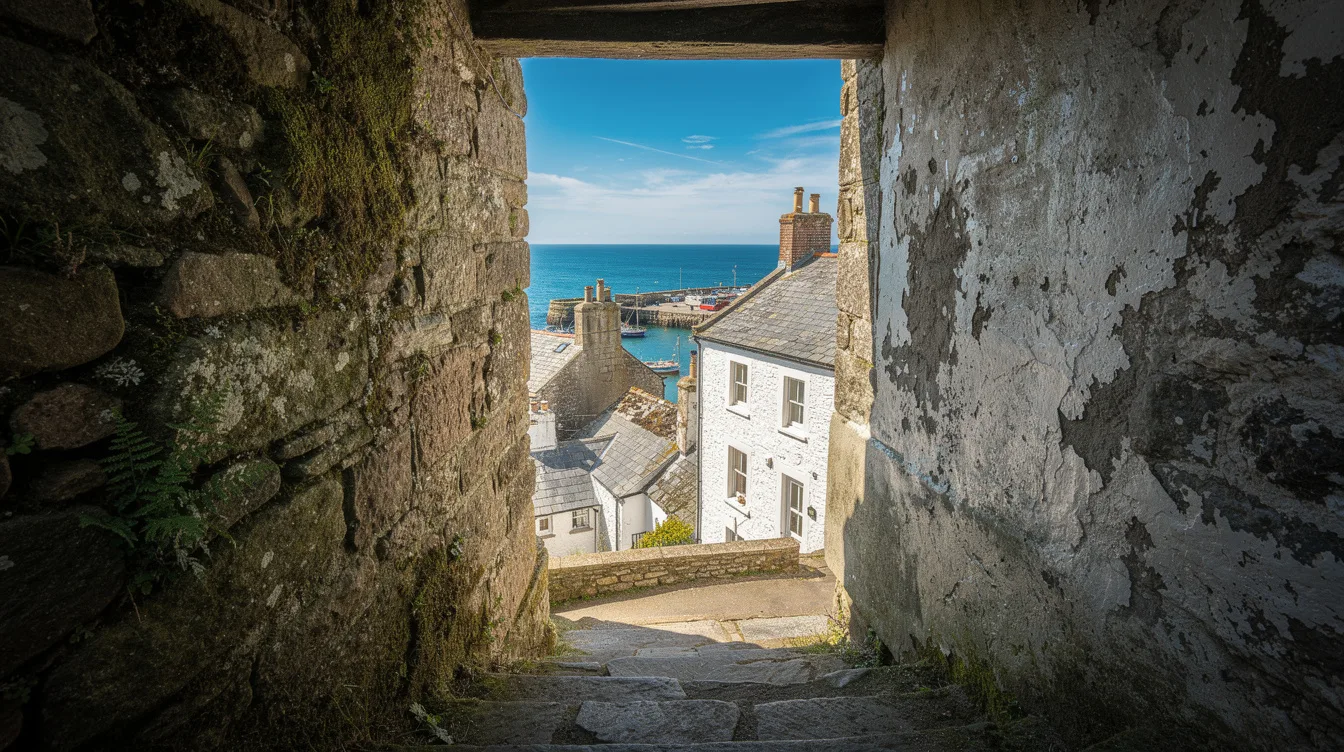
Port Isaac is easy to mistake for a television set, which is exactly why you should keep walking. Its central lanes tighten into Temple Bar, known locally as Squeeze-belly Alley.
The title isn’t a metaphor. This actual passage through the village entered the Guinness book in 1978, and you’ll understand its nickname before you reach the far end. Whitewashed walls press close, footsteps echo off stone, and the sea seems suddenly farther away.
The alley is the point, but don’t rush it
Temple Bar works because Port Isaac was built around a working harbor rather than designed for visitors. Narrow streets once carried goods through the old center, so the village still feels compressed and practical. Squeeze-belly Alley is amusing, but it also explains the place.
But don’t treat it as a quick photo stop. Pause at the entrance, let people pass, and notice how fast the light changes between the walls. You’re walking through a village whose harbor economy once moved coal, wood, stone, salt, pottery.
The passage is small, yet it gives Port Isaac its best argument against more polished coastal stops. It can feel crowded when visitors bunch up near the harbor. Still, a few turns beyond the obvious lane, the noise drops to gulls, doors closing, and shoes on uneven ground.
At the Platt, fishing is still part of the view
The harbor, called the Platt, is where Port Isaac makes sense. Boats sit against the rocky shoreline, cottages rise steeply above them, and fishermen still land fish, crab, and lobsters here. You don’t need an itinerary to enjoy it.
You need time to watch.
And that active fishing identity matters. Tourism became the village’s main economic force after World War I, but the harbor has not become a decorative backdrop. The smell of salt and wet rope keeps the scene grounded, even when cameras crowd the edge.
There are roughly 90 listed buildings in the harbor conservation area, which is why the center feels coherent rather than curated. The old core dates largely from the 18th and 19th centuries. It is handsome, but its tight corners can make a slow walk feel necessary.
Doc Martin brought fame, not a different village
For many visitors, the first recognition comes from Doc Martin. Port Isaac provided the backdrop for the ITV series from 2004-2022, appearing as the fictional village of Portwenn. Fern Cottage was used as the doctor’s home.
But the show is only one layer here. If you follow filming spots too closely, you can miss the harbor’s older rhythms and the plain pleasure of wandering. Look up from the screen memory.
The village is more interesting when it is not trying to perform for you.
You may also hear about Fisherman’s Friends, the sea-shanty group associated with the village. Check the local events calendar if live performances matter to you. Otherwise, let the soundscape stay simple: water against stone, a boat engine, voices bouncing through a lane.
The walk down is easy. The return asks more.
Parking sits above the village because the streets below are extremely narrow. From the Main Car Park or New Road Car Park, expect a 5-10 minute downhill walk to the harbor. That descent is pleasant.
The climb back asks for steadier legs.
And that’s a useful filter. Port Isaac is best approached as a compact half-day stop, not a place to conquer on a packed schedule. Go early or later in the afternoon, especially in summer, when the harbor is less busy and the lanes have room to breathe.
The village is most practical by car. The nearest mainline station is Bodmin Parkway, around a 40-minute drive away, and the route into Port Isaac uses the A39, B3314, and B3267. Once you arrive, leave the car above and accept the walk.
Beyond the alley, follow the coast slowly
Port Gaverne, immediately nearby, offers a quieter extension with coastal views, swimming, and pub stays. It is a good counterweight to Port Isaac’s compact center. You can also use the South West Coast Path for shorter local walks or longer ambitions.
The full National Trail runs 630 miles, but nobody needs to take on that scale to get the point. Start from the harbor, follow the coast for as long as your knees and the weather allow, then turn back before the village lights begin to glow.
By the time you return through Temple Bar, the walls hold the day’s last warmth, and the harbor below sounds farther off than it did before.